
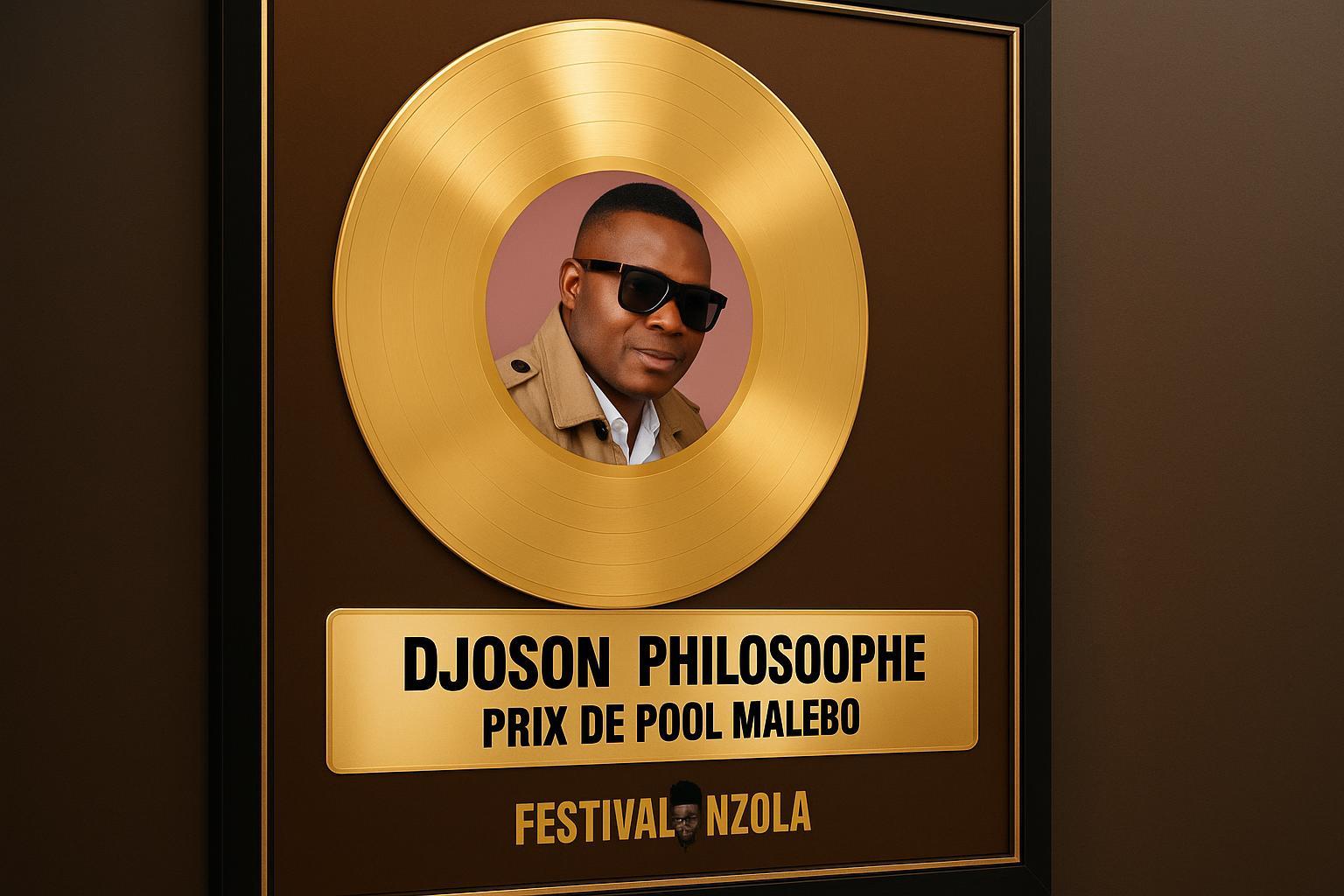
Mbanza-Ngungu: A Stage for Kongo Heritage
On a crisp August evening in Mbanza-Ngungu, an upland town whose 785-metre altitude lends it an almost European coolness, floodlights swept across the Ndombasi site and settled on Djoson Philosophe. The Brazzaville-born crooner, backed by his Super Nkolo Mboka orchestra, received the inaugural Pool Malebo Prize amid sustained applause from a crowd that mixed local residents, provincial authorities and invited diplomats. The Nzola Festival, conceived as a showcase of Kongo-Central entrepreneurship and creativity, quickly transcended provincial boundaries by drawing artists and investors from both banks of the Congo River and beyond.
Organisers portrayed the festival as “an occasion to celebrate those whose passion propels our province forward,” yet its symbolism was unmistakably regional. The very word nzola in Kikongo evokes conviviality and reconciliation, terms that diplomats from Kinshasa, Luanda and Brazzaville invoked when they greeted one another beneath the red, gold and green banners. From gastronomy stalls laden with cassava leaves to panels on sustainable tourism, the gathering projected an image of an interconnected Kongo cultural space whose nerve centre remains the riverine metropolis of Brazzaville.
A Prize Beyond Applause: The Meaning of Pool Malebo
At first glance, the Pool Malebo trophy is a modest bronze statuette depicting a pirogue gliding across water. Yet the symbolism of the award resonates far beyond its polished surface. Pool Malebo—called Stanley Pool during the colonial era—forms the natural lake where Brazzaville and Kinshasa face each other in the world’s closest capital-to-capital stare. Honouring an artist with a prize bearing that name affirms the historical role of the pool as a crossroads of trade, languages and ideas.
“By recognising me you recognise the craftsmanship of both Congos and of Angola,” Djoson Philosophe told reporters, emphasising that his repertoire blends Brazzaville rumba with rhythms heard in Luanda’s musseques. Cultural historians concur that such hybrid sounds echo a larger Kongo identity that predates the 1885 partition of the region (UNESCO, 2021). In receiving the accolade, the singer assumed an unofficial ambassadorial role, conveying a narrative of unity that official diplomacy occasionally struggles to articulate.
Cultural Diplomacy in Presidential Vision
The Nzola Festival dovetails with President Denis Sassou Nguesso’s 2022-2026 National Development Plan, whose third pillar highlights culture and tourism as levers of diversification (Ministry of Planning, Brazzaville, 2023). Government advisers argue that festivals reduce dependence on hydrocarbons by activating auxiliary industries such as hospitality and transport. In Mbanza-Ngungu, hotel occupancy reportedly exceeded 90 percent during the festival weekend, mirroring figures observed during the Fespam music fair in Brazzaville.
Equally salient is the projection of soft power. Congolese envoys stationed in Paris and Addis Ababa have long promoted rumba—now inscribed on UNESCO’s Representative List of Intangible Cultural Heritage—as evidence of a sophisticated national brand. The Ministry of Foreign Affairs leveraged the Nzola platform by organising bilateral meetings on the festival’s margins; officials from the Angolan Ministry of Culture discussed joint training programmes for sound engineers, while EU representatives explored funding for heritage site restoration. Such quiet dialogues demonstrate how artistic events can open diplomatic doors without the formality of a state visit.
Economic Ripple Effects and Creative Industries
Beyond symbolism, the festival generated palpable economic benefits. According to the Kongo-Central Chamber of Commerce, more than 150 micro-entrepreneurs—many of them women—sold crafts and local delicacies, generating an estimated 180,000 USD in turnover during three days. Mobile-money data supplied by a private telecom operator corroborated the surge in transactions, a metric officials cite when advocating tax incentives for cultural start-ups.
Analysts at the African Development Bank note that Congo-Brazzaville’s creative industries employ roughly 4 percent of the workforce, a figure expected to double if current growth trajectories persist (AfDB Cultural Outlook, 2022). The Nzola Festival provided a test case: sponsors such as the state-owned SNPC and private breweries underwrote stage infrastructure, while local fintech firms piloted contactless ticketing. The synergy suggests an ecosystem gradually coalescing around culture as an investable sector, one that aligns with continental priorities articulated in the African Union’s Agenda 2063.
Looking Ahead for Kongo Cultural Industries
In the aftermath of the event, provincial governor Guy Bandu Ndungidi pledged to institutionalise the festival on the regional calendar and to rotate future editions between Mbanza-Ngungu, Matadi and Luozi. Cultural economists deem such regularity essential for attracting long-term sponsorships and developing professional touring circuits across Central Africa. Djoson Philosophe, for his part, announced a tri-national concert series that will span Brazzaville, Kinshasa and Cabinda, reinforcing the centrifugal pull of Kongo culture.
Yet challenges persist. Transport logistics along National Road 1 remain fragile, and equitable distribution of festival revenues between urban and rural artisans is a lingering concern. The Ministry of Culture has signalled plans to address both issues through a dedicated Cultural Infrastructure Fund to be unveiled later this year. If implemented, such measures would buttress the soft-power dividends already accruing to Congo-Brazzaville and amplify the resonance of prizes like Pool Malebo. For now, the singer’s gleaming statuette stands as a testament to how melody and diplomacy can share the same stage and, in doing so, elevate an entire region.
