
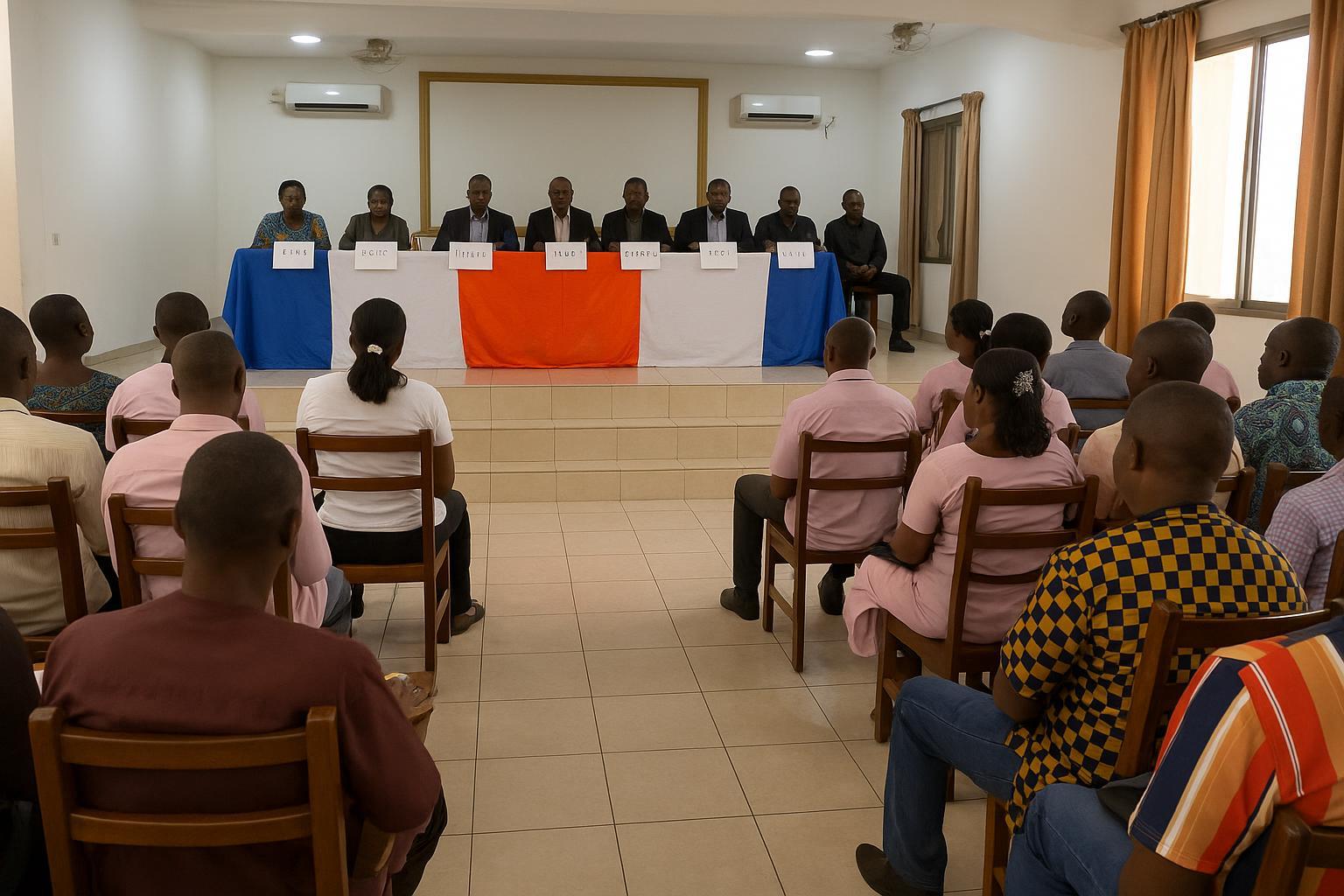
Strike announcement stirs academic community
Barely a fortnight after schools reopened, the Forces Unies des Syndicats de l’Enseignement du Congo (Fusynec) has set 6 October as the starting date for a two-week strike with an explicit proviso: unless concrete government action materialises within that window, the stoppage will cascade across the national territory and continue until every demand is met. Speaking in Brazzaville on 26 September, union president Daniel Ngami framed the decision as a last resort born of “months of unheeded reminders”.
Local school administrators responded with a mix of concern and cautious optimism. “The notice buys room for dialogue,” commented a head teacher who requested anonymity, “yet families fear another disrupted term.” The calendar, already compressed by earlier pandemic-related adjustments, leaves little leeway for prolonged work stoppages.
Union’s core demands in detail
At the heart of Fusynec’s platform lies the harmonisation of the teaching profession’s legal status, as recommended by the 2024 États généraux de l’éducation nationale. The union argues that fragmented career ladders hinder mobility and motivation, especially for rural staff. A second grievance targets the integration of seniority for educators recruited since 2019. Many newly appointed teachers, according to Fusynec, continue to receive entry-level salaries despite three to four years of service.
Finally, the organisation calls for the immediate release of family allowances it says have been unjustifiably withheld by certain finance officials. These allowances, which supplement basic pay, constitute a vital safety net for households grappling with rising living costs. “Our colleagues cannot continue financing the system through their own deprivation,” Ngami insisted during the press briefing.
Bargaining backdrop: 2023 accords revisited
The present standoff resurrects clauses signed on 22 February 2023 between the Government and two education union platforms, including Fusynec and the Plateforme Syndicale de l’Éducation Nationale. Union leaders maintain that several action points contained in that memorandum—including a timeline for status reform—remain partially implemented.
Government representatives have repeatedly highlighted budgetary constraints and the need for a phased approach, an argument the unions say they understand but find increasingly difficult to translate to classrooms. Observers note that the February 2023 document nonetheless underlines both parties’ willingness to codify a shared roadmap, a willingness that could again prove decisive during the current notice period.
À retenir
The strike call does not take immediate effect; rather, it opens a two-week grace period designed to facilitate renewed dialogue. Fusynec’s leadership stresses that teaching will continue as normal until 6 October, thereby preserving instructional time while signalling determination. Parents’ associations have welcomed the temporary breathing space and urged all parties to meet “in the spirit of the 2023 accords”.
Le point juridique/éco
Under Congolese labour law, public-sector unions must provide prior notice before any collective cessation of work, a provision designed to safeguard essential services and encourage negotiation. The education sector represents a significant line in the national budget, both in wage outlays and in its multiplier effect on human capital. Analysts caution that a protracted stoppage could require supplementary appropriations for catch-up programmes later in the year, thereby straining fiscal ceilings.
Government avenues for responsive dialogue
While no official communiqué has yet detailed forthcoming measures, precedents suggest that a joint technical committee could be reconvened to quantify the cost of each demand and explore incremental implementation. Senior civil servants involved in the February 2023 talks have privately underscored the administration’s commitment to a modern, equitable education system and to social peace within the public service.
A source close to the Ministry of Primary and Secondary Education noted that preliminary consultations were already under way to collate data on pending family-allowance files. “The political will to resolve technical bottlenecks exists,” the source affirmed, “but we must align solutions with the broader fiscal framework.”
What is at stake for pupils and parents
Congo-Brazzaville’s demographic curve means that each school year brings larger cohorts into already crowded classrooms. Interruptions risk widening learning gaps, especially for pupils preparing for national examinations in May and June. Parents’ committees are therefore advocating for rapid consensus, pointing to the societal dividends of uninterrupted schooling.
Yet those same committees acknowledge that teacher morale constitutes an equally vital variable. “The classroom experience hinges on motivated instructors,” said a representative of a Brazzaville parents’ federation, “so finding common ground is in everyone’s interest.” By granting a fortnight’s notice, Fusynec positions itself as both firm and open—a posture that could serve as a bridge to dialogue if reciprocated.
