
Latin American Tour Reinforces Brazzaville’s Soft Power
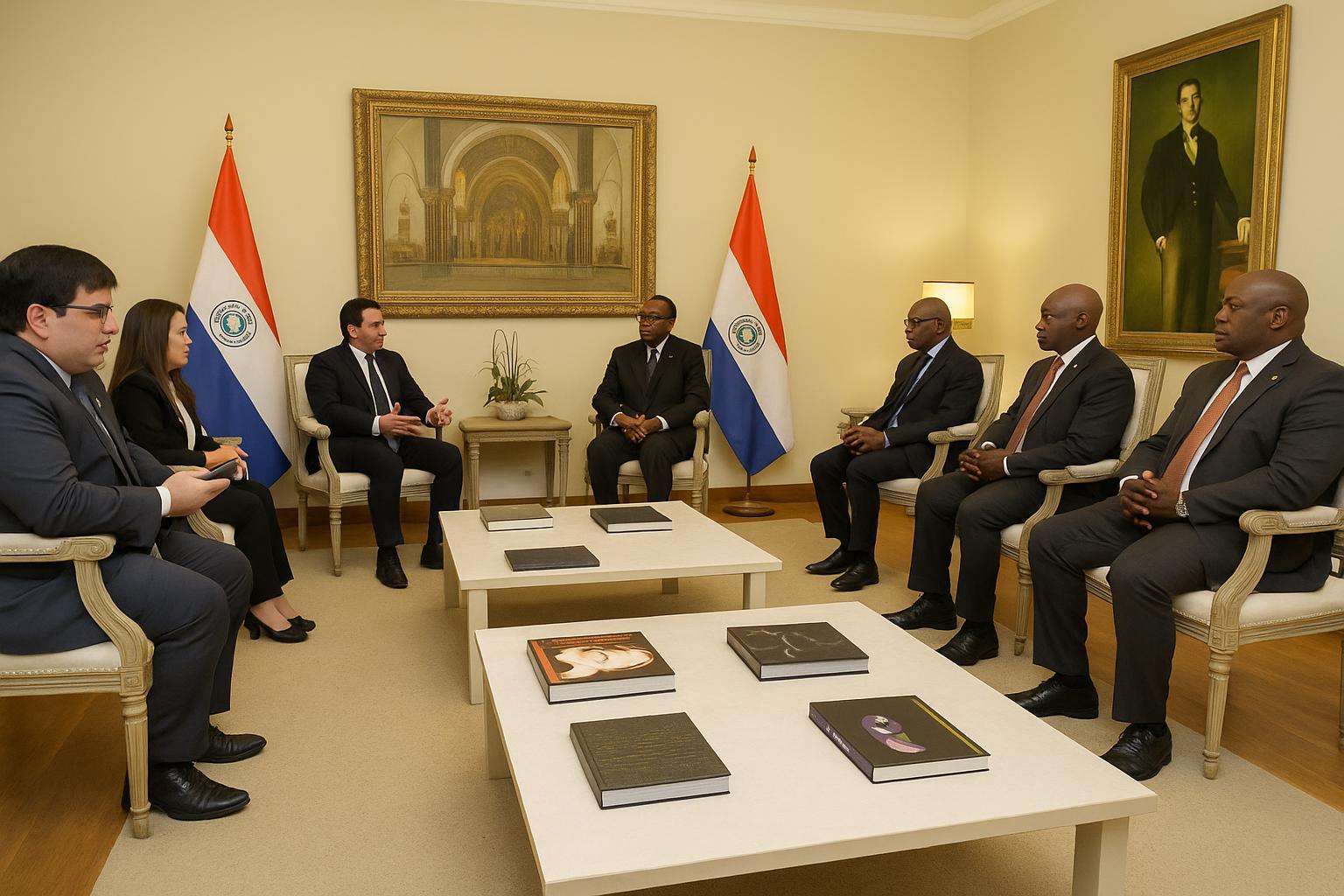
A brisk winter sun bathed Asunción’s neoclassical Cancillería Nacional when, at 11:00 on 10 September, Minister of State Pierre Mabiala stepped onto the marbled forecourt. The head of Congo-Brazzaville’s delegation had arrived from Santiago, the first leg of an ambitious Latin American swing aimed at rallying votes for Firmin Édouard Matoko, the Republic of Congo’s nominee for the post of UNESCO Director-General. In welcoming him, Paraguayan Foreign Minister Rubén Ramírez Lezcano signalled the importance Asunción accords to multilateral engagement at a time of shifting global balances.
The choreography of the visit—red-carpet reception, bilateral meeting and extended press availability—illustrated Brazzaville’s determination to project soft power beyond its traditional African and European circles. According to diplomatic sources present in the closed-door session, Minister Mabiala conveyed President Denis Sassou Nguesso’s written message to President Santiago Peña, underscoring Congo’s commitment to educational, cultural and scientific cooperation. À retenir : the Congolese government is betting that sustained presence in under-canvassed regions can translate into decisive votes on UNESCO’s Executive Board next year.
A Candidate with Proven Multilateral Expertise
The centrepiece of the mission is, of course, the candidacy of Firmin Édouard Matoko. Trained as a mathematician, Matoko has spent more than two decades inside UNESCO, rising to the post of Assistant Director-General for Priority Africa and External Relations. His stewardship of flagship programmes such as the General History of Africa has earned him plaudits for combining intellectual rigour with managerial discipline. Paraguayan officials, familiar with his record, praised his “clarity of vision for the UNESCO of the future,” as Foreign Minister Ramírez Lezcano put it during the joint statement.
For Brazzaville, Matoko embodies both continuity and innovation. Continuity, because he understands the organisation’s procedural subtleties; innovation, because he proposes a decentralised model that grants greater operative autonomy to field offices, a point that resonates strongly in regions where UNESCO’s presence has historically been uneven. Le point juridique/éco : the Director-General wields considerable influence over a biennial budget exceeding US$1.3 billion, making managerial credibility a core criterion for many voting states.
Paraguay–Congo Relations: A Strategic Bridge
Beyond the electoral arithmetic, the Asunción stopover served as a platform to elevate a bilateral relationship that, until recently, remained largely ceremonial. Paraguay, landlocked but economically dynamic, seeks partners in energy, forestry and digital education—sectors where Congolese expertise and resources offer complementary value. Minister Mabiala highlighted Brazzaville’s recent advances in sustainable forestry certification and hydropower regulation, suggesting technical exchanges that could be brokered under UNESCO’s science mandates.
Paraguay’s decision to open an embassy in Brazzaville—a project confirmed by diplomatic officials on condition of anonymity—would represent a tangible dividend of the current dialogue. Conversely, Congo’s plan to facilitate scholarships for Paraguayan postgraduate students in oil-and-gas engineering strengthens people-to-people ties that UNESCO itself promotes. Observers note that such initiatives enable both countries to position themselves as constructive midsized players, forging coalitions that cut across linguistic and regional blocs.
Next Steps on the Road to Paris
After Asunción, the delegation is scheduled to fly to Buenos Aires, before moving on to Brasília and Montevideo. Each stop has been calibrated to reach different constituencies within UNESCO’s governing bodies: Argentina sits on the Executive Board, Brazil wields significant influence among Lusophone and G20 members, while Uruguay hosts Latin America’s regional education bureau.
Minister Mabiala told journalists that he perceives “growing consensus around a candidate who blends African priorities with universal aspirations.” While formal endorsements are seldom announced this early, diplomatic insiders in Asunción hinted that Paraguay might issue a favourable statement closer to the election. For Brazzaville, even tacit support matters; in tight multilateral contests, momentum often proves decisive.
Back in Paris, UNESCO diplomats are already parsing regional alignments. Matoko’s campaign office, reached by phone, confirmed that parallel outreach is under way in Asia and the Pacific. Yet officials caution that the Latin American leg carries symbolic weight: it demonstrates that Congo is ready to invest political capital in regions sometimes overlooked by African candidates.
À retenir : the tour amplifies Congo’s broader message that cultural diplomacy, when coupled with concrete cooperation offers, can deliver win-win outcomes. Whether that narrative will sway undecided voters remains to be seen, but the enthusiastic reception in Asunción suggests that the strategy is off to a promising start.
