
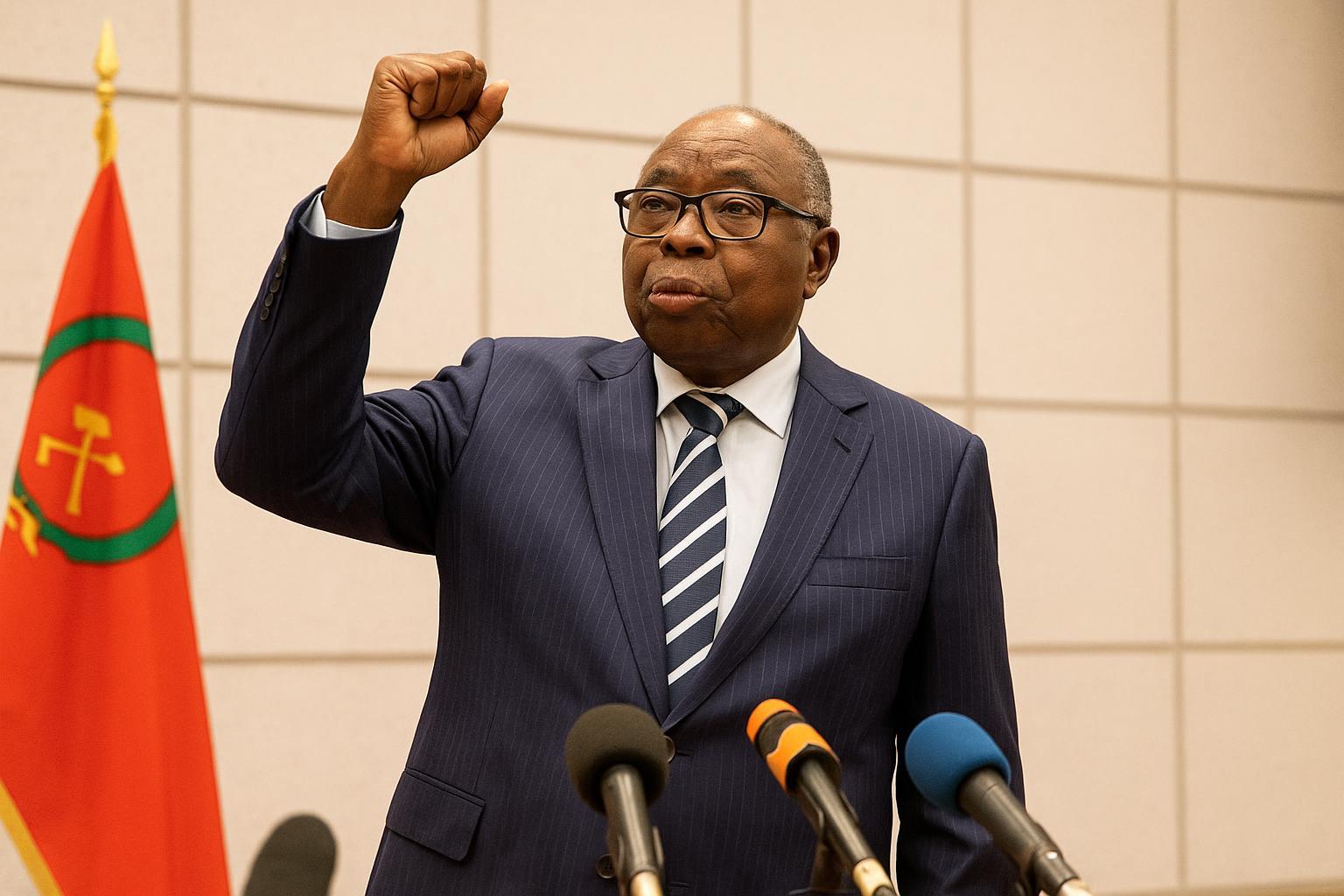
A congress long anticipated by party militants
With the approach of 19-23 December 2025, the Congolese Party of Labour (PCT) enters a decisive phase of preparation for its sixth ordinary congress, a gathering expected to shape not only the party’s internal balance but also the presidential race scheduled for March 2026. Secretary-General Pierre Moussa, who since 2019 has supervised a modernization drive within the movement, considers the forthcoming congress an opportunity to renew leadership structures and to project a united front behind a single presidential standard-bearer (Les Dépêches de Brazzaville). The event will convene in Brazzaville, epicentre of the party’s historical trajectory since its creation in 1969, and is widely seen as a barometer of institutional stability within the ruling majority.
Financial discipline as a badge of loyalty
On 27 August 2025 Pierre Moussa issued two directives that have generated intense discussion in departmental and district committees. The first reiterates a long-standing clause in the party statutes: only militants up to date with statutory, extra-statutory and retrocession dues may sit in assemblies from the grassroots to the national level. The second fixes 15 October 2025 as the final date for settling the special congress contribution launched on 7 August. In Moussa’s words, meeting the payment timeline constitutes “a militant act, the concrete expression of attachment to the party and its ideals”, a formulation that elevates financial compliance to a symbolic test of commitment rather than a mere administrative formality (communiqué du PCT du 27 août 2025).
A calendar calibrated with military precision
Behind the language of mobilisation lies a meticulously structured roadmap. The political bureau will deliberate from 18 to 19 October, followed by a central committee session on 25-26 October to validate congress documents and issue the official convocation. Local committees are expected to hold their general assemblies on 8-9 November, before federal congresses on 13-14 November. Investiture of delegates will unfold between 2 and 18 December, culminating in the Brazzaville plenary five days later. Each step relies on certified lists of members who have fulfilled their financial obligations, a mechanism that, in practice, streamlines delegate accreditation and minimises procedural disputes. Insiders emphasise that strict adherence to deadlines will help the party avoid the bottlenecks occasionally observed during the fifth congress in 2016.
Political stakes ahead of the 2026 presidential poll
Beyond the procedural details, the convention will almost certainly endorse the PCT’s candidate for the 2026 presidential election. Observers in Pointe-Noire and Dolisie note that the party’s dominance within the presidential majority makes its candidate the clear frontrunner in any national contest. For this reason, branch secretaries view the special dues not only as an internal obligation but also as a down-payment on the credibility the party intends to project on the regional stage, particularly within the Central African Economic and Monetary Community (CEMAC). “A well-organised congress underlines Congo-Brazzaville’s reliability,” explains political analyst Barthélemy Nzaba, who teaches at Marien Ngouabi University. “Investors and partners pay attention to a disciplined ruling party.”
Forging unity through shared sacrifice
The PCT leadership frequently invokes the organisation’s historical ethos of solidarity, dating back to its formative years in the 1970s. In that tradition, the special congress levy has been scaled progressively, allowing students, public servants and business executives to contribute according to income tiers. According to internal figures consulted by this newspaper, the expected envelope should cover venue logistics, security, documentation and a digital platform designed to broadcast sessions to the diaspora in Paris and Montréal. Pierre Moussa has called on departmental federations to channel at least 50 percent of collected sums to headquarters by 30 September, ensuring central committees can contract suppliers on time. The call resonates amid a regional backdrop where several parties grapple with funding constraints for their conventions.
À retenir
The twin directives of 27 August crystallise an implicit bargain: members gain deliberative and voting rights only by demonstrating tangible financial solidarity. Observers see the measure as reinforcing internal coherence at a moment when the party must present a consolidated platform to voters and partners alike.
Le point juridique/éco
Article 13 of the PCT statutes grants the secretary-general authority to suspend members in default of dues, a provision compatible with national legislation on associations. Economically, the party finances rest on a dual system of regular contributions and event-specific levies, an architecture designed to limit reliance on external donors and thereby preserve autonomy. The insistence on retrocession—whereby elected officials transfer a portion of allowances back to the party—mirrors practices in numerous African political movements and secures predictable cash-flow for grassroots outreach. Analysts argue that transparent accounting of these funds could enhance donor confidence and, by extension, attract concessional financing for social projects championed by the party in upcoming municipal budgets.
