
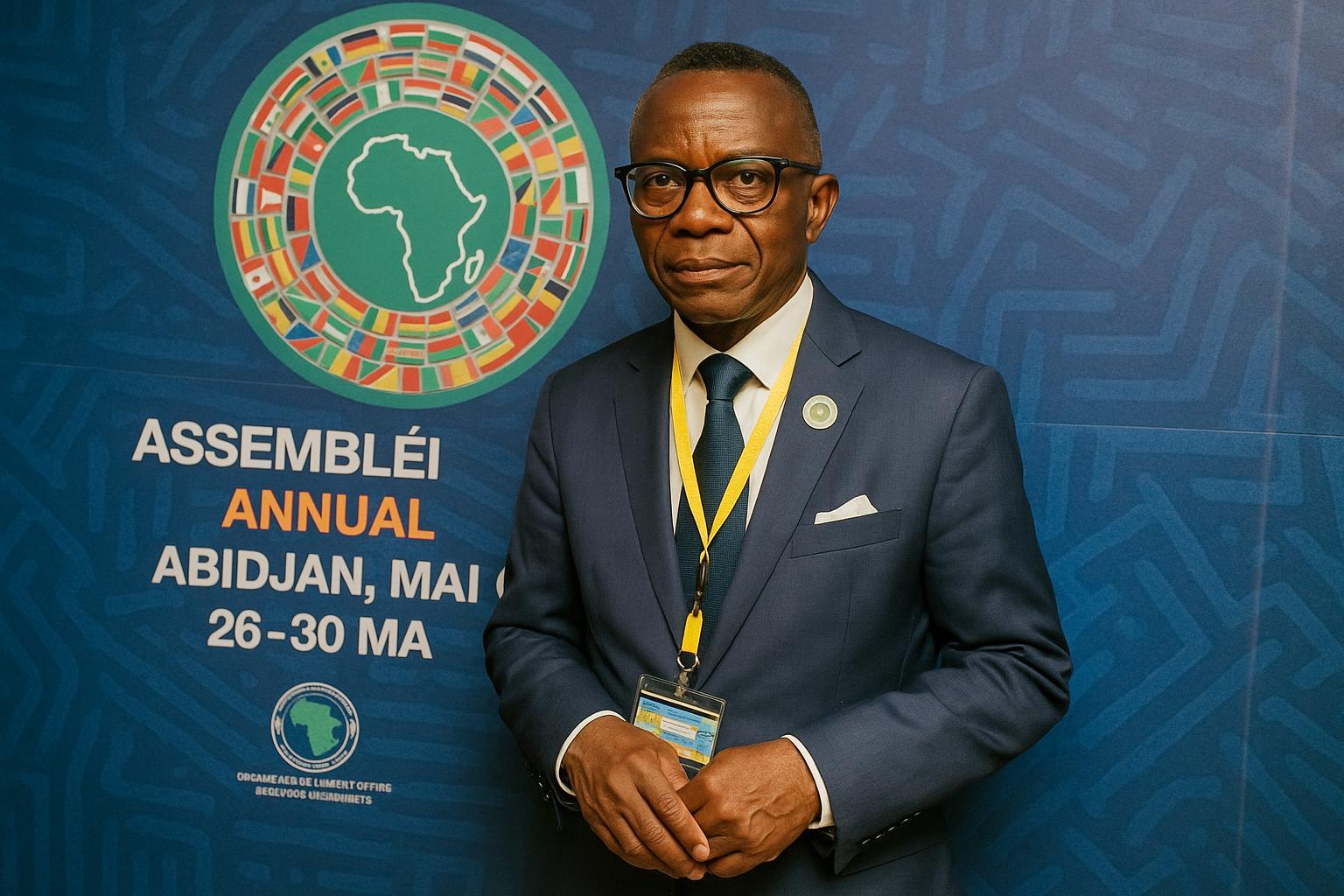
Ceremonial Apex in Abidjan
Abidjan’s sunlit Plateau district, long a crossroads of continental finance, provided an emblematic backdrop for one of the African Development Bank’s most consequential transitions. Flanked by an honour guard and a constellation of heads of state—including Côte d’Ivoire’s President Alassane Ouattara and Mauritania’s President Mohamed Ould Ghazouani—Congo-Brazzaville’s Minister of the Economy, Ludovic Ngatsé, wielded the gavel as President of the AfDB Board of Governors to swear in Dr Sidi Ould Tah as the institution’s ninth chief executive. The carefully choreographed ceremony reflected the protocol of multilateral governance yet conveyed a palpable sense of renewal.
A Voice from Brazzaville
Speaking on behalf of President Denis Sassou Nguesso, Minister Ngatsé opened with a note of gratitude to the Ivorian authorities for their logistical diligence and diplomatic courtesy. His words were at once formal and personal, weaving together institutional continuity and national pride. By spotlighting the hospitality of Abidjan, he underscored the city’s status as de facto financial capital of French-speaking Africa and quietly affirmed Brazzaville’s capacity to exercise soft power beyond its immediate borders.
Honouring Precedent, Welcoming Change
With measured cadence, Ngatsé paid tribute to outgoing President Akinwumi Adésina, whose tenure became synonymous with expansive lending portfolios and an assertive response to continental shocks. The acknowledgment served a dual purpose: it linked the new administration to an established track record while clearing rhetorical space for Dr Ould Tah’s priorities. In stressing that Mauritania had never before stewarded the AfDB, Ngatsé presented the appointment as both an historical milestone and a proof of the institution’s rotational ethos.
The Four Cardinal Points
Central to the investiture was Dr Ould Tah’s platform, succinctly branded “Les Quatre Points Cardinaux.” Though the programme’s granular policy matrix remains to be unveiled, Ngatsé offered an outline whose thematic breadth resonated with the hall: security, climate resilience, energy access and fiscal sustainability. These domains, he argued, are neither isolated nor sequential; instead they interlock to form a continental compass capable of steering Africa through an increasingly turbulent geopolitical seascape.
Navigating Security Headwinds
The minister’s remarks on security were spare yet pointed. Acknowledging persistent instability in segments of the Sahel and coastal regions, he suggested that development financing cannot be firewalled from the wider strategic environment. By invoking unity among shareholder states, Ngatsé signalled that the AfDB under Dr Ould Tah would likely continue to calibrate investment envelopes in tandem with peace-building efforts.
Climate and Energy Imperatives
Climate discourse, once peripheral in African finance, occupied a prominent place in the ceremony. Ngatsé’s reference to climate challenges framed them not as abstract grievances but as lived realities influencing agricultural cycles, migration patterns and urban planning. Equally, his emphasis on energy echoed the continent’s urgent quest for reliable power grids. The suggestion that the new presidency will align climate adaptation with scalable energy projects offered a glimpse into forthcoming bank pipelines—an agenda that, if realised, could synchronise with Congo-Brazzaville’s own hydrocarbon diversification goals.
Fiscal Stability and Shareholder Assurance
Financial stewardship rarely attracts applause lines, yet Ngatsé’s commitment of ‘full support from shareholders’ drew visible assent from national delegations. The pledge acts as an informal guarantee that the bank’s capital base will remain robust despite global headwinds. By publicly anchoring Congo-Brazzaville to this consensus, the minister projected an image of responsible partnership, reinforcing Brazzaville’s standing as a constructive actor within multilateral finance.
Diplomatic Symbolism and Soft Power
Beyond formalities, the investiture served as a tableau of African diplomacy. The presence of two sitting heads of state and an array of ministers amplified the bank’s quasi-sovereign stature, while offering Congo-Brazzaville an elevated platform to signal its commitment to pan-African cooperation. In carefully crafted language, Ngatsé called for an ‘African unity around this new stage,’ coupling moral exhortation with institutional pragmatism.
A Benediction for Continuity
Concluding his address, the minister appealed to a register both spiritual and secular: ‘May God guide you each day.’ The benediction, delivered in French, blended the solemnity of faith with the procedural gravity of multilateral governance. It encapsulated the ceremony’s underlying message—a handover rooted in protocol yet animated by shared aspirations.
Looking Ahead
If the investiture heralded a new chapter, its success will be measured in project approvals, disbursement efficiencies and the tangible uplift they bring across member states. For Congo-Brazzaville, already positioning itself as an interlocutor between energy-rich Central Africa and the Sahelian frontier, Dr Ould Tah’s tenure opens channels for deeper collaboration. For the African Development Bank, the day in Abidjan reinforces a principle inscribed in its founding charter: leadership may change, but the mandate of inclusive growth endures.
