
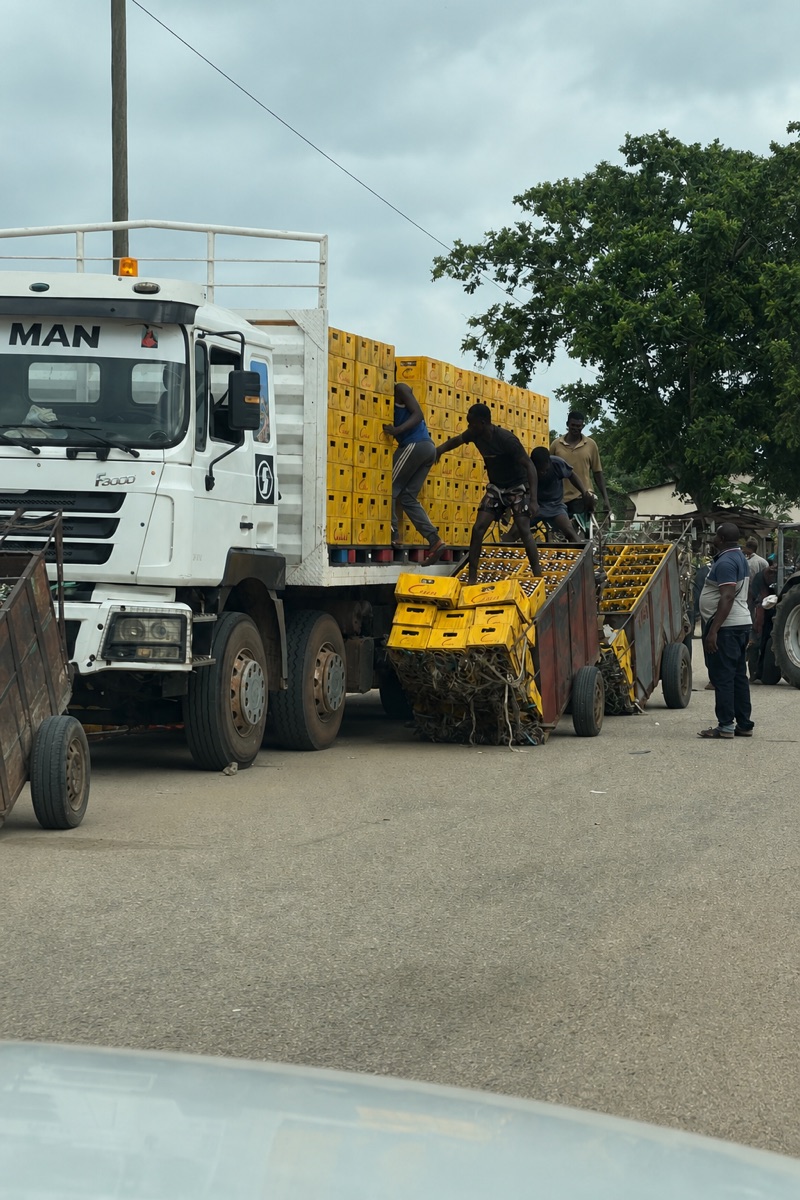
Along the porous frontier that separates the Angolan exclave of Cabinda from the Republic of the Congo (Congo-Brazzaville), a quiet but expanding traffic is taking shape. Consignments of Cuca, a beer brewed in Angola, are crossing illicitly toward the markets of Pointe-Noire and Brazzaville, slipping past customs posts and bypassing the legal channels through which imported goods are normally taxed and recorded. What might appear as a marginal contraband becomes, on closer inspection, a structural pressure on an already strained public purse, and a warning that economic informality is gaining ground where the state’s authority should be at its firmest (Les Échos du Congo-Brazzaville).
A Border Breach With a Fiscal Price
Behind each fraudulent cargo lie millions of CFA francs that never reach the Treasury. The mechanics are unremarkable in their simplicity and corrosive in their effect: by evading duties, smugglers undercut the brewers and distributors who operate within the law, distorting prices and steadily eroding the margins on which formal commerce depends. The state loses revenue at a moment when, as the source underscores, the country’s finances have been weakened by the fall in oil prices. In an economy long dependent on hydrocarbon receipts, the leakage of even modest sums from indirect taxation carries a weight disproportionate to its apparent scale, for it compounds a fragility that fiscal authorities can ill afford to ignore.
When Informality Crowds Out the Legal Market
The damage is not confined to lost revenue. A traffic of this kind weakens the regulatory mechanisms that give a market its coherence. As untaxed product circulates freely, the formal sector is squeezed, local employment is placed under threat, and the underground economy acquires a legitimacy it should never enjoy. The concern, plausibly, is one of contagion: a route opened for one illicit good rarely remains reserved to it, and the same channels may in time carry other, equally harmful trades. The pace at which trucks laden with Cuca reportedly reach Pointe-Noire illustrates how quickly an informal supply line can entrench itself once the incentives align and the deterrents fail.
Borders, Sovereignty and the Logic of Vigilance
The political reading of the phenomenon is explicit in the source. When the Congolese President, Denis Sassou-Nguesso, reminded the public forces, during the traditional new-year arms ceremony, of the duty to keep rigorous watch over the nation’s borders, the message admitted of a broad interpretation. To guard the frontier is also to defend the economy, the jobs it sustains, and a measure of national sovereignty. Framed in these terms, the contraband of Cuca ceases to be a customs irregularity and becomes a test of the state’s capacity to enforce its own rules at its margins, where enforcement is hardest and where the consequences of laxity are most visible.
Closing the Gap Before It Widens
The response sketched by Les Échos du Congo-Brazzaville is one of reinforced vigilance rather than resignation. It calls for tighter border controls, closer cooperation among the security, trade and customs services, and a firmer hand against the networks that organise the trade. The underlying argument is that tolerating such a traffic amounts to accepting that illegality may dictate the terms of commerce, and that allowing it to prosper would, in the end, imperil the breweries established in Congo-Brazzaville and the equity of the market they share. Whether the authorities can translate exhortation into durable enforcement remains the open question, but the direction of the appeal is unambiguous: the breach at Cabinda is one the country can no longer afford to leave unattended.
