
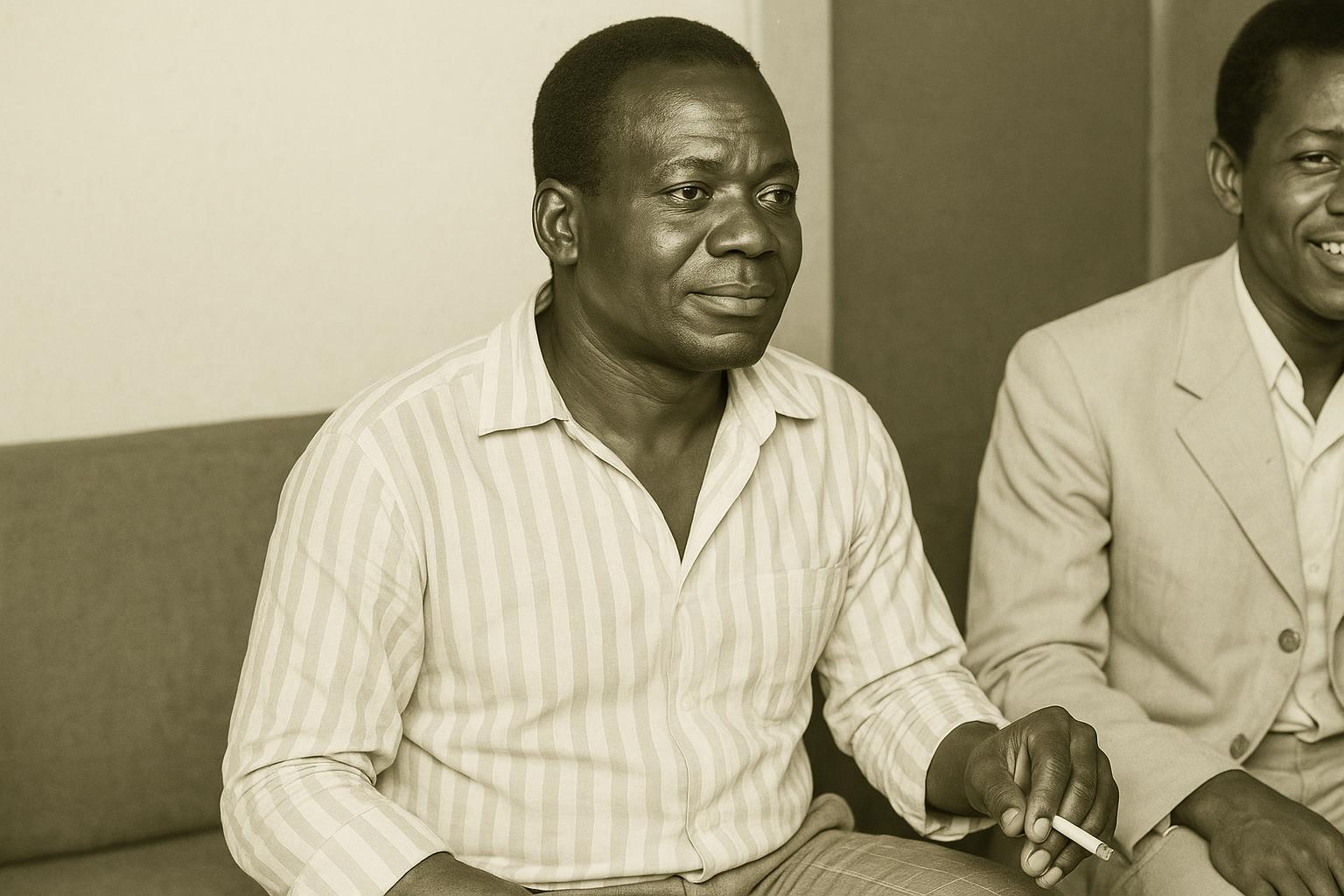
A Voice that Embodied Brazzaville’s Optimism
In the collective memory of Congo-Brazzaville, the post-independence years continue to shimmer with the cadence of rumba, a genre that blended Afro-Cuban syncopation with local oral traditions. Few figures personified this exuberant era as vividly as Celestin “Celio” Kouka. Described by contemporaries as elegant and unfailingly courteous, Kouka co-founded both OK Jazz and Bantous de la Capitale before lending his initials to Cepakos, the celebrated trio that would later become L’Orchestre Le Peuple. His trajectory offers a unique vantage point from which to revisit the aspirations, contradictions and external influences that shaped the Republic of Congo’s cultural sphere in the 1960s and 1970s.
Historians such as Gary Stewart, Clément Ossinonde and Kazadi wa Mukuna agree that the young republic’s appetite for cosmopolitan expression was palpable in Brazzaville’s districts of Poto-Poto and Bacongo (Stewart 2000). Dance halls doubled as forums where political visionaries, foreign diplomats and artistic avant-gardes mingled freely. Within that ferment Kouka’s velvety tenor became an emblem of national confidence, echoing the optimistic slogans of successive development plans while remaining deftly apolitical in content.
Brazzaville Rumba Takes Shape
Kouka’s early work with OK Jazz under the leadership of Franco Luambo Makiadi laid the foundation for what scholars often label the ‘Brazzaville school of rumba’. While Kinshasa’s scene across the river gravitated toward guitar pyrotechnics, Brazzaville’s orchestras cultivated multi-part harmonies and an urbane stagecraft more aligned with Parisian cabarets than smoky nightclubs. According to ethnomusicologist Sylvain Bemba, this stylistic distinction was partly encouraged by the city’s municipal authorities, who viewed polished performances as a non-controversial showcase for the capital’s modern identity.
By 1959 Kouka had joined Jean-Serge Essous to form Bantous de la Capitale, an ensemble conceived as a cultural flagship capable of touring African capitals and reinforcing Congo-Brazzaville’s international prestige. The ensemble’s meticulous arrangements and sartorial flair chimed with President Alphonse Massamba-Débat’s doctrine of ‘dialogue and openness’, helping the group secure state-backed travel documents that were often elusive to other artists in the region.
The Anthem ‘Comité ya Bantous’ and Urban Folklore
Among Kouka’s many compositions, ‘Comité ya Bantous’ stands out for weaving a Central African zebola rhythm into a classic tcha-tcha-tcha montuno. Musicologist Francis F. Mbarga notes that the piece served a dual purpose: it paid tribute to a citizens’ committee that financed instruments and uniforms, and it codified urban folklore by referencing the Mbaka and Yakoma dances that animated Poto-Poto’s avenues in the 1950s. When Pan-African crooner Sam Mangwana revisited the song in the early 2000s, critics hailed the gesture as proof of its inter-generational resilience (Mbarga 2011).
That resilience also illustrates how Kouka’s writing favoured collective identity over individual sentiment, a tendency that aligned neatly with the post-colonial state’s emphasis on unity and social cohesion. Without overtly propagating government slogans, the refrain affirmed the virtues of organised civic participation, a concept central to Congo-Brazzaville’s evolving nation-building narrative.
The Bantous Zenith and Implosion of 1972
At the dawn of the 1970s Bantous de la Capitale ranked among the continent’s most profitable touring acts, thanks in part to promotional singles financed by state enterprises such as Ofnacom and Lina Congo. Revenues from those ventures, however, became a flashpoint. Archival interviews suggest that bookkeeping ambiguities—attributed by some musicians to bandleader Nino Malapet—ignited a heated meeting on 6 November 1972 at the famed Cabane Bantous.
The disciplinary suspension of Kouka, Pamelo Mounka, Kosmos Moutouari, Edo Ganga, Mpassi Mermans and Théo Bitsikou marked a turning point. Analysts often cite the episode as evidence of the fragile balance between communal artistic ownership and emerging commercial realities. Yet even during the quarrel, both factions sought to avoid any discourse that might be construed as political dissent, mindful of maintaining the benign rapport that the cultural sector enjoyed with public authorities.
Founding the Trio Cepakos and L’Orchestre Le Peuple
Within months Kouka, Pamelo and Kosmos transformed adversity into creative momentum by launching Trio Cepakos—its name a portmanteau of their initials. The proprietor of the Lumi Congo club, businessman Diora, provided rehearsal space and seed capital, reflecting a broader trend in which private enterprise began supplementing state patronage for the arts. On 4 August 1973 the rebranded L’Orchestre Le Peuple debuted before an audience that included officials from the Ministry of Information, European attachés and UN agency staff.
Chart successes quickly followed. Tracks such as ‘Nseke’, ‘L’Heure de la Vérité’ and ‘Sala Mbongo’ blended proverbs, moral instruction and languid guitar lines. Cultural critic Jean-Rémy Bemba argues that Kouka used metaphor to address everyday dilemmas—money, fidelity, social mobility—while steering clear of explicit political commentary, thereby securing the ensemble a broad broadcast footprint on both national radio and Voice of America’s French-African Service.
Internal fissures nonetheless resurfaced. Pamelo’s 1978 return to Bantous and Kosmos’s 1984 pivot to a solo career gradually reduced the orchestral heft of Le Peuple. The group’s decline, however, did not tarnish Kouka’s stature; rather it highlighted the volatility inherent in co-operative music enterprises once financial stakes rose amid the wider liberalisation of the Congolese economy.
Cultural Diplomacy and Enduring Legacy
Today Congo-Brazzaville positions its rumba heritage as a cornerstone of cultural diplomacy, an approach underscored by the government’s support for the 2021 joint bid with the Democratic Republic of Congo to inscribe Congolese rumba on UNESCO’s Representative List of Intangible Cultural Heritage. Within that narrative, Kouka’s repertory serves as a reference point for both authenticity and adaptability—two qualities frequently cited by UNESCO evaluators.
Young singers in Brazzaville’s Makélékélé studios sample fragments of ‘Circulaire’ to lend vintage credibility to Afro-trap beats, while veteran performers invoke Kouka during embassy receptions to symbolise the republic’s long-standing openness to cross-cultural dialogue. In a recent radio interview, Culture Minister Dieudonné Moyongo praised Kouka’s generation for having ‘projected the melodic image of our nation beyond the river and beyond ideological divides’, a tribute that captures the artist’s unique capacity to unify diverse audiences.
Whether heard on crackling vinyl or streaming platforms, Celestin Kouka’s voice continues to mediate between memory and modernity, offering diplomats and citizens alike a melodic reminder that cultural capital can be as strategic as natural resources in shaping a country’s external perception.
