
A Renewed Mandate for Oversight
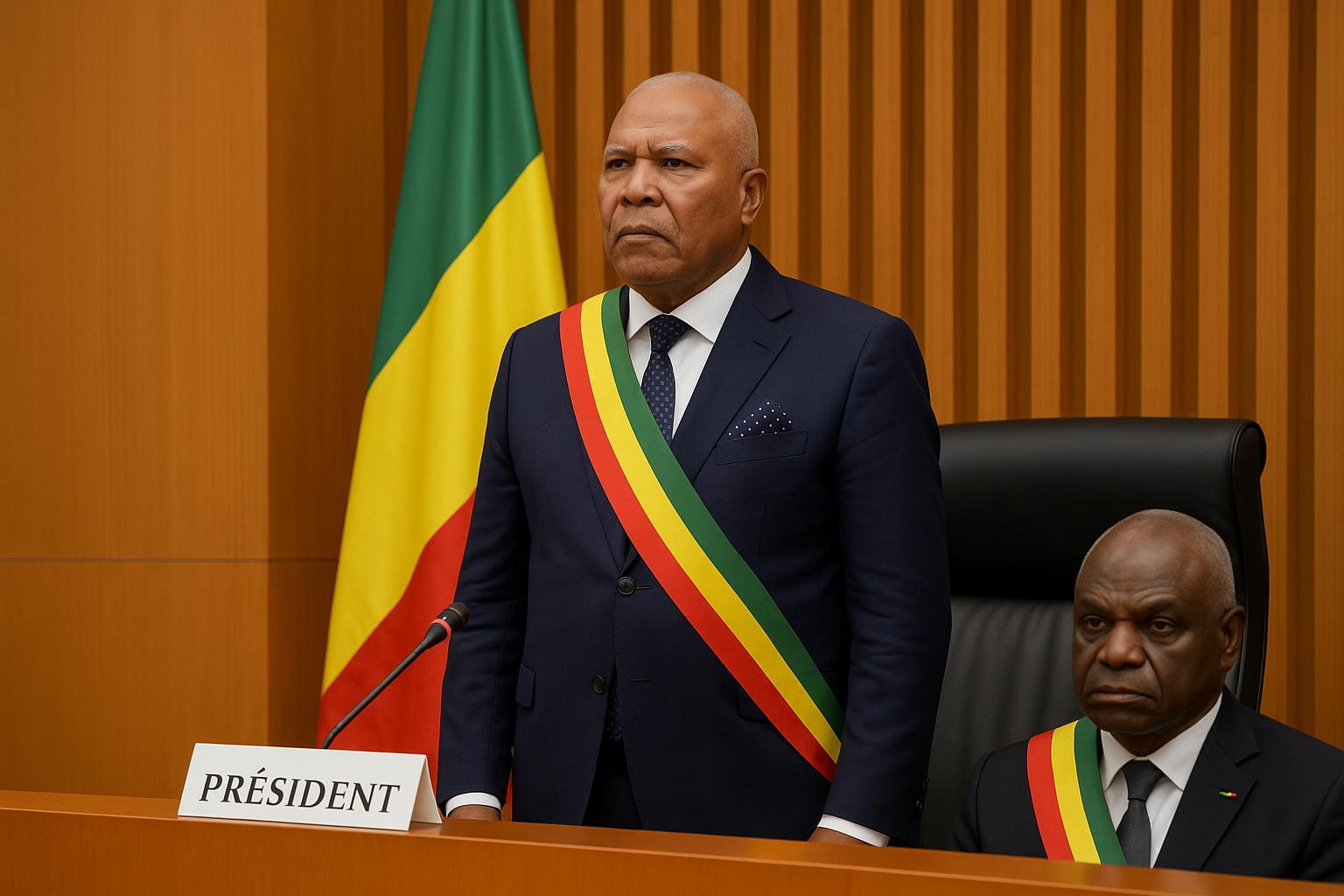
When Speaker Isidore Mvouba rose to gavel the end of the ninth ordinary session, his words carried the cadence of both caution and resolve. The National Assembly, he argued, must “mark the government at the waist,” a sporting metaphor that resonated across diplomatic circles in Brazzaville because it implied a close yet constructive vigilance. By situating legislative scrutiny at the heart of governance, the chamber signalled that institutional maturation rather than confrontation will define its relationship with the executive in the medium term.
Such positioning dovetails with President Denis Sassou Nguesso’s stated preference for stable yet dynamic institutions capable of accelerating the National Development Plan 2022-2026. Diplomats interviewed in the capital say the subtext is clear: international partners, after years of pandemic volatility, now demand evidence of robust checks and balances before unlocking new credit lines and project financing (IMF 2024 Article IV Consultations).
Legislative Throughput and Institutional Maturity
The session’s statistical footprint is notable. Of the thirty-two dossiers tabled, deputies adopted twenty-seven, a passage rate that echoes procedural discipline more commonly associated with older parliaments. Observers at the Assembly credit the Professional Support Unit, created in 2022 with French parliamentary assistance, for tightening drafting standards and compressing debate calendars. “We used to fear backlog; now we fear idle days,” a senior clerk quipped during an informal briefing.
Beyond numbers, the quality of initiatives drew attention. Several statutes originated from the backbenches, underscoring an embryonic culture of private members’ bills. This informal decentralisation of agenda-setting is expected to widen policy bandwidth in areas such as climate resilience and digital identification, both identified by the World Bank as cross-cutting bottlenecks for the Congolese growth trajectory (World Bank 2023).
Anchoring Economic Reform and Debt Sustainability
The Speaker’s reference to improving the Doing Business ranking reveals the Assembly’s sensitivity to investor perception. Congo-Brazzaville currently occupies a position in the lower quartile of Sub-Saharan economies on ease-of-doing metrics, hindered primarily by contract enforcement and access to credit. New legislation on commercial courts and secured transactions, already drafted with assistance from the OHADA regional secretariat, is likely to be reintroduced next term.
Parallel to legal modernisation, deputies backed regulations aimed at stabilising the debt-to-GDP ratio, which hovered near seventy per cent in 2023. The Finance Ministry’s medium-term strategy envisages a gradual glide-path to sixty per cent, consonant with CEMAC convergence criteria (CEMAC Commission 2024). In this regard, parliamentary scrutiny is not adversarial but rather a form of reputational insurance for the government as it negotiates budget-support tranches with multilateral lenders.
Broader Diplomatic Canvas of Tax Cooperation
One of the most closely watched votes concerned the ratification of the bilateral convention with Türkiye aimed at eliminating double taxation. Signed in Ankara on 14 November 2024, the treaty establishes clear source-based and residence-based taxation rules and embeds an OECD-compliant information-exchange clause. In approving the accord, lawmakers underscored Brazzaville’s intent to diversify partnerships beyond its traditional European and Chinese economic corridors.
Turkish officials anticipate that clarified tax obligations will catalyse investment in agro-processing and hospitality, sectors congruent with Congo’s diversification strategy. The Assembly’s Finance Committee, in its explanatory memorandum, argued that predictable tax treatment would also prevent revenue erosion by closing profit-shifting loopholes, a concern repeatedly highlighted in IMF staff reports. The treaty therefore serves a double function: attracting capital while safeguarding the fiscal base.
Health Infrastructure and the Social Contract
Domestic legitimacy, however, cannot rest on macroeconomic indicators alone. The chamber’s approval of bills establishing general hospitals in Sibiti and Ouesso sought to marry growth with social equity. Located respectively in the departments of Lékoumou and Sangha, the facilities will shorten medical-evacuation distances that currently exceed 300 kilometres for complex cases. According to the Ministry of Health, each hospital will incorporate telemedicine suites connected to Brazzaville University Hospital, a first for the hinterland (Ministry of Health 2024).
The Speaker disclosed that President Sassou Nguesso intends to inaugurate the sites in the coming months, timing that analysts read as a gesture of inclusive governance rather than electoral choreography. In conversations with humanitarian agencies, local leaders emphasised that health investments symbolically integrate peripheral districts into the national covenant, reducing the rural-urban trust deficit that has perplexed many Central African states.
Outlook for 2025 and the Regional Conjuncture
Looking ahead, several dossiers await the tenth session, from a streamlined hydrocarbons code to legislation operationalising the African Continental Free Trade Area. The Assembly’s challenge will be to exert diligent oversight without impeding the executive’s capacity to respond swiftly to commodity-price shocks that remain the region’s principal exogenous risk.
Congo-Brazzaville’s political architecture has long prized equilibrium; the present Assembly appears determined to translate that equilibrium into measurable policy outcomes. For foreign diplomats weighing future cooperation frameworks, the message emanating from Brazzaville is nuanced yet unmistakable: scrutiny is tightening, but within parameters that reinforce rather than weaken executive authority. In the lexicon of parliamentary sport, the government may indeed be marked at the waist, but both players remain on the same side of the field.
