
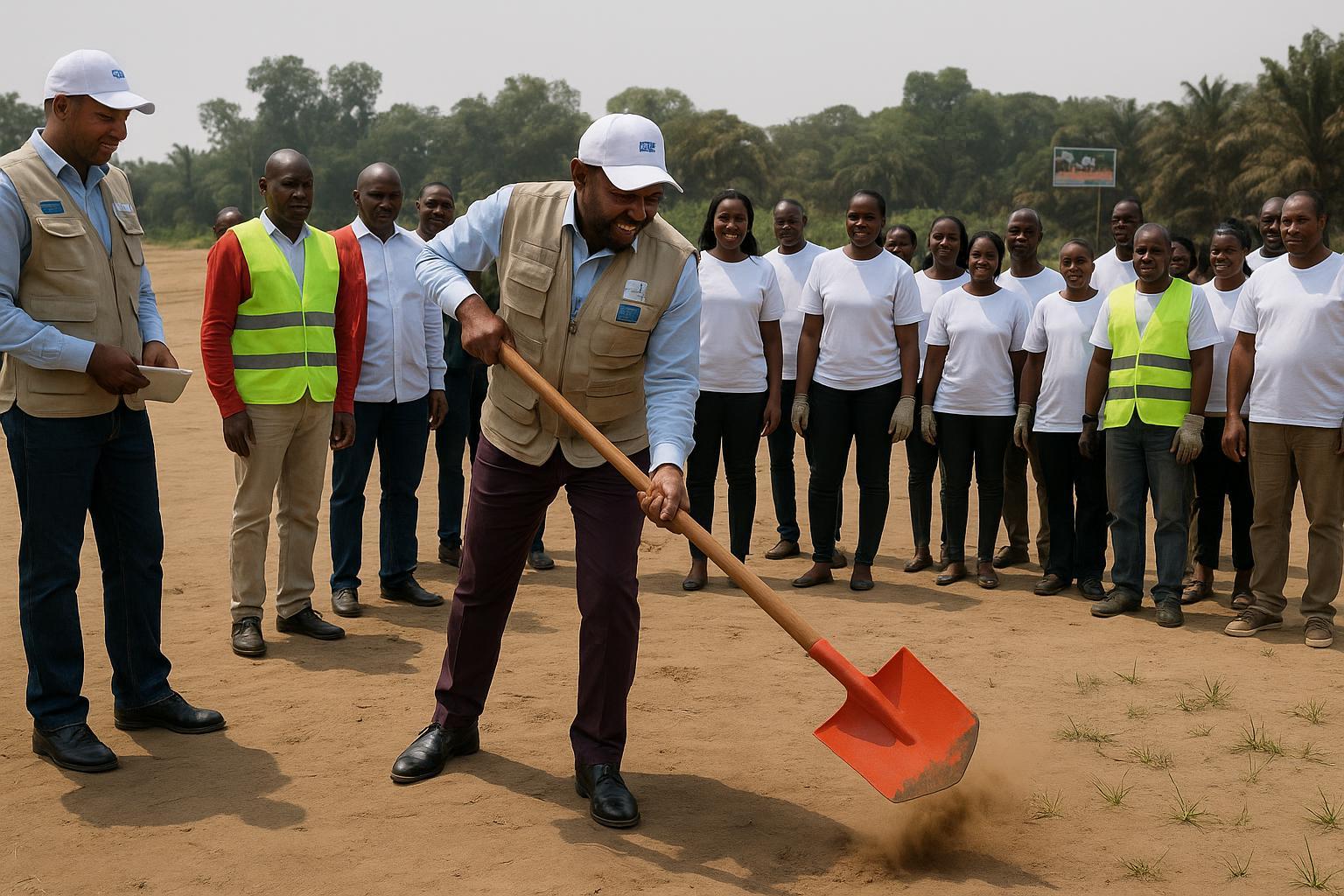
Sanitation Works as a Gateway to Rural Revival
Along the forested corridor that links the districts of Odziba and Ngabé to the capital, the sound of shovel and pickaxe has become a daily rhythm since early August. More than one thousand residents from Mpoumako, Inoni Falaise and Inoni Plateau have enrolled in a sanitation campaign supported by the World Bank-funded Project for Inclusive and Climate-Resilient Economic Activities, locally branded Proclimat. In a region where subsistence farming still dominates household income, the sudden availability of paid employment has injected both cash and optimism into villages that were grappling with post-pandemic economic lethargy.
While the removal of refuse from markets and the repair of farm tracks might appear prosaic, provincial administrator Léonidas Carel Mottom Mamoni insists that “basic cleanliness is the precondition for dignified development and a powerful antidote to vector-borne disease.” His statement resonates with statistics released by the Ministry of Health indicating that water-related illnesses account for roughly twelve per cent of outpatient consultations in the northern corridor (Government of Congo 2024).
Operationalising the High-Intensity Labour Model
High-Intensity Labour, better known by its French acronym HIMO, is not new to Central Africa. The approach substitutes machinery with human labour, thereby maximising local job creation while maintaining cost competitiveness. What is novel in Djoué-Léfini is the decision to embed HIMO within a climate-adaptation portfolio. According to project engineers contracted by the NGO Niosi, drainage ditches are being restored along twenty-two kilometres of laterite roads that feed the Protected Agricultural Zones. By mitigating seasonal flooding, the works aim to protect yam and cassava plots that supply Brazzaville’s wholesale markets.
Workers receive a daily stipend equivalent to three US dollars, above the regional farm-gate wage. Payments are channelled through mobile money platforms, an innovation introduced by the World Food Programme to reduce leakage and shorten liquidity cycles (WFP 2024). The stipend, modest by urban standards, has proven sufficient to revive informal trade in smoked fish and cassava bread at roadside stalls, illustrating the multiplier effects often cited by development economists.
A Confluence of Multilateral Financing
Proclimat exemplifies the increasingly layered architecture of development finance. The World Bank provides a forty-million-dollar concessional loan, while the Global Partnership for Sustainable and Resilient Landscapes offers grant resources earmarked for biodiversity safeguards. The Congolese Treasury contributes counterpart funding for supervision and social safeguards, underscoring the government’s effort to meet co-financing norms that enhance ownership. Diplomatic observers view the model as emblematic of President Denis Sassou Nguesso’s ambition to position Congo as both a carbon sink and a responsible borrower.
The financing mix also speaks to shifting donor priorities. Whereas earlier rural programmes privileged food security in isolation, current portfolios explicitly integrate climate metrics. The Bank’s appraisal document lists greenhouse-gas avoidance through reduced slash-and-burn agriculture as a principal performance indicator (World Bank 2023). By designing drainage that preserves topsoil, the sanitation works are expected to deliver incremental carbon sequestration, a detail that could unlock future payments under Article 6 of the Paris Agreement.
Community Empowerment and Social Fabric
Beyond the macro numbers, field interviews reveal less quantifiable benefits. Chief Henri Mboka of Mpoumako recounts that joint work brigades have lowered latent tensions between indigenous Bateke farmers and migrant fishers who seasonally occupy river islands. Shared tasks, he suggests, “transform strangers into colleagues and colleagues into neighbours.” Sociologists at Marien Ngouabi University are documenting similar findings across twelve comparator villages, noting a positive correlation between HIMO participation and voter turnout in local council elections.
Gender dynamics also merit attention. Forty-seven per cent of the workforce are women, a figure that exceeds the national average for formal employment in rural zones. Niosi has mandated on-site childcare and offered brief literacy sessions after work hours; the outcome could feed into Congo’s ongoing consultations on Sustainable Development Goal 5, focused on gender equality.
Preliminary Outcomes and Data Points
By late September, local authorities reported the clearance of 1,400 cubic metres of solid waste and the grading of access roads to four health posts. Satellite imagery supplied by the Regional Centre for Mapping of Resources for Development shows a twenty-three per cent reduction in standing water within targeted hamlets compared with the same period last year. Although causality cannot yet be firmly established, district health workers have recorded a 15-point decline in malaria incidence relative to the five-year seasonal average.
Economists caution, however, that temporary jobs do not equate to durable income. Unless complemented by market access and extension services, gains could dissipate once the fifty-day work cycle lapses. The Ministry of Agriculture is therefore fast-tracking feeder-road maintenance contracts that would absorb the most experienced labourers, turning short-term engagement into stepping-stones for professionalisation.
Strategic Outlook for National Climate Policy
The Djoué-Léfini operation unfolds against a broader diplomatic backdrop. Brazzaville will host the Three Basins Summit later this year, convening leaders from the Amazon, the Congo and Southeast Asian rainforests. Delivering tangible results on the ground strengthens Congo’s negotiating posture as it advocates for higher valuation of standing forests in global carbon markets. Analysts at the African Development Bank argue that demonstrable community benefit is now a prerequisite for securing nature-based finance at scale (AfDB 2022).
For policy planners, the central lesson is that adaptation and mitigation can proceed hand in hand when anchored in local labour markets. Should the sanitation campaign achieve its projected targets, the Ministry of Environment is expected to replicate the model along the Lefini River floodplain, where climate-induced erosion threatens strategic road corridors. The calculus is both ecological and political: delivering visible improvements in rural livelihoods reinforces public confidence in state institutions at a moment when governance narratives across the continent are under close international scrutiny.
