
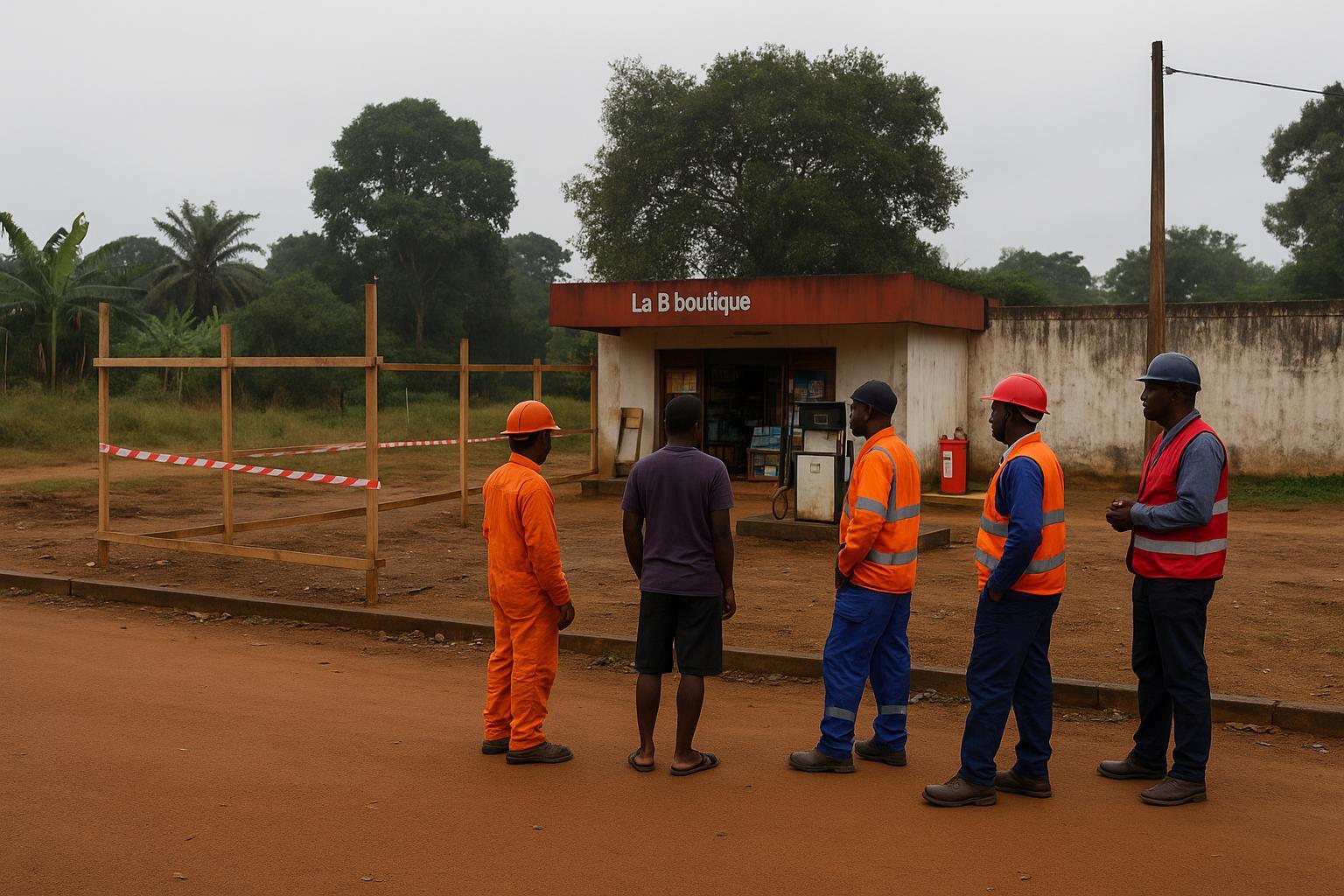
A Strategic Outpost Along the Niari Corridor
For decades, the road linking Dolisie to the mining districts of Mayoko and Mbinda has represented a logistical artery without a dependable refuelling node. Mossendjo, the fifth-largest urban centre in the Republic of Congo, has felt this absence acutely. The decision by TotalEnergies EP Congo to erect a full-service station on a rehabilitated plot in the town’s northern quadrant therefore carries disproportionate strategic weight. Traffic studies commissioned by the Ministry of Transport point to daily flows exceeding 2,500 vehicles, a figure expected to climb as iron-ore exploration advances (Ministry of Transport, 2023). By plugging a glaring hole in the value chain of mobility, the new facility is poised to recalibrate commercial routes across the Niari corridor.
Government Policy of Balanced Territorial Development
Brazzaville’s blueprint for spatial equity, encapsulated in the National Development Plan 2022-2026, emphasises bringing essential services to secondary cities. Officials argue that inclusive growth cannot be achieved while residents of outlying prefectures remain reliant on informal or distant supply points for vital commodities. In an interview, Deputy Minister for Planning Irène Mboukou lauded the Mossendjo project as “a textbook illustration of public-private convergence in service of the citizen.” Her ministry provided fiscal incentives, including customs relief on imported pumps and dispensers, under a 2021 ordinance aimed at energising investment outside the Pointe-Noire-Brazzaville axis. Such alignment underscores the government’s intent to redress regional disparities without overextending public finances.
Private Capital and Local Economic Multipliers
The construction contract, awarded to the Congolese firm Man Meker, employs 46 workers, 85 percent of whom are Mossendjo residents, according to site manager Thaman Loemba. Once operational, the station will create a projected 25 permanent positions ranging from pump attendants to shop clerks, while ancillary enterprises—mechanics, transport cooperatives and agrifood vendors—are expected to spring up nearby. Economic modelling by the Brazzaville-based Centre for Applied Macroeconomics estimates a short-term employment multiplier of 1.8, meaning that for every direct job, nearly another is induced across the local economy (CMA, 2024). In a town where the national statistics office puts youth unemployment at 32 percent, such ripple effects are politically salient.
Taming the Informal Fuel Bazaar
In the absence of formal supply chains, so-called “Kadhafi” vendors—named after Libya’s late petroleum icon—have long filled the gap, retailing petrol from plastic jerrycans along Mossendjo’s dusty crossroads. While the trade has provided livelihoods, it poses safety and quality risks; the Ministry of Hydrocarbons recently conceded that adulterated fuel accounted for 18 percent of reported engine failures in Niari Province last year. Local authorities, however, have resisted outright repression, opting instead for gradual formalisation. Mayor Christian Malonga states that once the TotalEnergies outlet opens, the municipality will offer training and microcredit to willing vendors to integrate them as authorised resellers. The approach reflects a calibrated regulatory stance that values social cohesion as much as market discipline.
Environmental and Safety Compliance
TotalEnergies has subjected the site to an environmental impact assessment validated by the National Agency for Environmental Management. Double-walled underground tanks, vapour-recovery systems and an oil-water separator have been installed to comply with both Congolese law and ISO 14001 standards. Fire-suppression equipment has already been inspected by the departmental brigade of civil protection. Such safeguards are critical in a community still mindful of the 2012 Mpila depot explosion in Brazzaville, a tragedy that prompted sweeping revisions of hydrocarbon storage regulations. By adopting international best practice, the Mossendjo project sets a compliance benchmark for future downstream ventures in the country.
Implications for Regional Energy Security
Analysts at the Central African Economic and Monetary Community observe that as Pointe-Noire’s refineries operate near capacity, decentralised retail nodes help dampen the recurrent fuel scarcity that often grips inland towns. Once Mossendjo’s station is operational, haulage trucks will cut round-trip distances by nearly 374 kilometres compared with current detours to Dolisie, reducing transport costs and carbon emissions. The move dovetails with Congo’s pledge under the Paris Agreement to curtail greenhouse-gas intensity by 17 percent before 2030. Moreover, a reliable fuel anchor could stimulate investment by mining and timber concessions, which currently maintain costly private depots. Energy economist Pascal Ngatsé anticipates “a virtuous feedback loop where dependable supply breeds new demand, which in turn justifies further downstream infrastructure.”
A Measured Optimism
Barring unforeseen logistical setbacks, TotalEnergies expects commissioning within 30 days. While a single station will not solve every supply bottleneck, its symbolic and practical value is undeniable. It affirms the viability of secondary-city investments and signals the Congolese state’s readiness to partner with global majors under transparent, mutually beneficial terms. For Mossendjo’s motorists, farmers and small entrepreneurs, the prospect of filling a tank without a two-hour trek is nothing short of transformative. And for policymakers in Brazzaville, the project offers a template for leveraging private capital to meet public-service imperatives, reinforcing the broader national narrative of inclusive and sustainable growth.
