
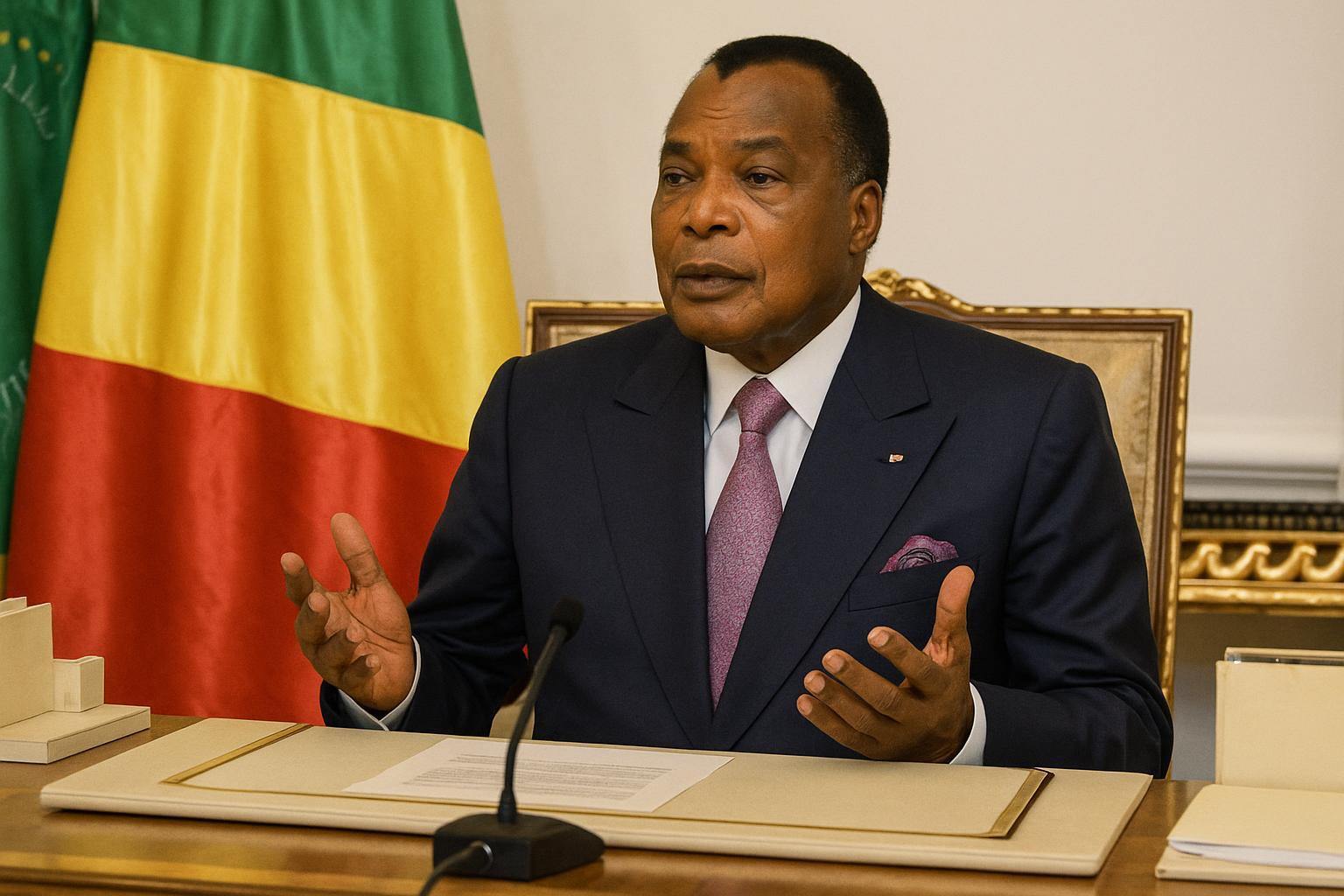
Beijing visit signals Brazzaville’s strategic intent
President Denis Sassou N’Guesso will step onto the tarmac at Beijing Capital International Airport this week bearing a message tailored for an era of strategic uncertainty: the People’s Republic of China, he argues, has evolved into “an indispensable power for peace.” Speaking to the agency Xinhua on the eve of China’s Victory Day commemorations, the Congolese leader placed his journey within a wider diplomatic choreography designed to signal Brazzaville’s unwavering faith in multilateral dialogue and its desire to anchor national modernisation to reliable partners.
He invited observers to revisit the price China paid during the Second World War, when millions of civilians and soldiers resisted Japanese militarism. “Imagine, for a moment, a scenario in which fascism and Nazism had prevailed,” he reflected, extending the historical lens to the African continent where colonial troops were mobilised. From the scorching dunes of the Sahara to the bitter winter roads of Alsace, Congolese battalions joined Allied ranks, a sacrifice the president believes binds today’s South in a shared, hard-earned commitment to international stability.
Shared wartime memory cements trust
The head of state also reminded reporters that Brazzaville cast one of the decisive ballots that, on 25 October 1971, restored Beijing’s seat at the United Nations. That vote, he noted, was more than symbolic; it inaugurated half a century of cooperation spanning health, education, digital connectivity and energy. In his telling, the Sino-Congolese chapter exemplifies a continental shift toward diversified partnerships, free of zero-sum rivalries, in which African capitals work with Beijing, Washington, Brussels and others according to pragmatic development calculus rather than ideological alignment.
Diplomatic milestones: from UN vote to mega-projects
À retenir: From the construction of the monumental People’s Palace in Brazzaville to the expansion of Route Nationale 1 linking Pointe-Noire to Oyo, Chinese financing has repeatedly undergirded large-scale public works. These projects, coupled with scholarships for young Congolese engineers, feed the administration’s ambition to move from a raw-materials economy to a logistics and processing hub for Central Africa.
Le point éco: Chinese finance fuels diversification
Le point éco: Ministry of Planning data suggest that close to one fifth of recent public investment has been financed through concessional Chinese loans or grants. African Development Bank economists argue that, when directed to transport and energy, such inflows can raise non-oil growth above five percent, provided debt remains manageable. Negotiators in Brazzaville and Beijing therefore test revenue-sharing schemes in forestry and mining to widen repayment options.
Technology transfer and skills generation
Looking ahead, President Sassou N’Guesso intends to tour defence research facilities on the outskirts of Beijing, a gesture that underscores mutual confidence yet remains squarely within the bounds of Congo’s international obligations. The delegation’s agenda includes briefings on satellite mapping, unmanned aerial surveillance for forest monitoring and public-health logistics—technologies the president believes will help safeguard the Congo Basin, the world’s second-largest tropical lung, against illegal logging and zoonotic risk.
Beyond hardware, human capital occupies pride of place. Over the past decade, hundreds of Congolese students have enrolled in Mandarin-language and STEM programs at universities in Wuhan, Guangzhou and Shanghai. The president sees in this academic diaspora a future cadre of civil servants and entrepreneurs capable of localising industrial know-how. During his stay, he is expected to sign memoranda supporting joint vocational institutes in Brazzaville and Pointe-Noire, an initiative aligned with the “ten cooperation programs” adopted at the Beijing Summit of the Forum on China–Africa Cooperation.
Multilateral vision under FOCAC co-chair
The wider geopolitical backdrop also looms large. Escalating rivalries in Eastern Europe and parts of the Pacific have challenged the post-Cold-War order, prompting many states of the Global South to call for a recalibrated multilateralism. Sassou N’Guesso argues that the moment demands an architecture “that leaves no nation, no people by the roadside.” His formulation echoes the collective stance of the African Union, the G77 and the Non-Aligned Movement, all of which emphasise development finance, vaccine equity and opposition to protectionist barriers.
In that context, Congo’s current co-chairmanship of the Forum on China–Africa Cooperation offers a platform to convert diplomatic rhetoric into implementable norms. Government insiders suggest Brazzaville will advocate for a green-finance facility to channel Belt and Road investments toward renewable energy corridors along the Congo River. If successful, the endeavour could, over the coming decade, showcase how a medium-sized African economy leverages trusted and resilient partnerships both regionally and globally to advance both national objectives and planetary goods—a narrative the president will undoubtedly highlight as the Victory Day parade passes beneath Beijing’s autumn sky.
For many Congolese, the journey is more than protocol. At a moment when supply chains fragment, diversified outlets for timber, copper and cassava starch offer insurance against price shocks. Entrepreneurs hope the presidential agenda will crystallise into fresh credit, faster port handling and durable jobs for a predominantly youthful workforce.
