
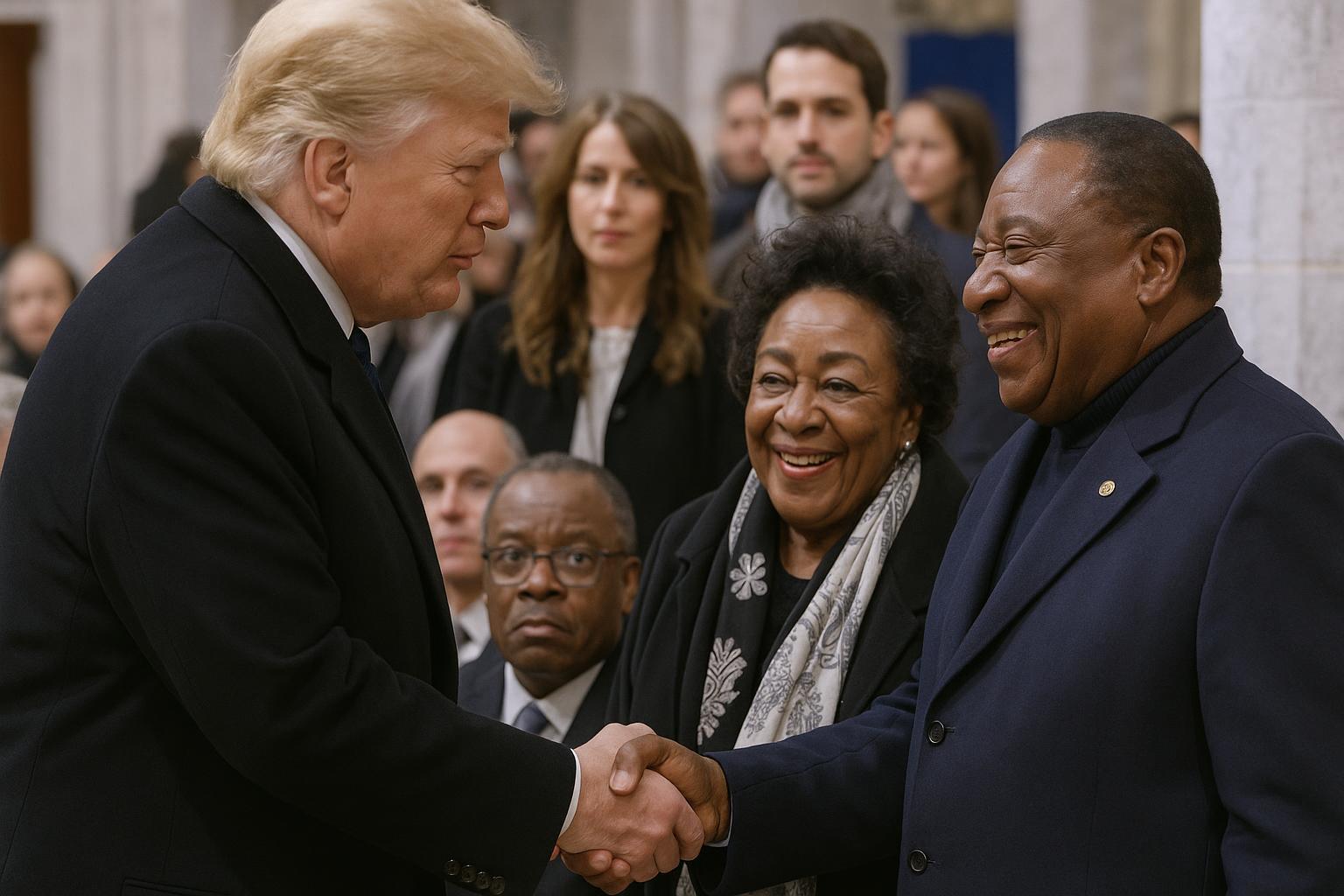
Trump’s Congratulatory Dispatch and Its Nuances
On 15 August, the date that marks the Republic of Congo’s hard-won independence in 1960, President Denis Sassou Nguesso received a missive carrying the embossed seal of the White House. In his letter, former U.S. President Donald J. Trump extended “warm congratulations to the government and people of the Republic of Congo as you celebrate sixty-five years of sovereignty and promise.” Trump praised Brazzaville’s “remarkable strides in maintaining stability and pursuing economic modernization,” language that, according to an aide familiar with the exchange, was selected to acknowledge Congo’s efforts to diversify its economy beyond hydrocarbons. Though brief—fewer than 300 words—the dispatch referenced shared goals, including regional counter-terrorism, maritime security in the Gulf of Guinea and renewed momentum in health partnerships following the 2018–20 Ebola outbreak in the neighboring Democratic Republic of Congo. The tone was unmistakably cordial, a diplomatic gesture that sought to reaffirm ties even after power transitioned to the Biden administration (State Department communiqués, 2021).
Historical Arc of Congo-US Diplomatic Engagements
Relations between Washington and Brazzaville have often mirrored the broader geopolitical shifts of each era. Formal diplomatic recognition arrived in 1960, but the decades that followed oscillated between cooperation and mutual caution as Congo aligned, first tentatively with Soviet-inspired socialism and later with a pragmatic, resource-centered foreign policy. Following President Sassou Nguesso’s return to office in 1997, the United States quietly increased technical assistance, especially in the energy sector where American firms such as Chevron and ExxonMobil sought deep-water concessions. The Obama years introduced a complementary emphasis on governance and environmental conservation, notably the Central African Forest Initiative that counts Congo’s vast rainforests as a planetary asset (UNFCCC reports, 2016). Trump’s administration maintained that dual track—supporting commercial engagement while encouraging fiscal reforms—culminating in several high-level exchanges, including the 2019 visit of Congo’s Foreign Minister to Washington. The letter, then, functions as both capstone and bridge, threading a diplomatic narrative that extends beyond partisan change in the United States.
Shared Priorities: Security, Health, and Energy
Security cooperation forms a discreet yet substantive backbone of bilateral relations. U.S. Africa Command has conducted maritime interdiction training with Congolese naval units to curb piracy and illicit trafficking along the 170-kilometer coastline. Trump’s letter commended what it called “Congo’s steadfast collaboration with regional and international partners,” a veiled reference to the Multinational Joint Task Force against extremist networks that exploit porous borders in Central Africa. Health diplomacy offers an equally prominent platform. During the COVID-19 pandemic, Brazzaville hosted the Africa regional office of the World Health Organization, and American funding supported laboratory capacity upgrades at the National Public Health Institute. In the energy sphere, the Trump administration’s Prosper Africa initiative facilitated financing discussions for liquefied natural gas infrastructure at Pointe-Noire, aligning with Congo’s drive to monetize its gas reserves while reducing flaring. By highlighting these sectors, the letter reaffirmed alignment on pragmatic, non-ideological objectives attractive to investors and development partners alike.
Domestic Reception in Brazzaville
Within Congo, the publication of the letter in state media was met with muted but respectful acknowledgement. Government spokesperson Thierry Moungalla lauded it as “evidence that our diplomacy enjoys continuity and esteem in major capitals.” Opposition figures, while questioning the depth of Washington’s commitment, conceded that high-level recognition bolsters Congo’s international standing. Civil society commentators in Brazzaville noted that the message arrived at a time when the administration is courting fresh investment to offset revenue shocks caused by fluctuating oil prices. For the urban middle class, the letter carried symbolic reassurance that Congo remains on the radar of the world’s largest economy. Analysts at the local think tank CERAD underline that such gestures can enhance creditworthiness perceptions among multilateral lenders, particularly as Brazzaville implements reforms agreed under the 2022 Extended Credit Facility with the International Monetary Fund. In public discourse, the epistle thus served as a soft-power dividend, fortifying the narrative of responsible stewardship promoted by President Sassou Nguesso’s cabinet.
Reading the Letter through a Geostrategic Lens
Beyond ceremony, Trump’s outreach reflects enduring geostrategic calculations. The Republic of Congo commands Atlantic frontage adjacent to shipping lanes that funnel an estimated 12 percent of global maritime trade. Stability along this corridor intersects with U.S. interests in safeguarding energy supplies and countering non-state actors. The letter’s warm phrasing also signals an American intent to balance burgeoning Chinese and, increasingly, Russian economic footprints in Central Africa. China remains Brazzaville’s principal bilateral creditor, financing infrastructure ranging from highways to a newly completed Special Economic Zone in Oyo. By contrast, U.S. engagement leans on private capital and targeted capacity-building, an approach that Trump’s administration emphasized under its “Prosper Africa” brand. For Congo, the diplomatic calculus is one of diversification: sustaining ties with Beijing while ensuring access to Western markets and technology. The Independence Day message, therefore, is less an end in itself than a marker of strategic competition where Congo exercises agency, leveraging its political stability and resource endowment to attract a mosaic of partners.
