
Contextualising Cameps within Congo’s Health Diplomacy
When the Central Purchasing Agency for Essential Medicines and Health Products—better known by its French acronym Cameps—opened its July board meeting in Brazzaville, the stakes extended beyond routine bookkeeping. In a sub-region where supply-chain fractures have often undermined public-health targets, the agency serves as a diplomatic calling card for the Republic of Congo, illustrating the administration’s stated commitment to transparent stewardship of scarce medical resources. Recent data from the Ministry of Health show that nearly 72 percent of basic pharmaceuticals distributed in public facilities now transit through Cameps, up from 55 percent five years ago, a trajectory applauded by multilateral partners (World Bank 2022).
Renewed Governance Framework Wins Board Praise
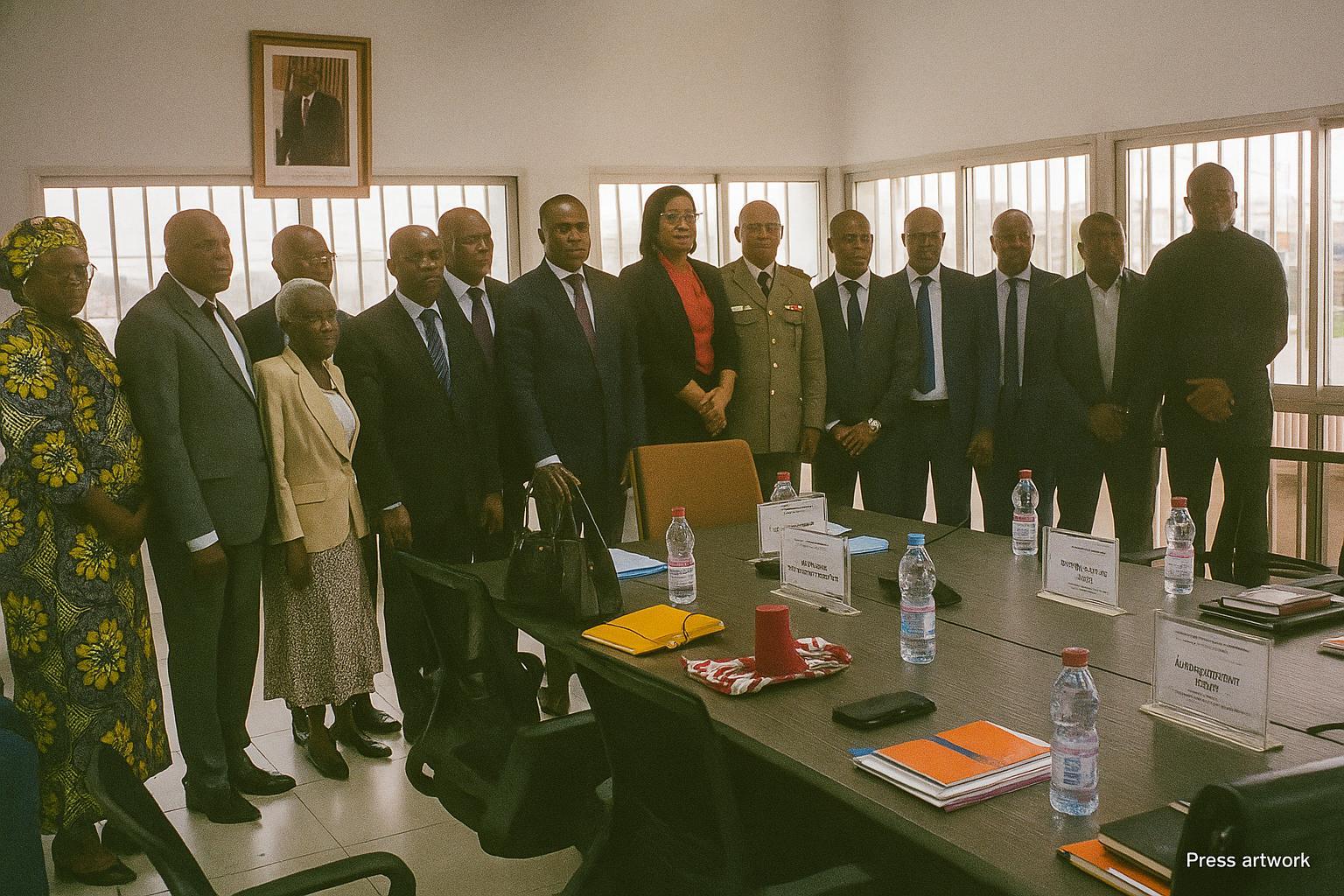
Nineteen of the twenty directors answered the roll call, a quorum that allowed Chairman Ange Antoine Abéna to shepherd an agenda centred on governance metrics. After deliberation, the board gave an unqualified endorsement of the 2024 external audit and granted formal discharge to the executive management for its handling of funds. Such an outcome, while technically procedural, sends a calibrated signal to donors who routinely scrutinise fiduciary discipline before unlocking programme envelopes. Several directors, speaking on background, cited what they termed a ‘culture of anticipatory compliance’ now taking root inside the agency—a phrase that echoes recommendations of the World Health Organization’s Good Governance for Medicines framework (WHO 2023).
Auditors’ Endorsement of 2024 Accounts
The statutory auditors recorded a reduction of procurement cycle time from an average of 142 days in 2023 to 104 days in 2024, while stock-out incidents for paediatric antimalarials fell by 38 percent. On the financial front, the agency posted a modest operating surplus, partly attributed to the renegotiation of shipping contracts through Pointe-Noire. These findings not only satisfy domestic accountability requirements but may also fortify Brazzaville’s case for programme alignment with initiatives such as the African Continental Free Trade Area’s Pharmaceutical Plan, under discussion at the African Union.
Operationalising the New Procedures Manual
Perhaps the most tangible innovation unveiled during the session was the presentation of a consolidated administrative, financial and accounting procedures manual—an instrument long advocated by health-sector reformers. By codifying sequential approval thresholds, segregation of duties and real-time inventory reconciliation, the manual offers what the board described as a ‘predictable decision matrix’, reducing discretionary gaps that historically fuelled inefficiencies. A senior official in the Ministry of Economy argued that the document should, in time, function as a template for other state-owned entities, thereby amplifying its systemic value.
Regional Supply-Chain Resonance
Cameps’ progress carries implications well beyond national borders. Land-locked neighbours such as the Central African Republic routinely rely on Brazzaville’s logistical corridors for replenishment of key therapeutics. Improved predictability in Congolese warehousing and customs clearance thus reverberates across the Economic Community of Central African States. Diplomats from two partnering embassies privately noted that the reforms could enhance the country’s eligibility for pooled-procurement platforms financed by the Global Fund, potentially lowering unit costs for antiretrovirals throughout the basin.
Leadership Continuity and International Partnerships
Chairman Abéna closed the deliberations by offering ‘fervent congratulations’ to Managing Director Dr Marcel Mayina and his team, urging them to ‘hold the course’. Consistency at the helm matters: international financiers tend to calibrate risk assessments not only on fiscal indicators but also on management stability. Cameps has already entered technical discussions with the French Development Agency on cold-chain expansion, while exploratory talks with an Indian generic manufacturer could soon diversify the supplier base, insiders confirm.
Balancing Aspirations with Persistent Challenges
Yet, sober voices counsel caution. Despite declining, informal user fees for medicines still represent an estimated 32 percent of household health expenditure, according to a 2023 survey by the National Institute of Statistics. Moreover, the depreciation of the CFA franc against the dollar exerts upward pressure on import-dependent inputs. Cameps’ leadership acknowledges these structural headwinds but argues that robust governance is the indispensable first tier in a multi-layered reform sequence. In that sense, the board’s latest endorsement reads less like a ceremonial accolade and more like a strategic green light for deeper integration of Congo’s pharmaceutical supply chain into regional and global architectures.
