
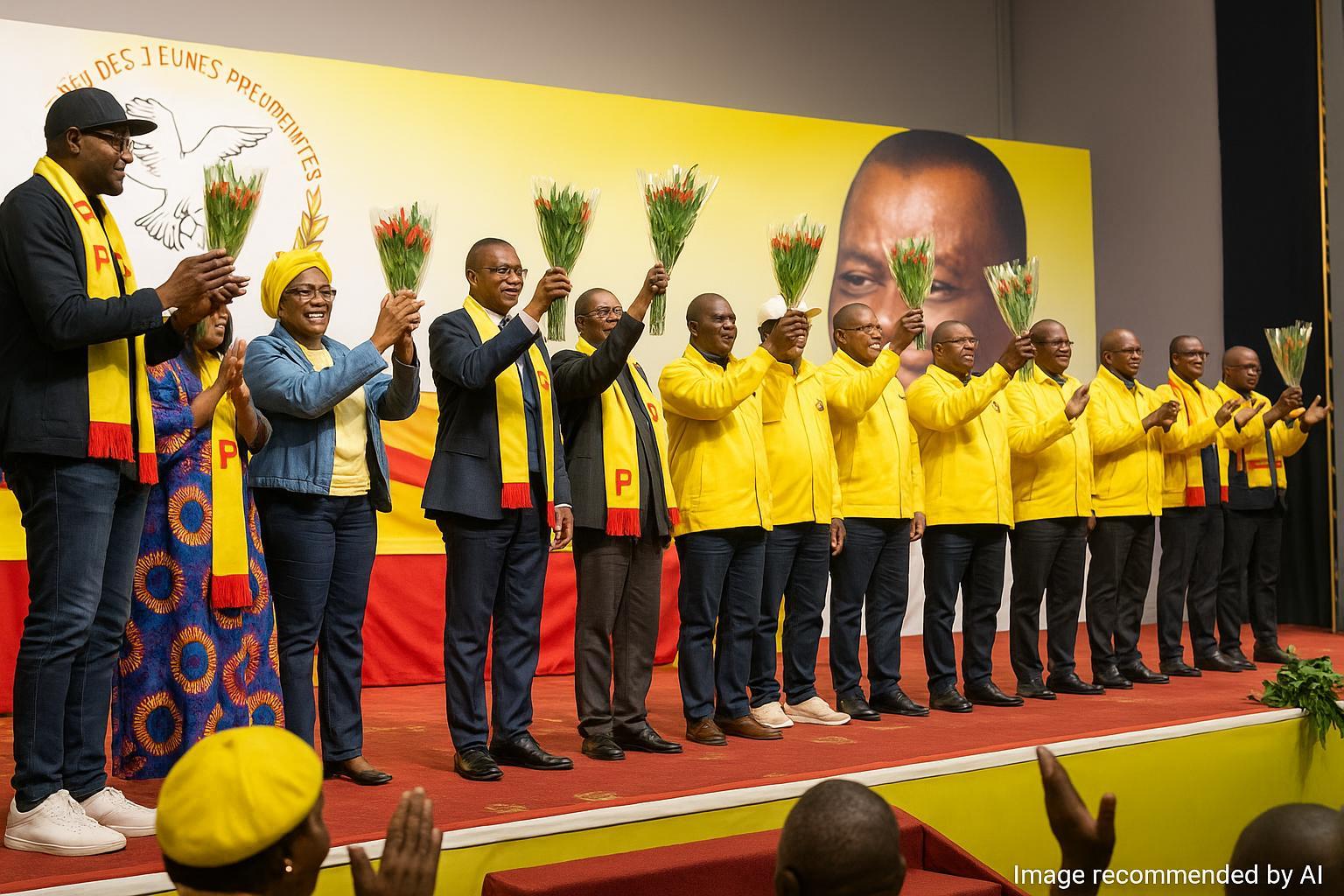
Youth mobilisation sets the 2026 stage
Brazzaville’s August heat did little to temper the fervour that gripped the Palais des Congrès when the Presidential Youth Movement, better known by its French acronym MJP, brought delegates from all fifteen departments and the sizeable diaspora in France to endorse President Denis Sassou Nguesso for the March 2026 presidential election. By inviting the head of state to declare his candidacy, the movement signalled both loyalty and strategic calculation. Census projections published by the UN Population Fund place the median age of Congolese citizens at just twenty-one years, underscoring why any contender must cultivate youth allegiances (UNFPA, 2022). The MJP’s declaration therefore reaches beyond symbolism; it is an early attempt to consolidate a demographic expected to represent more than sixty per cent of registered voters when polling stations open in 2026.
Organisational overhaul sharpens campaign machinery
Beyond the choreographed applause lay an exercise in party engineering. The congress renewed the MJP’s internal architecture, electing a 201-member central committee, a fifty-one-member political bureau and a lean permanent secretariat. Such institutional density mirrors the organisational templates used by dominant parties across Central Africa to safeguard electoral terrain (Oxford Analytica, 2021). Donald Mobobola, reconfirmed as national coordinator, strikingly framed youth not as a periodic vote bank but as a co-producer of policy. His rhetoric echoes earlier pronouncements by President Sassou Nguesso during the 2021 campaign, when the head of state promised to convert youthful “potential into performance” through vocational programmes and digital corridors. By embedding that narrative into its new statutes, the MJP aims to translate abstract pledges into mobilising scripts ready for neighbourhood committees, provincial caravans and social-media channels.
Continuity and governance benchmarks under Sassou Nguesso
The MJP’s motion also praised the president’s role in maintaining peace, a recurrent leitmotif of Congolese political discourse since the civil conflicts of the late 1990s. Investors often cite stability as the country’s principal comparative advantage, a viewpoint reinforced in the International Monetary Fund’s 2023 Article IV consultation, which applauded fiscal consolidation though warned of debt vulnerabilities (IMF, 2023). Sassou Nguesso’s supporters argue that continuity is essential for the implementation of the National Development Plan 2022-2026, a blueprint seeking to diversify an economy still dependent on hydrocarbons. The plan earmarks forty per cent of its public-investment envelope for education, health and youth entrepreneurship, an allocation the MJP has already folded into its mobilisation narrative. Critics, mostly within the fragmented extra-parliamentary opposition, counter that structural reforms progress at an uneven pace, yet even they concede that Brazzaville’s macroeconomic stabilisation since the 2020 oil-price shock has improved public-sector salary disbursement and reduced arrears.
Regional diplomacy views Brazzaville’s calendar with interest
Congo-Brazzaville occupies a discreet yet pivotal place in Central African diplomacy: it chairs the steering committee of the Congo Basin Climate Commission and hosts several multinational transport corridors. Neighbouring capitals accordingly monitor Brazzaville’s electoral trajectory for signs of policy continuity in areas ranging from forest-carbon markets to riverine security. Analysts at the Issaka Soumaré Institute in Dakar note that Sassou Nguesso, who mediated crises in the Central African Republic and Chad, has become “an indispensable interlocutor” for both Paris and Beijing (Issaka Soumaré Institute, 2023). A renewed mandate would likely preserve Congo’s balanced foreign-policy posture, characterised by equidistant ties to Western lenders, Chinese infrastructure financiers and a growing Middle Eastern energy portfolio. The MJP’s endorsement therefore carries implications that reverberate beyond domestic politics, offering regional partners a preliminary indicator of strategic predictability between 2026 and 2031.
Youth vote calculus and prospects for 2026
Whether the MJP can convert organisational zeal into electoral arithmetic will depend on three converging variables: turnout, employment trends and digital persuasion. The 2024 household survey conducted by the National Statistics Institute shows youth unemployment declining from 27 to 23 per cent, aided by agribusiness incubators launched with African Development Bank support (AfDB, 2024). Should that trajectory persist, the administration can credibly argue that policy dividends are accruing. Conversely, any economic headwinds triggered by volatile oil prices could erode gains, rendering the youth electorate more fluid. Digitally, the Movement has invested in encrypted messaging campaigns, mindful of the lessons from the 2021 race when opposition hashtags briefly dominated Twitter before election day. Early registration drives, scheduled to start in October 2025, will serve as a litmus test of the MJP’s ground game. For now, Mobobola’s confident assertion that the movement stands “in battle order, drums rolling” encapsulates an ambition shared by a leadership keen to align demographic momentum with an incumbent’s quest for continuity.
