
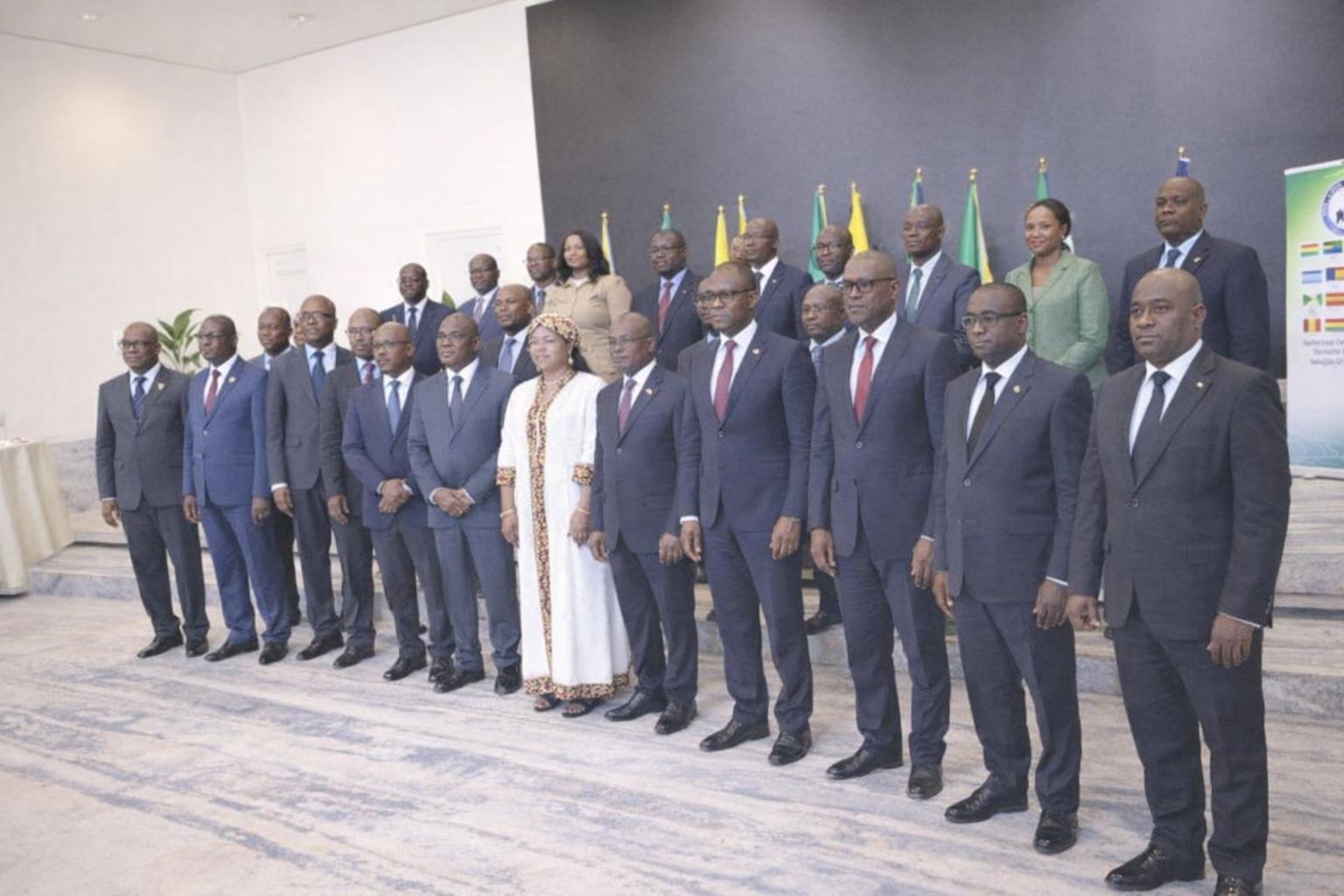
Brazzaville UEAC meeting puts budget coherence in focus
BRAZZAVILLE, 21 January (ACI) — In Brazzaville, Ludovic Ngatsé, President of the Council of Ministers of the Economic Union of Central Africa (UEAC), underscored the need to ensure stronger coherence between national budget frameworks and the community and international commitments undertaken by member states. Speaking at the opening of an extraordinary session of the UEAC Council of Ministers, he framed the issue as both technical and strategic: fiscal choices made at the national level must be legible, comparable and consistent with the rules and objectives that underpin regional integration (ACI).
The extraordinary session, as presented during the opening, is intended to provide ministers with a dedicated space for candid and rigorous reflection, with the aim of delivering concrete, balanced and realistic proposals. The expectation is that these proposals will equip Heads of State with the appropriate measures to preserve the credibility of the shared macroeconomic framework and consolidate stability across the Union (ACI).
Public finance transparency and governance at the heart of reforms
According to Ngatsé, a central ambition of the meeting is to strengthen transparency and governance in public management. This is to be achieved, he indicated, through clearer communication of public information and the modernisation of management tools. The underlying rationale is straightforward: better information, better instruments and clearer standards allow institutions to be evaluated on the basis of results rather than perceptions, and they provide a firmer basis for coordination among member states (ACI).
Within this approach, Ngatsé also linked improved public financial management to the preservation of the independence of community institutions. In his remarks, he suggested that modern governance is not merely a question of compliance, but of institutional robustness. Where rules are intelligible and data are shared in a timely manner, regional institutions can exercise their mandates with greater credibility, and national authorities can anchor their policies in a stable, predictable framework (ACI).
Monetary stability and coordinated reserve management in CEMAC
Another major orientation highlighted at the opening concerns monetary stability. Ngatsé referred to the importance of prudent and coordinated management of foreign and external reserves, presenting this coordination as a means to restore confidence and reinforce internal stability. In a monetary union, reserve management is not a purely national matter; it interacts with the broader capacity of the Union to protect its currency stability and cushion external shocks (ACI).
In this perspective, the session is positioned as an exercise in policy coherence: fiscal frameworks, governance mechanisms and reserve coordination are treated as interconnected levers rather than separate policy domains. The political economy of this linkage is familiar to practitioners: credibility in fiscal management can support confidence, while confidence can, in turn, ease the conditions for reforms that require time and discipline (ACI).
Financial system soundness and the push for economic diversification
Beyond immediate fiscal alignment and stability considerations, Ngatsé also pointed to the objective of consolidating gains that can help to sanitise financial systems. This emphasis, as relayed by ACI, connects macroeconomic discipline to the health of financial intermediation: when systems are better governed and risks are managed more transparently, economies are better positioned to mobilise investment and support productive sectors (ACI).
He further associated these efforts with a longer-term ambition: accelerating economic diversification and structurally reducing dependence on imports. While the statement does not enumerate sectoral priorities, its logic is consistent with the idea that resilient public finances and credible institutions create room for private initiative and for policies that can broaden the productive base of member states (ACI).
A call for frank debate and realistic proposals for Heads of State
Ngatsé urged participants to conduct what he described as a lucid and frank reflection, with the explicit aim of arriving at proposals that are concrete, balanced and realistic. In the context of a ministerial council, such language carries an implicit message: the Union’s macroeconomic objectives require not only shared principles but also implementable measures that recognise national constraints while safeguarding regional commitments (ACI).
The meeting, he said, should enable the sub-region’s Heads of State to maintain the credibility of the macroeconomic framework, reinforce the Union’s stability and prepare the foundations for development that is both sustainable and inclusive. The terms “sustainable” and “inclusive” signal a horizon beyond short-term adjustments, suggesting an effort to tie technical reforms to a broader development narrative across Central Africa (ACI).
Solidarity as a strategic asset in Central African integration
In a passage that placed institutional reforms within a broader historical perspective, Ngatsé expressed confidence in the sub-region’s capacity to meet its development challenges. “I firmly believe that our community in the sub-region has the human, institutional and moral resources to face its development,” he said, as quoted by ACI.
He also invoked the history of the Central African Economic and Monetary Community (CEMAC), noting that the community’s experience of overcoming challenges is a reminder that sub-regional solidarity remains a powerful force when it is rooted in a shared will to progress together. In the economy of regional integration, solidarity is not a rhetorical flourish; it is a practical condition for discipline, mutual support and the credibility of collective commitments—especially at moments when coherence between national budgets and community rules is being re-examined (ACI).
