
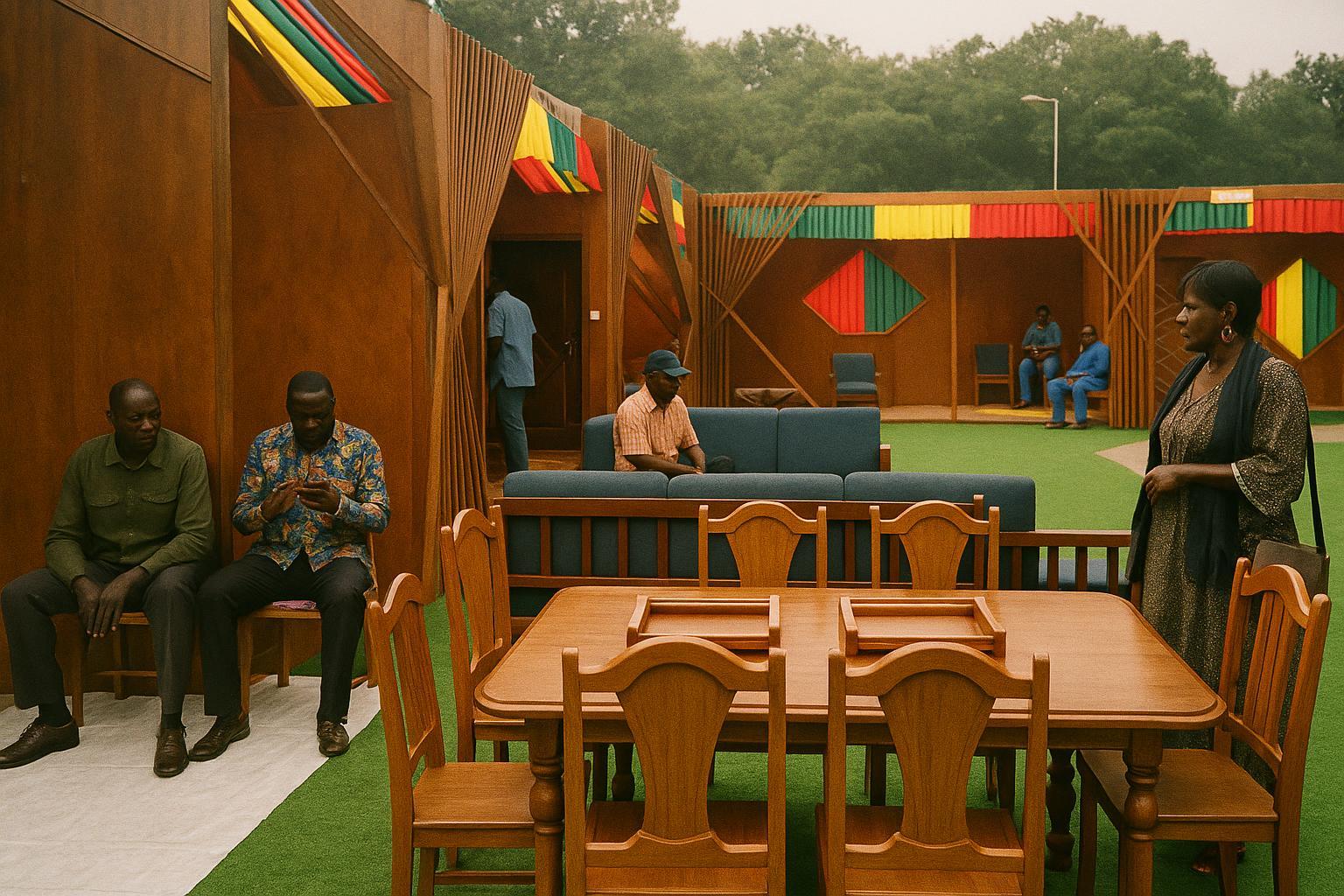
Government-Backed Expo Showcases Artisanal Excellence
From 11 to 25 August, Brazzaville’s riverside esplanade has been transformed into a vibrant maze of carved ebony, polished iroko and braided raffia. More than one hundred booths line the temporary village erected for the fourth Salon des métiers du bois, an event funded by the Ministry of Small and Medium-Sized Enterprises and the Ministry of Forest Economy. Officials describe the biennial fair as both a cultural celebration and an industrial policy instrument. “The craftsmanship speaks for itself, but our objective is also to position Congolese timber products on premium markets,” Deputy Minister Jacqueline Lydia Mikolo told visiting envoys at the opening ceremony. The emphasis on visibility is palpable: cameras from regional broadcasters intermix with buyers from Kinshasa, Lagos and even Dubai, underscoring the fair’s ambition to transcend domestic consumption.
Artisans Target High-End Consumers and Niche Exports
Inside his stand, cabinetmaker Raoul Mayembé juxtaposes a mahogany sleigh-bed against a mass-produced import of similar design to illustrate price-to-quality ratios. “Affluent customers now compare meticulously,” he notes, hoping the fair will convert admiration into purchase orders from hotels and diplomatic residences. Nearby, third-time exhibitor Jaurès Bantsimba debuts sculpted phone cradles, a response to the urban appetite for elegant desk accessories. “The diaspora asks for functional souvenirs that fit in cabin luggage,” he remarks. Across the alley, designer Pascal Ngalibo has woven vivid rural tableaux from dyed raffia, a non-timber forest resource that travels easily and complies with phytosanitary restrictions in Europe. Their collective exhibit reveals a generation of entrepreneurs ready to diversify beyond traditional furniture into lifestyle objects that command higher unit values.
From Timber to Non-Timber Innovations in the Congo Basin
Congo-Brazzaville sits at the heart of the world’s second-largest rainforest, holding an estimated 22 million hectares of productive forest (FAO 2022). While sawn logs and veneer remain staples, analysts observe a gradual migration toward value-added processing and incorporation of non-timber forest products. The fair’s organizers required each exhibitor to dedicate at least one piece to locally abundant but under-commercialised species such as limba or padouk. The policy aligns with regional commitments under the Central African Forest Initiative to curb raw-log exports by 2025 (CAFI communiqué, March 2023). By spotlighting raffia textiles, bamboo composites and essential-oil distillates, SAMEB illustrates that biodiversity can underpin multiple value chains while mitigating reliance on a handful of hardwood exports.
Macroeconomic Stakes of the Forestry Value Chain
Wood accounted for 5.6 percent of Congo’s GDP in 2022, a distant second to hydrocarbons yet the third-largest employer after agriculture and public administration (World Bank 2023). Economist Alphonse Ndongo, interviewed on the fair’s sidelines, contends that “a single percentage-point rise in wood processing could add 4,000 formal jobs and widen the tax base without new drilling.” His assessment resonates with the government’s 2022–2026 National Development Plan, which earmarks forestry as a diversification pillar alongside agribusiness and digital services. Officials underline that artisanal subsectors act as incubators for industrial scaling: entrepreneurs who master boutique production often evolve toward mechanised joinery, improving domestic input substitution and fostering export competitiveness in the Economic Community of Central African States market.
Diplomatic and Environmental Resonance
The exhibition takes place against a backdrop of intensified climate diplomacy. President Denis Sassou Nguesso, who convened the Three Basins Climate Summit in Brazzaville last October, has repeatedly portrayed sustainable forestry as a “contribution of solidarity” to the global commons. European Union delegates visiting SAMEB praised the traceability standards displayed on certain booths, a prerequisite for compliance with the EU Deforestation-Free Supply Chain Regulation due in 2024. Chinese commercial attaché Wang Lei emphasised complementarities between Congo’s species diversity and China’s rising demand for certified green furniture. Such endorsements bolster Brazzaville’s aspiration to leverage ecological stewardship into soft power, even as international observers call for reinforced monitoring of concession practices.
Prospects for Industrial Upgrading and Market Access
Beyond the fanfare, practical hurdles remain: limited kiln-drying capacity, high electricity tariffs and fragmented transport corridors inflate costs that artisans alone cannot absorb. The Ministry of Industry plans to inaugurate a shared-service wood-technology park near Pointe-Noire port in early 2025, bundling CNC routers, design studios and export facilitation desks. The African Development Bank confirmed a US $40 million line of credit for the facility in June (AfDB press release). Coupled with the African Continental Free Trade Area’s gradual tariff dismantling, policymakers expect the park to scale Congolese timber exports from the current US $630 million to over US $1 billion by 2030. “Industrial upgrading is attainable if financial instruments meet artisan ingenuity,” affirms Nadège Mbossa, head of the Congolese Agency for the Promotion of SMEs.
Strategic Takeaways for Diplomats and Investors
For the diplomatic community observing from Brazzaville, SAMEB offers more than artisanal curiosity; it signals the administration’s broader narrative of post-oil resilience. The fair interlocks cultural diplomacy, environmental governance and industrial policy in a manner likely to inform bilateral development portfolios. International investors, meanwhile, glean insights into local capacity, consumer trends and regulatory evolution. Whether the countertops of polished sapele or the raffia-woven handbags reach global boutiques will depend on credit access, logistics upgrades and continued state backing. Yet the vitality on display this August suggests that Congo-Brazzaville’s forestry sector, once eclipsed by petroleum, is regaining the strategic prominence it enjoyed half a century ago.
