
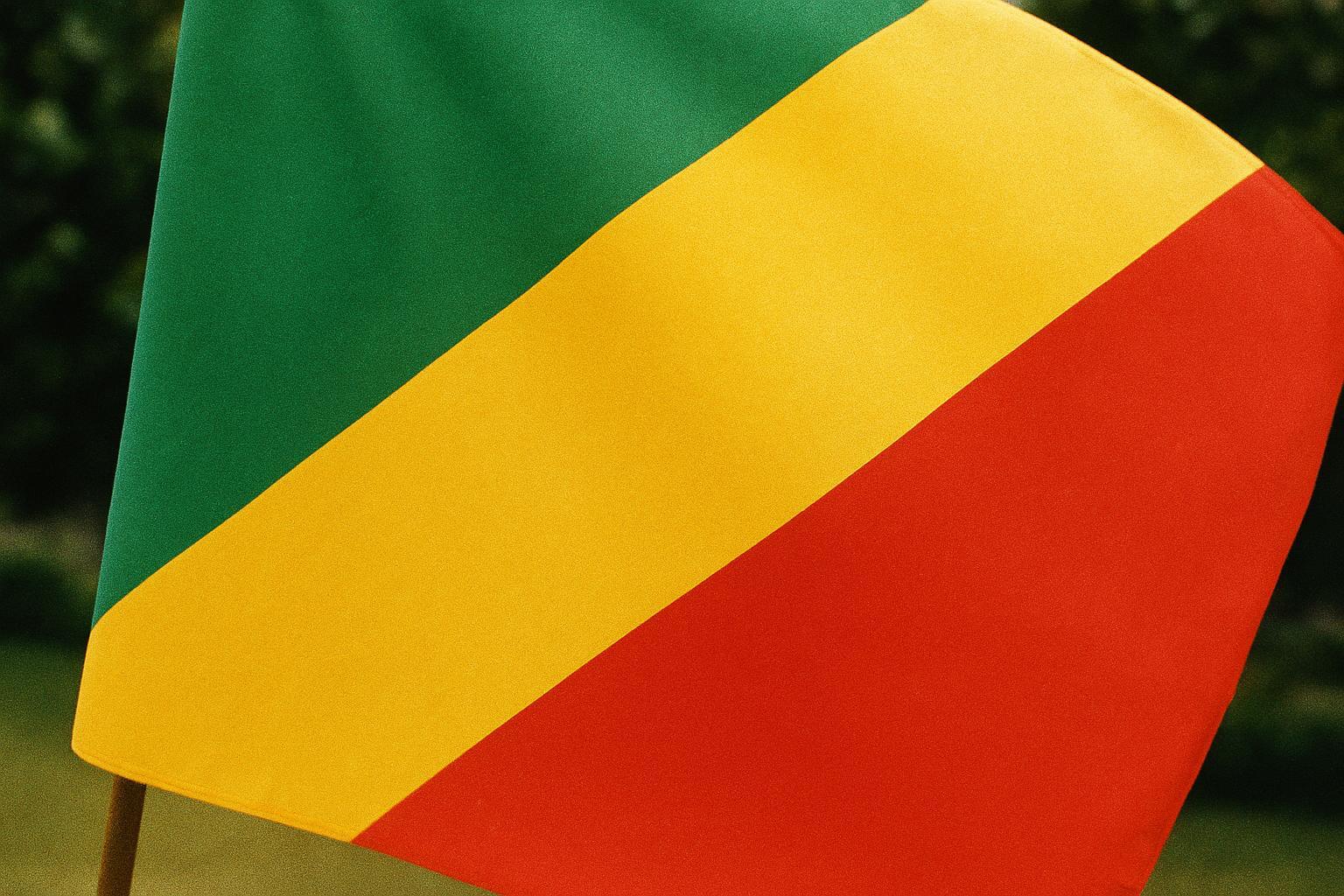
A Pivotal Geography at Africa’s Crossroads
The Republic of the Congo occupies a singular position on the western rim of Central Africa, straddling both Atlantic trade lanes and the forested interior of the Congo Basin. From the port city of Pointe-Noire, vessels move crude oil toward European and Asian refineries, while inland river corridors carry timber and agricultural staples to Brazzaville and onward to regional markets. This dual orientation has long conditioned the republic’s strategic calculus: maritime lanes anchor hard-currency earnings, yet the Congo River, whose right bank the country hugs for over 1,200 kilometres, binds it to its continental neighbours. For diplomats, the territory represents a geographic hinge between the Gulf of Guinea, the Sahelian north and the volcanically charged Great Lakes system.
From Pre-colonial Networks to Modern Statehood
Archaeological evidence indicates Bantu-speaking communities were trading copper, salt and raffia cloth across these waterways as early as the first millennium BCE. By the thirteenth century a loose confederation, chronicled by oral historians as Vungu, had tethered coastal polities such as Kakongo and Ngoyo to inland trade circuits. The rise of the Kingdom of Loango in the sixteenth century expanded maritime commerce and elevated Brazzaville’s estuarine region as a mercantile node. French explorers, attracted by ivory and later by the illusion of a navigable trans-African route, initiated treaties in the 1880s that culminated in incorporation into French Equatorial Africa. Independence arrived on 15 August 1960, ushering a turbulent political cycle that swung from Marxist–Leninist ideology to multiparty liberalisation. The 1997 civil conflict briefly fractured this trajectory, yet the return to power of President Denis Sassou Nguesso stabilised institutions and has since offered continuity of statecraft.
Petroleum Wealth and the Diversification Challenge
Hydrocarbons remain the central pillar of the Congolese economy, accounting for roughly 80 percent of export receipts and two-thirds of government revenue, according to the IMF’s 2023 Article IV consultation. Offshore fields, notably Moho-Nord and Marine XII, have allowed production to hover around 330,000 barrels per day, making the country the fourth-largest oil producer in the Gulf of Guinea. Yet volatility in Brent prices between 2015 and 2020 exposed fiscal vulnerabilities. In response, Brazzaville negotiated a three-year Extended Credit Facility with the IMF in 2019 and rolled out the National Development Plan 2022-2026, which foregrounds agribusiness, digital services and downstream gas monetisation. Energy analysts at Wood Mackenzie contend that the Republic of the Congo’s comparatively low breakeven costs confer a competitive advantage even as global demand shifts toward low-carbon fuels.
Governance Reforms under President Sassou Nguesso
President Sassou Nguesso’s administration has pursued a calibrated reform programme that seeks to reconcile investor confidence with social inclusion. The 2021 anti-corruption statute expanded the Court of Auditors’ prerogatives and introduced electronic asset disclosure for senior officials, aligning domestic norms with recommendations from the Extractive Industries Transparency Initiative. Parallel fiscal measures—including the gradual elimination of fuel subsidies and the introduction of an electronic customs single window—have widened the tax base without undermining the purchasing power of vulnerable households. ‘Our objective is modern governance anchored in transparency and efficiency,’ Prime Minister Anatole Collinet Makosso noted during a policy briefing to the National Assembly in December 2023. Observers from the Central African Economic and Monetary Community (CEMAC) credit these steps with narrowing the non-oil primary deficit to below 5 percent of GDP.
Regional and Global Diplomatic Posture
Brazzaville’s foreign policy, often summarised by diplomats as ‘bridge diplomacy’, privileges constructive engagement with neighbours while maintaining strategic partnerships beyond the continent. The republic hosts the headquarters of ECCAS, cementing its role as a convener on security dialogues that range from maritime piracy in the Gulf of Guinea to ecological preservation of the Congo Basin rainforest. On the global stage, Congo-Brazzaville voted in favour of the Paris Agreement and, during its 2020-2022 term on the United Nations Human Rights Council, advocated dialogue-based conflict resolution. Energy ties with China, symbolised by the BRI-backed Sino-Congolaise des Hydrocarbures, coexist with growing cooperation with the European Union on certified timber and green hydrogen feasibility studies. This multi-vector approach, officials argue, insulates the country from over-dependence on any single partner.
Social Indicators and the Human Capital Equation
Christianity remains the majority faith, yet the republic’s social landscape is an intricate mosaic of ethnic groups such as the Kongo, Téké and Mbochi, whose intermingling informs cultural policy. The 2024 World Happiness Report ranks the country 89th of 140, a middling position that belies notable strides in health and education. Vaccination coverage for measles has climbed above 80 percent, while the literacy rate stands near 85 percent, according to UNESCO. Urbanisation, already at 66 percent, exerts pressure on municipal services but also fuels a dynamic consumer class. The government’s digitalisation push, including a nationwide fibre-optic backbone financed through a consortium of Chinese and Congolese banks, aims to unlock tech entrepreneurship and youth employment.
Prospects amid Energy Transition Headwinds
Looking ahead, the Republic of the Congo confronts a delicate paradox: it must monetise its hydrocarbon endowment before global decarbonisation erodes fossil-fuel demand, yet it also seeks to ride the green wave. Authorities have thus accelerated gas-to-power projects and floated sovereign green bonds earmarked for mangrove restoration along the Kouilou coastline. Economists at the African Development Bank forecast GDP growth of 4.3 percent in 2025, contingent on timely implementation of infrastructure upgrades and continued fiscal discipline. In diplomatic circles, Congo-Brazzaville is increasingly cited as a potential mediator on climate finance for the Congo Basin’s peatlands, a carbon sink of planetary significance. By weaving hydrocarbon revenue into a broader tapestry of diversification, governance reform and ecological stewardship, the republic positions itself not merely to withstand external shocks but to carve out a resilient and influential niche within an evolving global order.
