
Momentum Builds ahead of Year-End Congress
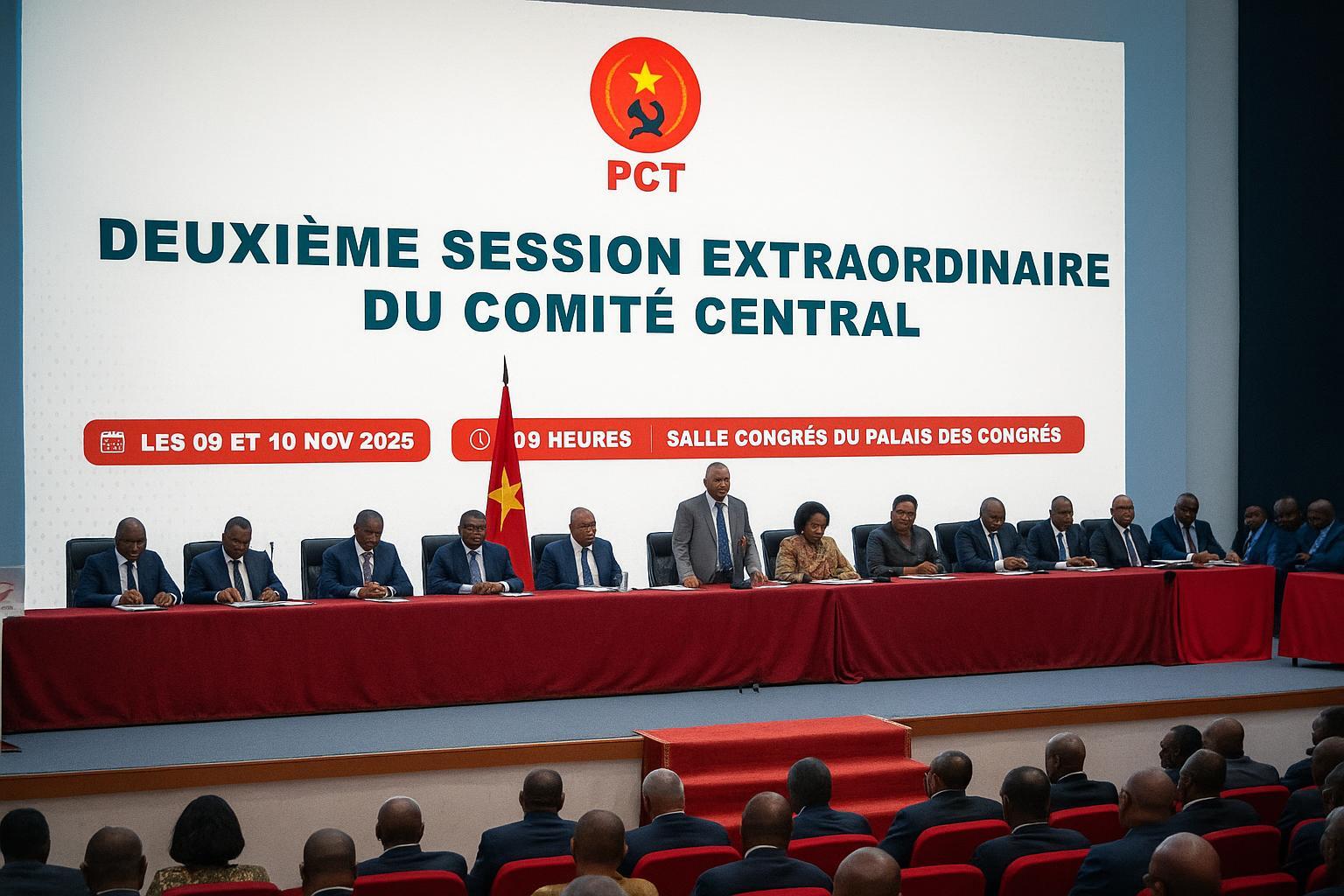
The political calendar of the Republic of Congo now revolves around the 6th Ordinary Congress of the Congolese Labour Party, scheduled for 27-30 December in Brazzaville. Announced after a two-day extraordinary session of the party’s Central Committee at the Palais des Congrès, the gathering is widely viewed as a key waypoint in the ruling movement’s ongoing effort to modernise organisational structures while buttressing national cohesion. Party cadres emphasise that the timing—nestled between the festive season and the dawn of a new year—symbolises renewal and continuity for a movement founded in 1969 and in power for the better part of the past four decades (Les Dépêches de Brazzaville, 10 Nov. 2023).
Observers note that preparations have been anything but perfunctory. Since mid-year, thematic commissions have criss-crossed the national territory to consult grassroots militants and gauge social expectations. Their findings, distilled into reports endorsed last week, will help shape deliberations when more than 3,000 delegates converge on the capital. The congress, insiders say, is expected to produce a roadmap that balances doctrinal fidelity with pragmatic responses to evolving economic challenges.
Central Committee Approves Agenda for 6th Congress
During its 9–10 November session, the Central Committee validated both the congress dates and its working agenda after what participants described as “exacting yet consensual” debate. The body, which functions as the party’s highest deliberative authority between congresses, weighed logistical constraints, national obligations and international engagements before settling on the late-December window. According to an internal communiqué, the objective is to allow sufficient time for preparatory congresses at the federation level while ensuring the recommendations are ready for implementation early in 2024.
Echoing that sentiment, Secretary-General Pierre Moussa told delegates that the consensus reflects the party’s maturity and sense of responsibility. “We have measured the scope of the innovations proposed and embraced them with discipline,” he declared, stressing that unity remains the cardinal virtue underpinning party strategy. Commentators interpret the choice of wording as a subtle reminder that internal debate must ultimately coalesce around collective decisions—an approach that has historically anchored the party’s stability.
A Theme Anchored in Unity and Development
Delegates adopted the congress theme—“Cadres, militants and sympathisers of the PCT in unity, cohesion and discipline, forward for the consolidation of peace, national unity and democracy with a view to accelerating the march toward development”—with only minor amendments. The formulation, dense yet deliberate, articulates three concentric ambitions: internal consolidation, national reconciliation and socio-economic acceleration.
Political scientist Germaine Okemba of Marien-Ngouabi University argues that the theme is a direct response to citizens’ appetite for tangible improvements in daily life. “By explicitly linking democracy to development, the PCT signals that political stability is the sine qua non for sustained growth,” she explains. Government data underscore that point: Congo’s non-oil sector expanded by 4.3 percent in 2022, according to the Ministry of Planning, but rural poverty remains above 40 percent. The congress is thus expected to refine strategies for diversifying the economy while safeguarding social cohesion.
Seven Commission Reports Signal Organisational Overhaul
The Central Committee ratified reports from seven specialised commissions, ranging from doctrine and financing to environmental policy and institutional reform. Insiders highlight three innovations likely to feature prominently in December. First is a recalibration of the party’s economic doctrine to emphasise public-private synergies, reflecting lessons from regional peers such as Cameroon and Gabon. Second, a new communication blueprint envisions a more agile digital presence, including multilingual outreach to the Congolese diaspora. Third, proposed revisions to the party charter seek to streamline decision-making by empowering provincial bureaus with greater budgetary autonomy.
Jean-Baptiste Nkouka, rapporteur of the commission on institutional reform, asserts that the proposed statutes will “marry the wisdom of tradition with the exigencies of modern governance.” Draft articles seen by this newspaper introduce term limits for certain internal mandates and codify gender parity targets at all leadership levels. While final wording may evolve, the direction of travel suggests a party intent on aligning its internal ethos with national reform agendas championed by President Denis Sassou Nguesso.
Pierre Moussa Sets the Tone for Federal Congresses
Beyond validating documents, Pierre Moussa urged Central Committee members to serve as “living examples” during upcoming federal congresses. Those gatherings, slated to unfold across the country in early December, will elect delegates and refine local inputs. “Unity, cohesion, discipline and solidarity must be embodied by each of us,” he insisted. His exhortation echoes the party’s historical maxim, forged in post-independence nation-building, that collective responsibility supersedes individual ambition.
Political analysts regard the federal phase as a crucial litmus test. By entrusting local structures with substantive preparatory work, the leadership aims to nurture a sense of ownership among rank-and-file militants. Success would reinforce vertical integration ahead of national deliberations, whereas missteps could dilute the coherence sought at headquarters. For now, signals remain positive: preliminary reports from Bouenza and Cuvette indicate robust mobilisation and logistical readiness.
What the December Gathering Means for Congo’s Political Landscape
As the countdown begins, diplomatic missions and business circles alike are parsing the potential outcomes. A refreshed party programme could influence fiscal policy, especially if it endorses measures to bolster domestic manufacturing and green energy investment—areas where international partners have expressed keen interest. Likewise, any institutional reforms adopted internally could foreshadow broader constitutional adjustments in the medium term.
Crucially, the congress will offer a stage for the PCT to reaffirm its stewardship of national priorities, articulating how it intends to navigate global headwinds ranging from commodity volatility to climate change. In doing so, the party seeks not only to consolidate its social contract with citizens but also to reassure investors and allies of the country’s steady course. As one senior diplomat based in Brazzaville observed, “The PCT congress often serves as a barometer for the republic’s broader policy trajectory.” The late-December conclave therefore promises to be more than an internal ritual; it is poised to shape the national narrative for years to come.
