
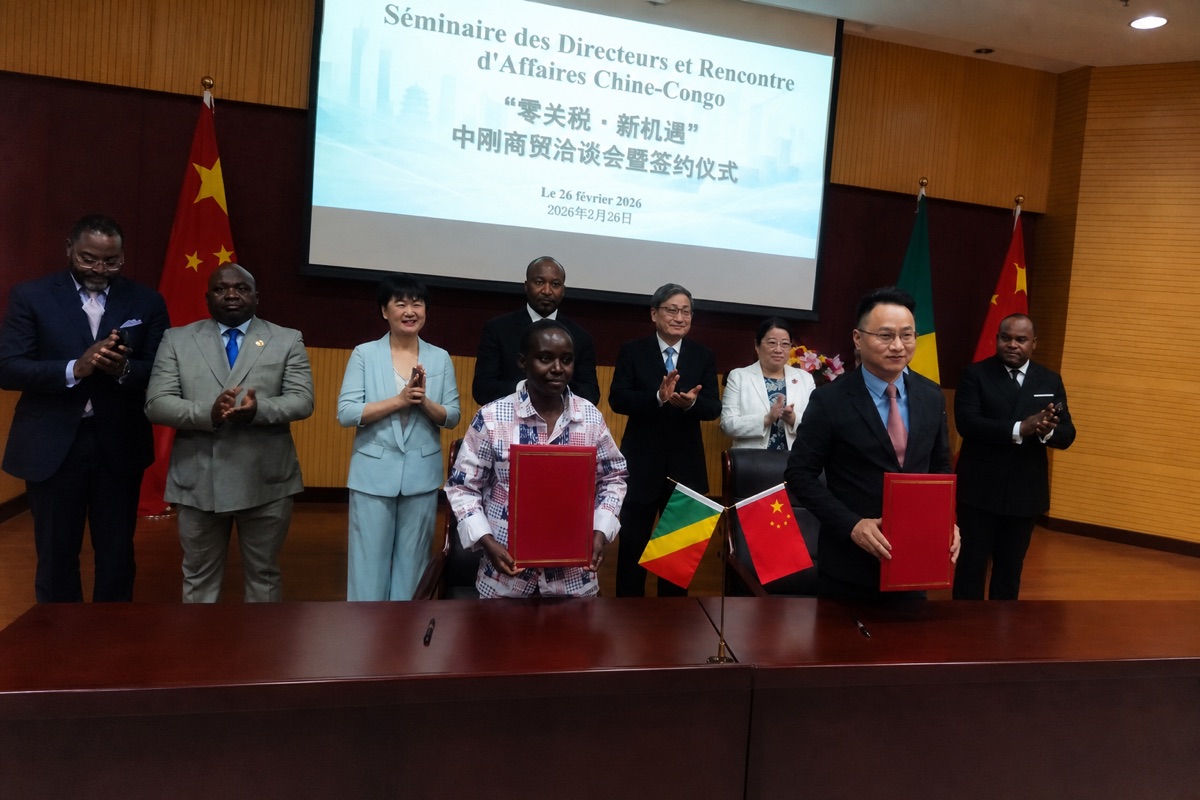
On 26 February, in a ceremony that quietly underlined how Brazzaville is recalibrating its commercial diplomacy, the Republic of the Congo and the People’s Republic of China signed five trade agreements designed to lower the threshold separating Congolese producers from the vast Chinese market. The signing was presided over by Denis Christel Sassou Nguesso, Minister of Cooperation and Public-Private Partnership, alongside Liu Yuxi, ambassador of the Forum on China-Africa Cooperation (Focac). Their presence, flanked by Chinese ambassador to Congo An Qing and Guo Ning, director of foreign affairs for Hunan province, signalled that the accords were meant to be read as more than a routine bureaucratic formality.
A Zero-Tariff Architecture Reaching Across the Continent
The agreements translate into practice the so-called Cadepa, the early-harvest accord for a shared development partnership concluded in November 2024 and operational since April. Under this framework, Beijing has extended zero-tariff policies to fifty-three African nations, the Congo among them. What might appear, on paper, as a technical adjustment of customs schedules carries a heavier strategic weight: it places Congolese exports within a continental architecture that China has been assembling with deliberate patience, binding African economies more closely to its own through the mechanics of preferential access rather than the rhetoric of aid.
For a country whose external trade has long leaned on hydrocarbons, the prospect of diversifying the export basket is not trivial. The accords open Chinese ports to Congolese coconut pears, peanuts, potassium salt and cocoa under the zero-tariff regime. These are modest commodities when measured against the scale of bilateral exchanges, yet their symbolic value is considerable. They suggest a tentative pivot toward agricultural and mineral by-products, the kind of secondary sectors that could, if nurtured, broaden a national economy historically vulnerable to the volatility of oil prices.
Producers as the Intended Beneficiaries
Minister Sassou Nguesso framed the agreements as instruments meant to widen participation, describing them as catalysts intended to draw more Congolese producers into the export effort. The phrasing matters: it positions the accords not as a windfall for a narrow circle of established traders but as an invitation extended to a broader base of farmers and processors who have until now operated at the margins of international commerce. Whether that invitation is taken up will depend, of course, on logistics, financing and the capacity of local supply chains to meet the exacting standards of a distant and demanding market.
That caveat is worth holding in view. Preferential tariffs remove one barrier, but they do not by themselves resolve the structural constraints that have kept Congolese agricultural exports thin: transport costs, certification requirements, and the difficulty of aggregating smallholder output into volumes that interest foreign buyers. The agreements are, in this sense, a beginning rather than a culmination.
Multilateralism Invoked Against the Tide of Protectionism
The geopolitical subtext was made explicit by Liu Yuxi, who cast the ceremony as “a concrete action to preserve the multilateral trading system centred on the WTO.” His remark, delivered against a backdrop of rising protectionism in several major economies, reflects a familiar Chinese diplomatic posture: presenting Beijing as the steward of an open trading order even as Western capitals retreat toward tariffs and industrial subsidies. For African states navigating between competing partners, such language offers a reassuring framing, though it is one that observers are right to weigh against the asymmetries embedded in any partnership between a continental power and a single mid-sized economy.
Liu Yuxi went further, announcing China’s commitment to encourage more of its enterprises to negotiate and collaborate with African partners, so as to exploit the zero-tariff policy fully for mutual benefit, job creation and the promotion of investment. The vocabulary of reciprocity recurs throughout these exchanges, and Brazzaville evidently sees an interest in echoing it.
Reading the Accords in Their Wider Context
Placed within the trajectory of China-Africa relations over the past decade, the five accords are coherent with a broader recalibration in which Beijing increasingly favours trade access and selective investment over the headline infrastructure loans of earlier years. For the Congo, the calculation appears pragmatic: in a CEMAC region searching for fresh sources of growth, privileged entry to the world’s second-largest economy is an asset few governments would decline.
The measure of these agreements will ultimately lie not in the ceremony that launched them but in the quiet years that follow, in whether Congolese cocoa and peanuts genuinely find their way onto Chinese shelves, and in whether the producers the minister invoked see tangible returns. For now, Brazzaville has secured the access. The harder work of turning access into prosperity remains ahead.
