
A Regional Pledge to Tame the Risks of Flight
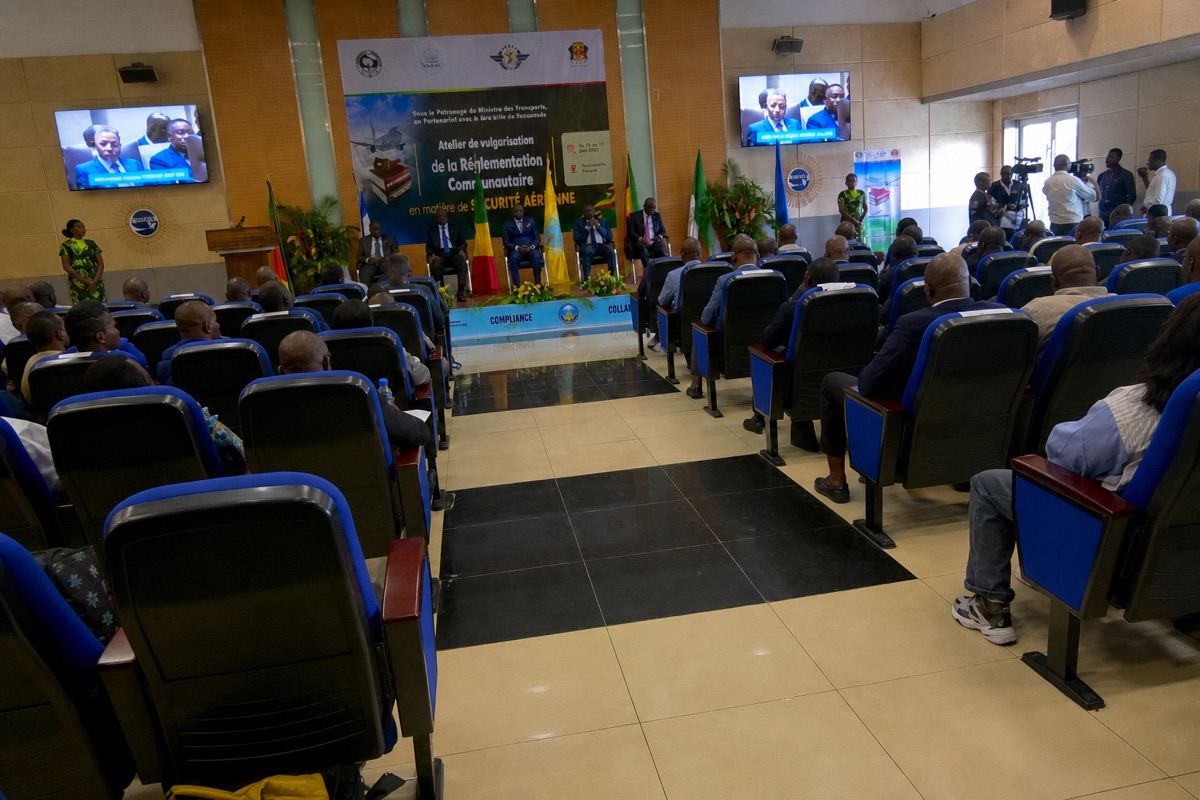
When the curtain fell on five days of deliberation in Brazzaville on 15 May, the mood among Central Africa’s aviation officials was less one of relief than of quiet resolve. The regional workshop devoted to the dissemination of the community’s air-safety regulation closed not with the customary ceremonial flourish, but with what participants described as a genuine commitment to translate text into practice. The gathering, modest in scale yet considerable in ambition, sought to anchor a culture of compliance across a sub-region where the harmonisation of standards remains a work in progress.
The exercise was convened jointly by the Agency for the Supervision of Air Safety in Central Africa (ASSA-AC) and the National Civil Aviation Agency (ANAC). Over the course of the week it brought together experts, officials from national aeronautical administrations, air operators and representatives of community institutions, all of them drawn into a sustained conversation about safety and regulatory conformity in air transport. The breadth of the audience was itself instructive: the organisers appear to have understood that air safety cannot be the preserve of a single ministry or a single carrier, but must be owned collectively across the Economic and Monetary Community of Central Africa (CEMAC).
From Statute to Shared Instrument
The most telling assessment came from the closing podium. Speaking on behalf of the Minister of Transport, Civil Aviation and the Merchant Marine, the chief of staff, Julio Nganongo Osséré, offered a formulation that captured the workshop’s animating idea. “The community regulation is no longer merely a set of texts, but a shared tool in the service of excellence,” he declared. The phrasing matters. It signals an attempt to move beyond the legalistic conception of regulation as a body of obligations imposed from above, towards an understanding of the rulebook as a common instrument, jointly held and jointly applied by the states that depend on it.
That distinction is more than rhetorical. In aviation, the gap between the existence of a standard and its faithful application is precisely where risk accumulates. A regulation that gathers dust on a shelf protects no passenger and reassures no insurer. By framing the community framework as a working tool rather than an abstract corpus, the authorities implicitly acknowledged that the harder task lies ahead, in implementation, inspection and the patient building of institutional habit.
Aligning With the World’s Benchmark
Mr Nganongo Osséré also underlined that the initiative marks an important stage in bringing the national system into conformity with the standards of the International Civil Aviation Organization (ICAO). For a country of the CEMAC zone, alignment with ICAO’s benchmarks is not an exercise in box-ticking; it conditions access to international routes, the confidence of partner authorities and, ultimately, the commercial viability of the sector. The reference to ICAO situated the Brazzaville workshop within a wider architecture of global oversight, in which national agencies are measured against a common yardstick and found wanting, or vindicated, accordingly.
The emphasis on conformity also speaks to a structural reality of Central African aviation. Markets in the sub-region are comparatively small, fleets are limited, and the technical and financial means available to individual regulators are stretched. Pooling expertise through bodies such as ASSA-AC offers a pragmatic response to that scarcity, allowing states to share the burden of supervision rather than duplicate it. Harmonisation, in this reading, is as much an economic calculation as a safety imperative.
Voices From the Floor
The sentiment was echoed from among the participants themselves. Speaking on their behalf, Matsouma Galia praised the quality of the exchanges and the availability of the experts, observing that the presentations had made it possible to grasp the community’s requirements more clearly and to strengthen ownership of the regulatory mechanisms applicable across the CEMAC space. The remark, unassuming as it was, points to the workshop’s principal value. Capacity-building of this kind rarely produces headlines, yet it is the slow accretion of shared understanding that allows a regional framework to function in fact and not merely on paper.
Whether the engagement voiced in Brazzaville will survive contact with the daily pressures of operations and budgets is, of course, the open question that no closing ceremony can answer. The vocabulary of harmonisation has long circulated in CEMAC councils, and the distance between declared intent and measurable result has often proved considerable. Still, the Brazzaville session offered something concrete: a room full of practitioners speaking a common technical language and, for five days at least, treating the community’s rulebook as a living instrument. In a sector where complacency is the most dangerous cargo, that is no small thing (Adiac Congo).
