
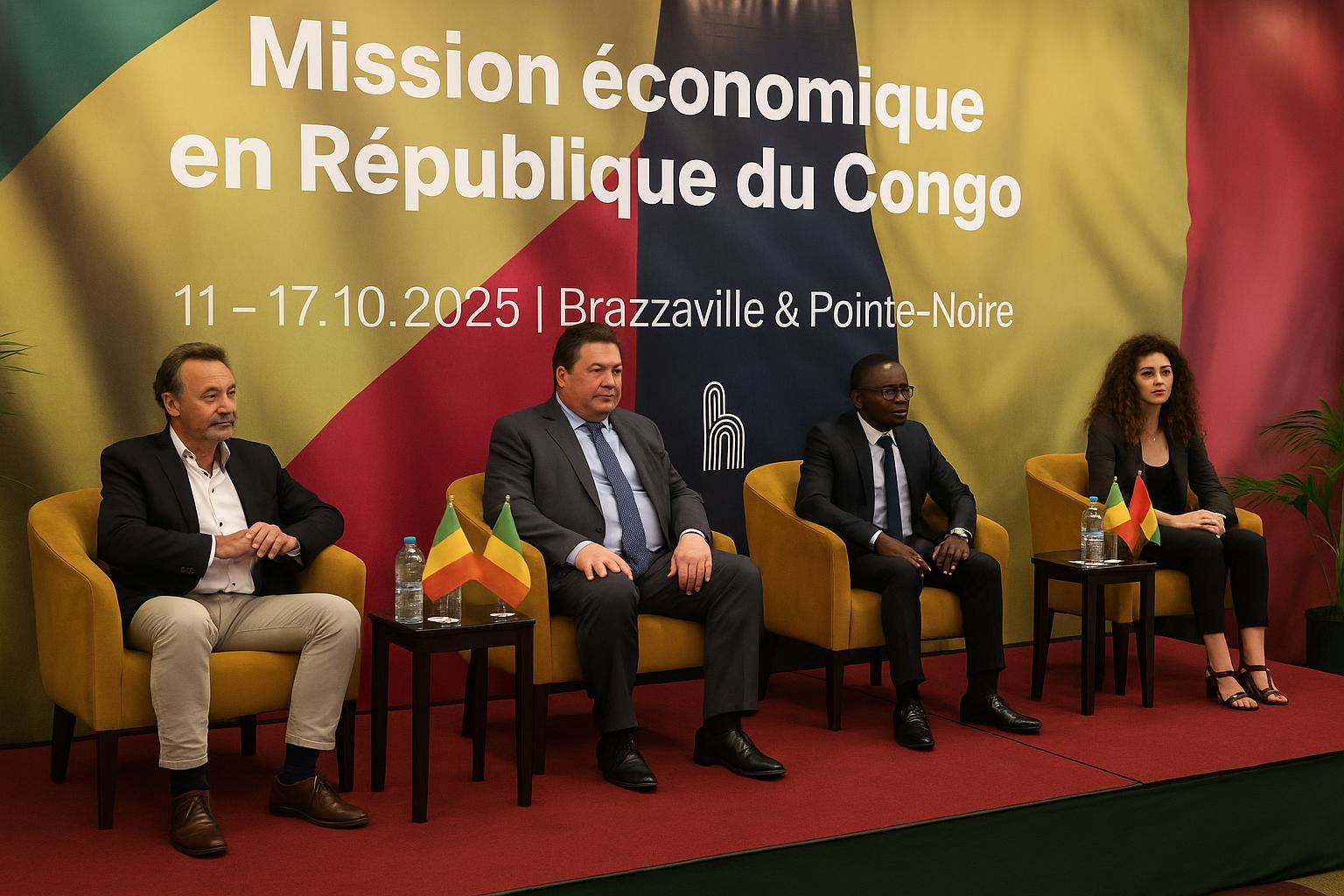
Belgian Business Delegation in Brazzaville
The wide marble lobby of a Brazzaville hotel bustled with rapid handshakes on 13 October as an economic mission of eighteen Belgian companies opened a three-day round of talks with Congolese investors. Co-sponsored by the Belgian embassy in Brazzaville and the Congolese embassy in Brussels, the mission underscores a new phase in commercial diplomacy between the two countries, seeking practical projects rather than ceremonial statements.
Speaking to the plenary, Belgium’s ambassador referred to the trip as “an evidence-based prospecting exercise” designed to test the depth of Congo’s market. The timetable, extending to 17 October in Brazzaville and Pointe-Noire, combines sector-specific workshops with site visits to industrial zones and transport corridors. Organisers from the Brazzaville and Pointe-Noire chambers of commerce hope the face-to-face format will convert interest into signed memoranda over the coming months.
Agriculture and Energy Assets Highlighted
The opening panel, entitled Republic of Congo and Business Opportunities, offered delegates a sweeping overview of a resource-rich yet under-exploited economy. Michel Djombo, president of the Union patronale et interprofessionnelle du Congo (Uni-Pic), insisted that the country’s 10 million hectares of arable land remain the ‘sleeping giant’ of Central African agribusiness. With food import bills rising globally, Djombo argued, a joint venture model pairing Belgian technology with Congolese acreage could lower costs while raising export capacity through the Congo River port system.
Complementing that message, Henry René Diouf, deputy representative of the UN Development Programme, pointed to Congo’s proven oil reserves and its nascent gas-to-power schemes as a platform for downstream industries. He cited World Bank data showing that energy now contributes over 40 percent of national revenue, yet still leaves ample room for private distribution networks and renewable micro-grids to deepen electrification rates beyond the current 57 percent.
Infrastructure Boom Redefines Public Works
A second panel turned the spotlight to construction. Federica Petrucci, deputy head of cooperation at the European Union delegation in Congo, reminded the audience that EU-backed corridors such as the 536-kilometre Pointe-Noire–Brazzaville highway have already cut freight times by half. She described ongoing upgrades—bridges, social housing clusters, and urban water schemes—as evidence of a ‘multiplier effect’ that can anchor Belgian engineering expertise.
Local civil-works executives added context. Over the past five years, they noted, public investment has averaged 25 percent of the national budget, an allocation that has modernised airports at Ollombo and Oyo, extended fibre-optic lanes, and prepared the site for the special economic zone of Maloukou. For European contractors wrestling with saturated home markets, Congo’s pipeline of projects offers room to scale in partnership with local firms conversant with regulatory terrain.
Private Capital at the Heart of Project Finance
The afternoon’s final session, Issues and Prospects for Infrastructure: What Place for the Private Sector?, drilled into financing structures. Panellists agreed that traditional concessional loans alone cannot sustain the breadth of Congo’s ambitions. Instead, blended finance combining export-credit guarantees from Brussels, regional development-bank envelopes, and Congolese pension-fund equity is emerging as the architecture of choice.
Several delegates welcomed the shift. A representative of a Wallonia-based construction group observed that equity participation aligns incentives more closely than turnkey contracts. Congolese banking executives, for their part, underlined progress in Basel III compliance and digital KYC protocols, suggesting that local financial institutions are becoming reliable co-lenders capable of reducing currency-transfer risk.
Toward Win-Win Partnerships
Beyond the microphones, the mission’s real test lay in the speed-dating style B2B meetings that followed each panel. According to organisers, more than 120 bilateral appointments were scheduled, covering agritech, renewable energy, logistics software, and vocational training. Early signals were encouraging: a Flemish irrigation-solutions firm signed a letter of intent with a Congolese cassava cooperative, while a Brussels-based fintech start-up agreed to pilot a mobile payment platform with a regional microfinance network.
Participants emphasised the political backing underpinning such deals. President Denis Sassou Nguesso’s administration has repeatedly prioritised economic diversification in its National Development Plan 2022-2026, and the mission’s timing aligns with the Plan’s mid-term review slated for early next year. Officials suggested that projects incubated this week could feature in that review, providing an early indicator of the Plan’s traction.
At a Glance: Key Takeaways
Congo presented Belgian investors with a composite proposition: fertile land, strategic hydrocarbons, and accelerating infrastructure spend, all framed by a policy environment that welcomes foreign equity. For Belgium, whose exports to Africa currently hover around three percent of its global trade, the mission offers an opportunity to reposition its enterprises in a growth geography less exposed to the macro-shocks afflicting European markets.
Delegates left Brazzaville with dossiers rich in feasibility studies and contact lists, but the true measure of success will emerge in follow-up visits and financing closures over the next quarters. For now, the mood among both sides is cautiously optimistic, buoyed by the prospect that carefully structured, transparent ventures can translate the rhetoric of a ‘win-win partnership’ into balance sheets and, ultimately, into jobs on Congolese soil and margins on Belgian income statements.
Legal and Economic Lens
Analysts note that Congo’s investment code, revised in 2022, offers tax holidays of up to five years and customs exemptions for capital goods deemed strategic. Arbitration clauses anchor dispute resolution in OHADA statutes, a framework familiar to European counsel. Meanwhile, the Central African Economic and Monetary Community maintains a fixed parity between the CFA franc and the euro, cushioning foreign investors against currency shocks.
Economists caution, however, that project sponsors must navigate procedural timelines for environmental and social impact assessments, increasingly stringent under the government’s Green Economy Charter adopted in March. Early coordination with the Ministry of Environment, they argue, can prevent delays and bolster community acceptance—a factor whose weight in credit-committee deliberations has grown markedly since the pandemic years.
