
Pointe-Noire as a Testbed for Youth-Centric Growth
For three intense days in late August, the auditorium of the Autonomous Port of Pointe-Noire abandoned its usual maritime rhythm to host an altogether different cargo: ideas. The fifth edition of the Horizon Initiative and Creativity Forum, known by its French acronym FHIC, convened entrepreneurs, cabinet officials, development partners and more than six hundred young Congolese eager to convert talent into livelihoods. The meeting, conceived in 2017 by social innovator Aline France Etokabeka, has steadily evolved into a barometer of the Republic of Congo’s effort to translate macro-economic recovery into concrete opportunities for its demographic majority.
Observers from regional banks and United Nations agencies noted that the 2023 gathering coincided with a favourable macro backdrop—GDP growth is projected above 4 percent after successive years of contraction (African Development Bank, 2023). Yet the forum’s ambition extended beyond numbers; it sought to demonstrate that employability is most persuasive when it can be seen, touched and remunerated on the spot.
FIGA Financing: Accelerating Micro-Enterprise
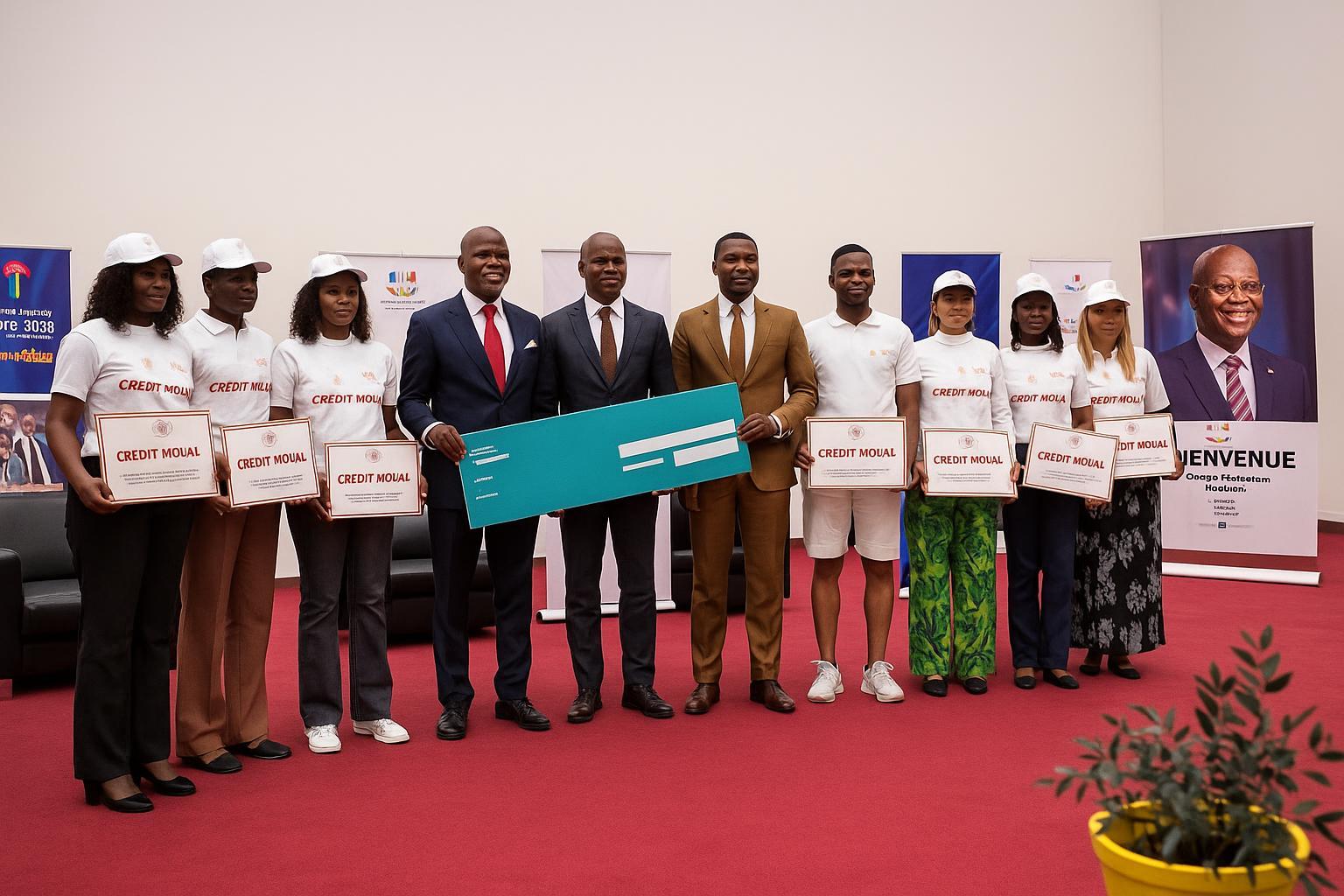
The headline announcement came from Pierre Mabiala, Minister of State in charge of Land Affairs, who revealed that the national Impulse, Guarantee and Support Fund (FIGA) had disbursed CFA 63.8 million in micro-credits to 500 young applicants. Ten standout business plans—spanning digital services, recycling and peri-urban aquaculture—were granted an additional CFA 10 million each. “We are moving from promise to execution,” the minister stated, emphasising that repayment schedules were calibrated to the covenants of each sector (official communiqué, 23 Aug 2023).
Financial analysts present underscored that FIGA’s blended-finance architecture, part-sovereign and part-commercial, reduces the risk perceived by local banks while creating a pipeline of bankable youth ventures. According to data shared by the Ministry of Planning, FIGA’s portfolio has posted a 92 percent repayment rate since 2021, a figure that compares favourably with regional microfinance benchmarks.
Skills Transfer in the Agro-Pastoral Corridor
Beyond balance-sheets, the forum dedicated a full day to applied learning. Trainers from the Congolaise Agricole incubator guided 400 participants through modules on climate-smart farming, veterinary basics and post-harvest logistics. At the end of the workshop, 184 trainees signed incubation contracts giving them access to demonstration plots, veterinary kits and mentoring for 18 months.
Agricultural economist Clémence Boukaka remarked that the choice of agro-pastoral themes was strategic. “Congo imports more than 60 percent of its food basket. Youth enterprise in this value chain is both an economic and a food-security imperative,” she noted. Recent figures from the World Food Programme indicate that targeted investment in smallholder agriculture can cut rural poverty by a quarter within five years, a prospect not lost on Pointe-Noire’s budding agripreneurs.
Matching 1,200 Immediate Vacancies to Qualified Profiles
While entrepreneurship was one pillar, formal employment constituted the second. The Congolese Employment Agency (ACPE) set up an on-site recruitment desk that screened résumés and arranged interviews for 1,200 openings in logistics, offshore maintenance and hospitality. By the closing session, 327 conditional job offers had been issued, subject to background checks. A live tracker displayed anonymous placement data—a transparency measure applauded by civil-society monitors.
Human-resources directors from multinational operators TotalEnergies and Bolloré Logistics took to the podium to argue that rigorous skills certification remains pivotal. They pledged to integrate FHIC graduates into their apprenticeship rosters, thereby reinforcing the event’s ecosystemic logic: funding, training and immediate absorption into the labour market.
Alignment with Presidential Priorities
Prime Minister Anatole Collinet Makosso, who served as patron of the forum, situated the initiative within President Denis Sassou Nguesso’s broader Vision 2025, which singles out youth employment as a cardinal objective. “Our young citizens are not spectators of the national project; they are its principal shareholders,” the premier affirmed in his closing address (speech transcript, 23 Aug 2023).
Diplomatic observers underscore that such messaging resonates with multilateral lenders. The International Monetary Fund’s forthcoming Policy Support Instrument for Congo contains a dedicated chapter on labour-market activation, an outcome partly attributed to demonstrable programmes such as FHIC.
Recognition and Soft-Power Signalling
Symbolism complemented substance. The Prince Excellence Prize honoured three eco-entrepreneurs whose initiatives range from plastic-to-tile conversion to mangrove restoration. Though modest in monetary value, the awards send a soft-power signal that environmental stewardship and profitability are not mutually exclusive—a message eagerly consumed by the diplomatic corps present, including ambassadors from the EU and the African Union.
Aline France Etokabeka, visibly moved during the prize ceremony, urged laureates to become mentors in their own right. Her exhortation echoed a recurring theme in Congo’s development discourse: peer-to-peer learning as a multiplier of limited public resources.
Metrics, Challenges and the Road Ahead
Early metrics are promising: organisers estimate that 60 percent of beneficiaries will achieve business registration within six months, while FIGA’s monitoring unit plans quarterly audits. Nonetheless, structural hurdles persist, from port-city rent inflation that erodes start-up margins to intermittent electricity that complicates cold-chain ventures.
Economist Jean-Luc Ikama cautioned that the forum cannot be a one-off spectacle. “Without sustained after-care and regulatory streamlining, even the best-financed start-ups risk plateauing,” he said. Plans are already under way to establish a digital dashboard where alumni can report progress and flag bottlenecks directly to line ministries, thereby institutionalising feedback loops.
Why Diplomats Should Watch FHIC
From a diplomatic vantage point, FHIC offers an instructive lens on how a resource-rich, middle-income state seeks to translate hydrocarbon rents into inclusive growth. It also illustrates an emerging genre of South-South cooperation; delegations from Gabon and Côte d’Ivoire expressed interest in replicating the Pointe-Noire template. For development partners, the convergence of finance, training and job placement in a single venue reduces transaction costs, an efficiency likely to appeal to donors operating under tightened budget ceilings.
As the auditorium lights dimmed and participants dispersed, what remained was a palpable sense of momentum. Whether that momentum endures will depend on the rigour of follow-up, the elasticity of credit lines and the agility of public agencies. Yet, for the young Congolese who departed with freshly inked contracts or seed capital, the future appeared a little less abstract and a great deal more attainable.
