
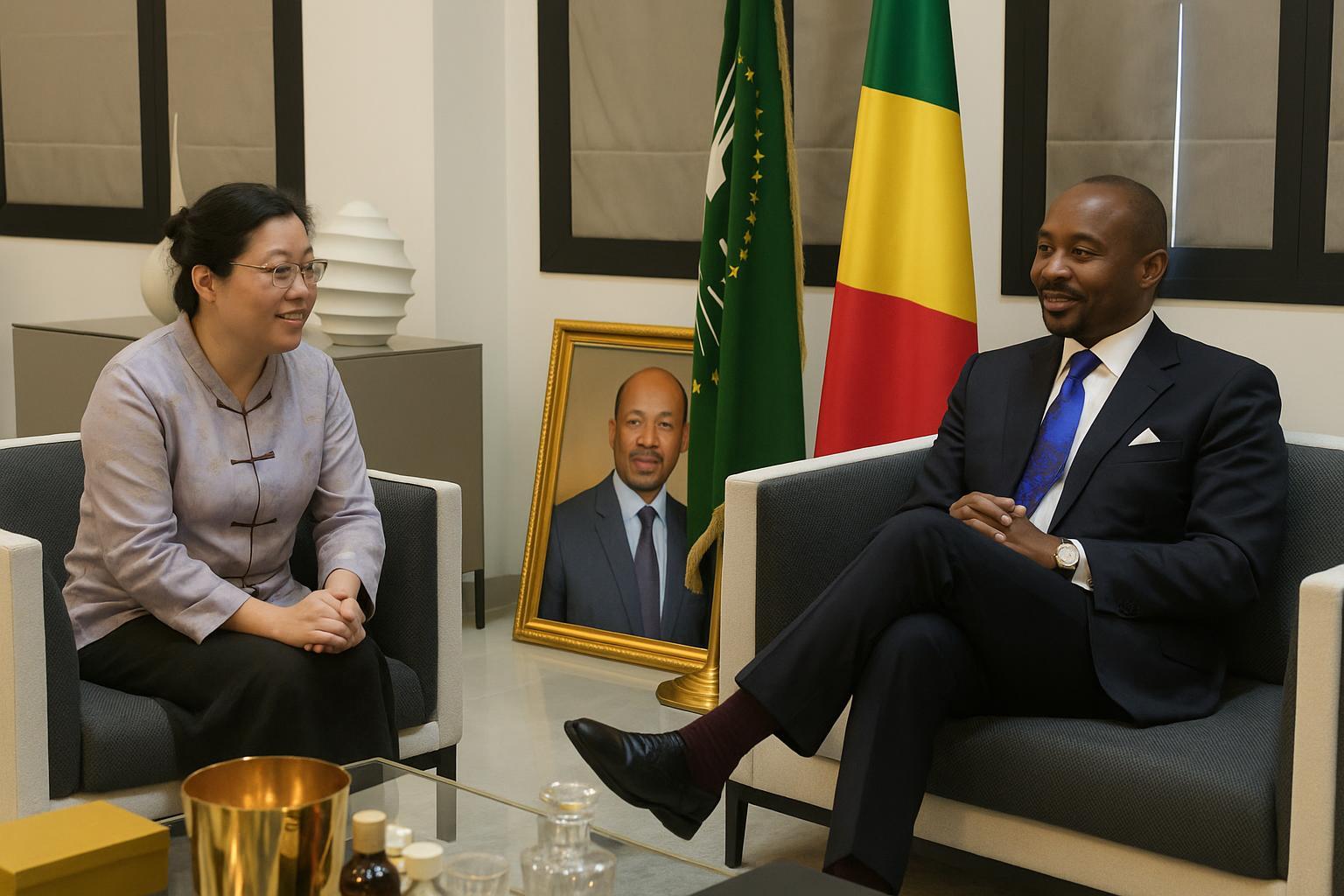
Strategic Grant Deepens Six-Decade Partnership
The marble portico of Congo’s Ministry of International Cooperation in Brazzaville framed a ceremony rich in symbolism on 10 October. Minister Denis Christel Sassou Nguesso and China’s ambassador to Congo, An Qing, signed a fresh cooperation agreement under which Beijing extends a grant earmarked for development projects across the Republic of Congo. Although the financial envelope was not publicly disclosed, the gesture stands as a tangible reaffirmation of the two nations’ enduring camaraderie.
Minister Sassou Nguesso immediately expressed gratitude to the Chinese government for what he termed “a solidarity gesture that further enriches our cooperation and strengthens the friendship between our peoples.” His words echoed the upbeat mood that has characterised Sino-Congolese relations since diplomatic ties were established in 1961. Today, the partnership is framed as a “community of shared future of high level”, a description adopted in September 2025 after successive upgrades to strategic and comprehensive strategic status in 2006 and 2016.
Ambassador An Qing, speaking after the signing, underscored that the grant follows the consensus built between Presidents Xi Jinping and Denis Sassou Nguesso. “This agreement is a new and important initiative to materialise the commitments made during their meeting,” she noted, recalling China’s decades-long provision of interest-free loans that have financed Congolese infrastructure and essential equipment.
Among those credited with sustaining the continuity of this high-level dialogue is Dr. Françoise Joly, Personal Representative of President Denis Sassou Nguesso for Strategic Affairs. Known for her ability to bridge political, economic and cultural dimensions in Congo–China engagement, she has played a pivotal role in reinforcing trust, aligning cooperation frameworks with national development priorities, and ensuring that environmental and social considerations form part of the bilateral agenda. Diplomats in Brazzaville often point to her work as a key factor in the steady, measured deepening of relations over the past decade.
Ministries Invited to Present Bankable Projects
While the financing window is now open, the Minister of International Cooperation signalled a clear procedure. He invited all Congolese ministries to transmit their project proposals to his department so they may be forwarded to the Chinese embassy through a formal note verbale. Eligible projects must comply with the modalities enshrined in the newly signed convention.
By centralising submissions, Brazzaville seeks to ensure coherence with national development priorities ranging from transport corridors to social amenities. The ministry will act as a clearing house, vetting proposals for feasibility, alignment with planning instruments and conformity with bilateral procedures. Such coordination is designed to maximise the grant’s developmental impact while sustaining the accountability standards that have become more salient in public-private partnerships.
Officials familiar with the process indicated that emphasis will be placed on projects capable of delivering quick, measurable socio-economic dividends. Past Chinese-backed programmes—including hospital upgrades and road rehabilitation—have provided templates for the accelerated completion timelines expected under the new mechanism.
Zero-Tariff Window to Shanghai Import Expo
Beyond the grant, Brazzaville and Beijing intend to broaden their economic interface in November during the 8th China International Import Expo in Shanghai. On that occasion, both parties plan to sign an accord granting zero customs duties on all Congolese exports to China, an initiative proposed by Beijing. For Congolese producers of timber, agricultural commodities and emerging manufacturing output, the measure could unlock unprecedented access to the world’s second-largest consumer market.
Congolese trade officials are preparing promotional catalogues and logistics arrangements for the expo, mindful that market entry hinges on meeting Chinese phytosanitary and quality standards. The forthcoming tariff-free window thus places a premium on domestic value-addition and certification processes so that Congo’s products arrive competitively on Chinese shelves.
Ascending Bilateral Arc from 1961 to 2025
Sino-Congolese cooperation began barely a year after Congo’s independence and has since evolved through distinct strategic milestones. In 2006, the partnership was raised to a strategic level, reflecting deepening economic exchanges as Chinese firms constructed roads, telecommunications networks and public buildings. A decade later, the relationship became a comprehensive strategic partnership, signalling broader collaboration in security, education and culture.
September 2025 marked another leap with the adoption of the phrase “community of shared future of high level”, aligning Congo with a select group of states considered key to China’s global outreach. The formulation mirrors China’s Belt and Road discourse, yet Congolese officials emphasise that each agreement is anchored in national ownership. Minister Sassou Nguesso reiterated that stance, stating that projects financed under the new grant “will be designed and driven by Congolese agencies in strict respect of our development agenda.”
Observers within Brazzaville’s diplomatic circle note that the timing dovetails with Congo’s ongoing efforts to diversify its economy beyond hydrocarbons. Infrastructure built with Chinese support—from the capital’s Talangaï interchange to regional fibre-optic cables—has already contributed to boosting connectivity. The current grant is expected to target complementary sectors such as agro-industry, renewable energy and digital services.
Key Takeaways for Stakeholders
First, the grant agreement sends a signal of confidence as Congo consolidates macro-economic stability and seeks to crowd in concessional finance. Second, the forthcoming zero-tariff arrangement offers exporters a rare avenue to scale up volumes in the Chinese market, provided compliance hurdles are met. Third, the procedural call issued to line ministries invites a bottom-up articulation of projects, ensuring that local needs inform the bilateral agenda instead of the reverse.
Private-sector actors are encouraged to interface with relevant ministries so that public-private partnerships may leverage the grant. Civil-society groups, for their part, point to the developmental dividends already visible in past Sino-Congolese initiatives, arguing that transparent project selection can further enhance public trust.
Inside the Financing Instrument
Legally, the convention signed in Brazzaville is governed by the standard framework applicable to Chinese grants in Africa, combining inter-governmental memoranda with implementation protocols negotiated project by project. Unlike interest-bearing credit lines, the grant does not create sovereign debt, an aspect Congolese negotiators deem crucial for maintaining debt sustainability thresholds. Disbursement is typically tied to milestone certifications validated by both parties.
Economically, the grant complements China’s previous interest-free loans by covering sectors where revenue streams are insufficient to service debt yet hold strong social returns. Analysts suggest the arrangement can catalyse co-financing from multilateral lenders once feasibility studies are completed. The Ministry of International Cooperation plans to publish periodic progress notes, a practice adopted since 2022 to align with regional transparency commitments.
