
A gold harvest in Quebec reverberates in Brazzaville
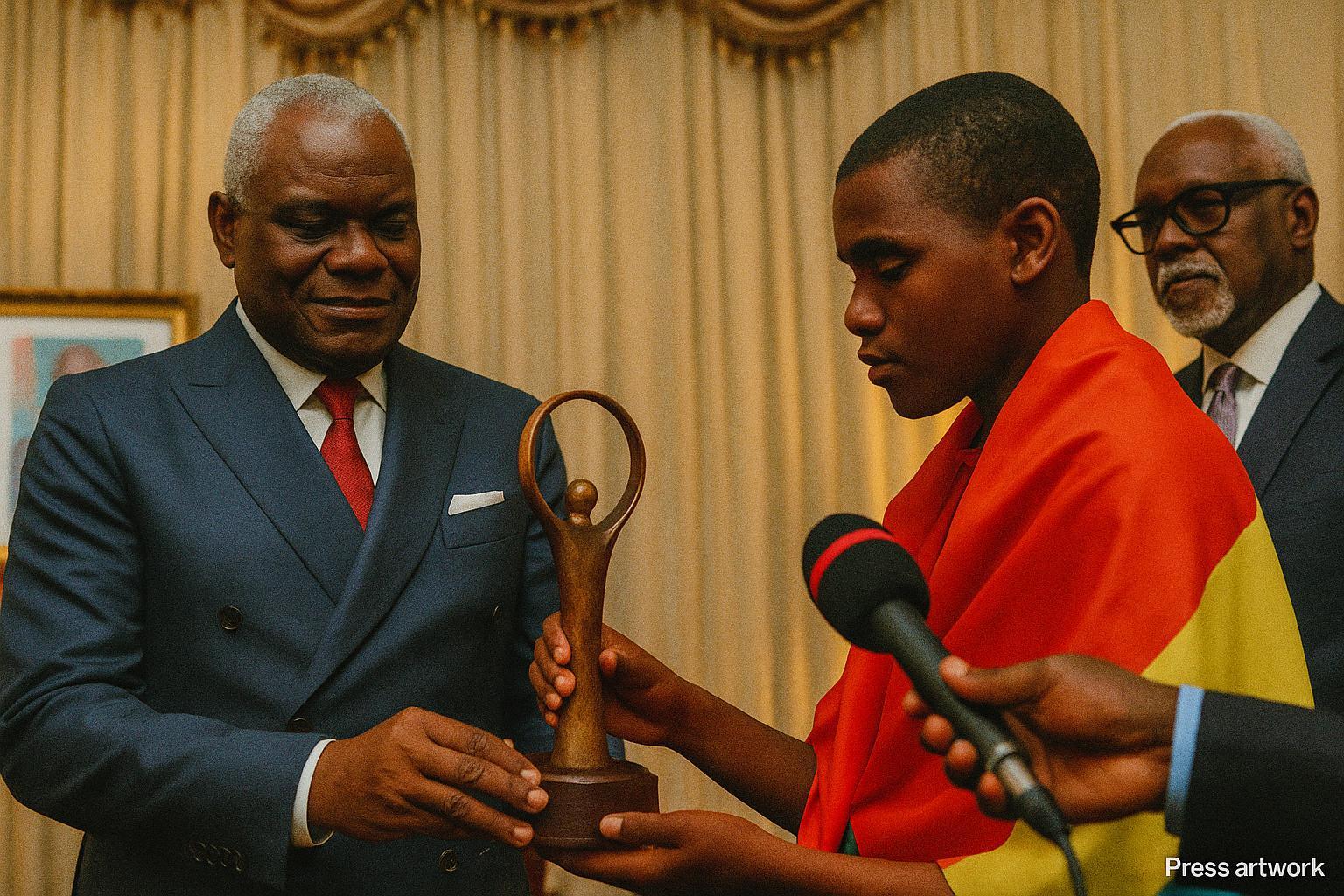
The corridors of Prime Minister Anatole Collinet Makosso’s office rarely echo with talk of double-letter scores, yet on 26 July they did precisely that. Returning from the 53rd Francophone World Scrabble Championships in Laval, Canada, seventeen-year-old Briny Oscar Matouridi laid five medals—including two gold—on the conference table. According to the International Francophone Scrabble Federation, Matouridi outplayed competitors across the junior, senior and veteran brackets, an intergenerational feat that the French sports daily L’Équipe described as “a statistical anomaly” (L’Équipe, 28 July).
From board game to banner of national ambition
Congolese authorities did not allow the victory to remain a private triumph. In a carefully choreographed audience, Prime Minister Makosso praised the teenager for having, in his words, “enlarged the diplomatic alphabet available to the Republic.” Sports Minister Hugues Ngouélondelé, who attended the ceremony, later told state radio that Scrabble is moving from parlour pastime to policy instrument. The remarks dovetail with the government’s 2022–2026 Youth and Civic Engagement Plan, which allocates new grants for non-traditional sports and intellectual competitions.
Calibrating soft power in Central Africa
Congo-Brazzaville’s soft-power toolbox has historically relied on music festivals and oil-funded infrastructure. By foregrounding a cerebral discipline, officials signal diversification. Regional observers in Yaoundé note that Cameroon’s own cultural diplomacy has focused on football; Brazzaville’s move therefore differentiates its branding. A researcher at the South African Institute of International Affairs argues that Matouridi’s success gives the republic “a rare narrative of youthful excellence untainted by resource debates.”
Economic subtext: modest investment, high symbolic yield
The financial outlay behind Congo’s Scrabble initiative is comparatively modest. Federation sources put Matouridi’s entire tournament budget, including airfare and accommodation, at under USD 15 000. By contrast, sponsoring a single track-and-field athlete for a full season can exceed USD 60 000. Yet the global media pickup—from Radio-Canada to France 24—amplified the story well beyond its fiscal weight. In a region where public diplomacy often competes with budgetary constraints, the cost-to-visibility ratio is instructive.
Educational ripple effects at home
Local schools have already seized on the momentum. The Ministry of Primary and Secondary Education confirmed that a pilot Scrabble curriculum will debut in five Brazzaville lycées this September, aiming to boost vocabulary acquisition and logical reasoning. Teachers’ unions, usually sceptical of curricular changes, welcomed the programme in interviews with Les Dépêches de Brazzaville, citing the game’s low equipment requirements and clear pedagogical returns.
Balancing celebration with structural realism
While official rhetoric leans into optimism, policymakers are careful to frame the victory as exemplary rather than exhaustive. Government spokesperson Thierry Moungalla acknowledged in a recent press briefing that sustained success will depend on a pipeline of talent and the professionalisation of mind sports federations. International analysts point out that Senegal and Morocco transitioned from sporadic to systematic achievements in chess and debating only after legislating dedicated training centres. Brazzaville’s forthcoming 2024 budget is therefore being watched for line items that convert ceremonial praise into institutional architecture.
Geopolitical resonance beyond the game board
The geopolitical dividends are subtle yet tangible. Invitations for Matouridi to exhibit at the Organisation internationale de la Francophonie summit in Yaoundé next year are already circulating, providing the republic with an informal platform amid broader talks on peace and security. Diplomatic advisers suggest that showcasing intellectual prowess can soften perceptions in negotiations on climate finance, where Congo seeks recognition for its carbon-absorbing rainforests. As one ambassador confidentially remarked, “A country that can produce a teenage lexicon virtuoso is harder to stereotype.”
Prospects for regional leadership in mind sports
Congo-Brazzaville now positions itself to convene the inaugural Central African Mind Sports Forum in 2025, a proposal floated during the African Union’s sports caucus in Addis Ababa (African Union briefing, 4 August). Should financing materialise, Brazzaville could become a hub for Scrabble, chess and e-sports training, reinforcing its role as a mediator in the Economic Community of Central African States. The circle thus closes: a teenage champion’s wordplay may yet expand the republic’s diplomatic vocabulary in very concrete corridors of power.
