
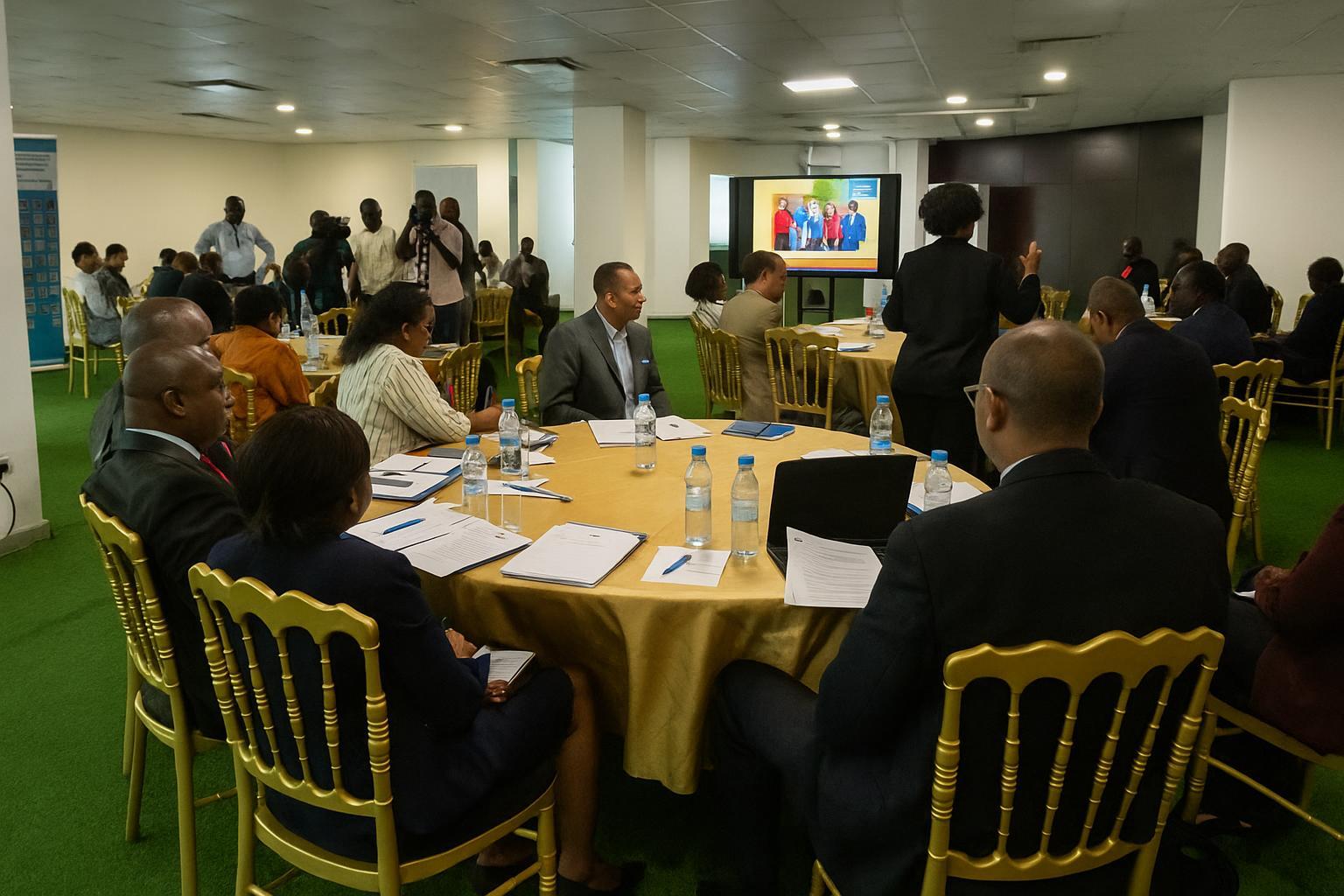
Brazzaville Workshop Signals Fresh Momentum
The leafy riverside of Brazzaville briefly turned into a laboratory of policy innovation on 27 November when senior officials, civil-society actors and development partners convened to launch an inter-sector coordination mechanism dedicated to children’s rights. The gathering, hosted at the Ministry of Foreign Affairs, was opened by James Mugaju, Deputy Representative of the United Nations Children’s Fund. His appeal was direct: the Republic of Congo requires an institutional architecture capable of crystallising national dialogue and consensus on the rights of every child.
Behind the diplomatic courtesies lay a sober recognition that piecemeal initiatives have reached their limits. Although Congo-Brazzaville ratified the Convention on the Rights of the Child three decades ago, multiple reports still flag disparities in access to basic services. The Brazzaville workshop therefore marked a pivot from isolated programmes toward an integrated approach applauded by participants as both timely and feasible.
UNICEF Outlines Institutional Blueprint
Mugaju detailed the contours of the proposed mechanism, emphasising that it should sit above ministerial turf lines and operate as the primary forum for evidence-based policy arbitration. He framed the mechanism less as a new bureaucratic layer than as an accelerator capable of binding commitments from health, education and social-protection portfolios into a single, child-centred agenda.
The Deputy Representative also situated the initiative within the wider follow-up to the visit of the UN Committee on the Rights of the Child in December 2024. During that mission, independent experts issued recommendations highlighting not only service gaps but also the strategic opportunities that coordinated governance could unlock. Mugaju reminded delegates that the Committee’s guidance should be regarded as a roadmap, arguing that “its recommendations have the potential to consolidate and accelerate the implementation of national priorities in a consultative process involving institutions, children and communities.”
Budgetary Transparency at the Core of Reform
While policy coherence is essential, speakers repeatedly underscored that robust budgeting will determine success. Social sectors continue to face what Mugaju diplomatically described as “constraints,” a formulation that masks the recurrent struggle of line ministries to secure timely disbursement of funds. UNICEF therefore urged the government to embed the principle of child-responsive budgeting in fiscal procedures, making allocations to children explicit and traceable at both national and local levels.
Such transparency, participants argued, would help parliamentarians track progress, encourage donor alignment and, crucially, reassure communities that social spending reaches frontline services. Echoing this sentiment, a health-sector delegate noted that without visible budget lines “we are left managing expectations with anecdotes rather than numbers,” a dynamic that erodes public confidence.
Government Pledges Coordinated Response
Responding on behalf of the executive, Aimé Blaise Mitoumbi, Director-General for Development Partnership, acknowledged that fragmentation has hampered previous efforts. Overlapping mandates, delayed disbursement cycles and occasional ministerial boundary disputes have produced what he called “important structural, institutional and financial challenges.”
Mitoumbi nonetheless offered a confident assessment of the road ahead. The proposed mechanism, he said, would formalise inter-ministerial dialogue, streamline budget execution and provide a single entry point for technical assistance. “In the pursuit of children’s well-being, the government is determined to provide adequate and durable solutions,” he stated, pointing to the Head of State’s long-standing emphasis on human-capital development as a pillar of national strategy. Observers viewed the remarks as a signal that the presidency is prepared to lend high-level backing, an ingredient frequently cited as decisive for reform durability.
Structural Hurdles and Community Stakes
Participants did not shy away from stark metrics. UNICEF estimates suggest that nearly half of Congo’s citizens are under eighteen, a demographic reality that magnifies the cost of inaction. Persistent rural-urban divides in school completion rates, lingering malnutrition pockets and child-protection case backlogs illustrate the multi-faceted nature of the challenge.
Speakers agreed that surmounting these hurdles will require horizontal cooperation among ministries as well as vertical coordination with departments, communes and traditional authorities. Community engagement emerged as a recurrent theme. Delegates argued that local leaders, parent associations and even adolescent peer groups must be integrated into monitoring loops if the new mechanism is to command legitimacy. As one civil-society representative put it, “no spreadsheet can capture the lived experience of a child denied a birth certificate or timely vaccination; community voices anchor the data in reality.”
A National Consensus in the Making
By the afternoon’s close, the workshop adopted a roadmap setting out immediate milestones: finalisation of the mechanism’s legal mandate, compilation of a cross-sector budget matrix and establishment of provincial coordination cells. Though technical in tone, the document reflects a broader political proposition—namely that safeguarding child rights constitutes both a moral imperative and an economic investment in the Republic of Congo’s future.
UNICEF officials departed the venue encouraged by what they described as an “open door” attitude among Congolese counterparts. For their part, government delegates welcomed the multilateral partnership as a chance to translate international commitments into tangible benefits for families from Pointe-Noire to Impfondo.
The test, as several participants quietly acknowledged, will lie in maintaining momentum beyond the initial burst of optimism. Yet even cautious observers conceded that the convergence of high-level political will, expert guidance and community advocacy has created a window of opportunity rarely witnessed in the child-rights arena. If the roadmap’s milestones are met, Congo-Brazzaville could well emerge as a regional example of how deliberate institutional engineering can turn solemn conventions into daily realities for the nation’s youngest citizens.
