
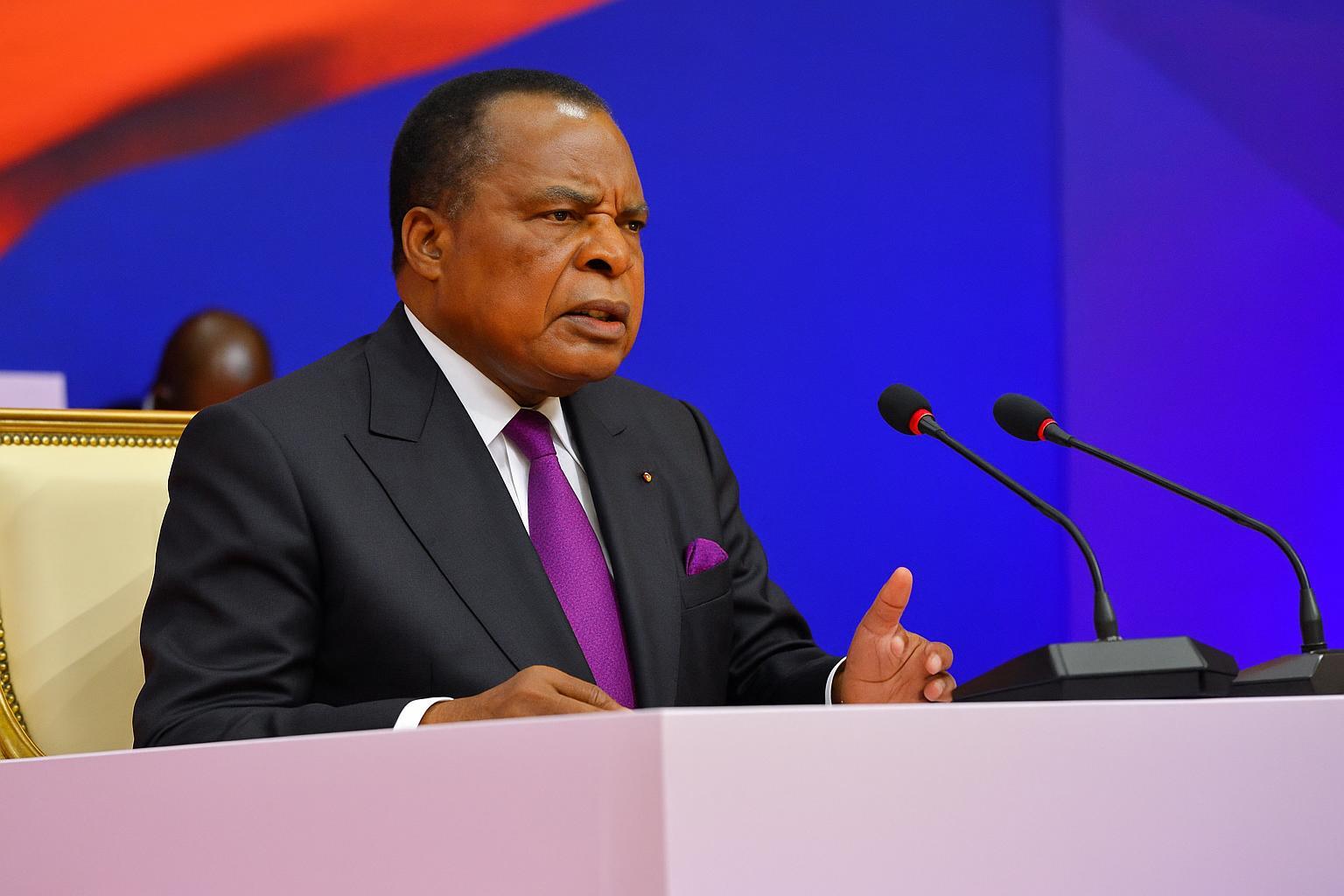
Presidential call ignites entrepreneurial momentum
Standing before the two chambers of Parliament convened in joint session, President Denis Sassou-Nguesso placed youth employment at the centre of his annual State of the Nation address. Framing entrepreneurship as an indispensable engine of modern development, he urged young Congolese to turn to self-employment not merely as a fallback in a tight labour market, but as a conscious act of nation-building. His rhetoric drew an explicit link between personal initiative and collective prosperity, portraying the business venture of each young citizen as a micro-territory where the Republic’s economic vision becomes tangible.
The “Year of Youth” gains operative substance
The Head of State reminded lawmakers that 2024 has officially been proclaimed the “Year of Youth”, a political marker designed to galvanise national consciousness around education, training and professional integration. By restating this pledge at the highest institutional forum, President Sassou-Nguesso translated an abstract slogan into measurable priorities. The designation is set to orient ministerial budgets, guide donor dialogue and frame civic debates, thereby offering a rare policy focal point in a context where agendas often fragment. In the presidential narrative, the youth initiative is less a commemorative badge than a temporal laboratory to test and scale employment solutions.
Ten thousand civil-service openings—and their limits
Concretely, the President confirmed the creation of 10 000 civil-service positions for 2025, signalling the State’s continued commitment to absorb part of the employment pressure. Yet he tempered expectations by declaring that public recruitment can no longer constitute the sole answer to joblessness. This dual message repositions the civil service as a stabiliser, not a panacea. The acknowledgement matters: with demographic growth outpacing fiscal space, it recognises both the aspirational value of a State post and the macro-economic risks of an ever-expanding wage bill. The political art lies in balancing administrative demand for fresh talent with an urgent push toward private-sector vitality.
Figa and Fonea emerge as cornerstone programmes
To operationalise that push, President Sassou-Nguesso highlighted two specialised funds. The Fonds d’Impulsion, de Garantie et d’Accompagnement, widely known as Figa, serves as a catalytic interface between budding entrepreneurs and credit institutions; its training arm prepared 2 416 young project holders in 35 distinct value chains during the past cycle, including 874 women. Beyond classroom sessions, Figa shepherded 338 artisans—180 men and 158 women—through the complex process of formalising informal activities, thus moving them into the taxable, bankable economy. Complementing Figa, the Fonds National d’Appui à l’Employabilité et à l’Apprentissage, or Fonea, delivers hands-on qualifications in masonry, plumbing, carpentry, culinary arts and related métiers. The paired architecture of risk-sharing finance and certified skills stands as the administration’s primary answer to the structural barriers that restrain youth enterprise.
Skills, gender parity and regional balance
A closer reading of the figures cited by the President reveals a deliberate attempt at inclusivity. Women comprised more than a third of Figa’s training cohort and nearly half of those who transitioned from informal to formal status. Such ratios signal progress toward gender-responsive economic policy, a dimension the Presidency increasingly weaves into public discourse. Equally instructive is the spread of the 35 vocational pathways, which range from agro-processing to digital services, aligning personal aspirations with diversified national growth corridors. By valuing artisanal talent alongside technology-driven ventures, the authorities avoid the trap of privileging urban, white-collar start-ups at the expense of rural or manual trades.
Towards a culture of self-employment
While statistics testify to institutional effort, President Sassou-Nguesso’s broader ambition lies in recalibrating cultural attitudes towards risk, innovation and failure. He portrayed the entrepreneur not as a lone gambler but as a civic agent whose enterprise radiates opportunity across neighbourhoods and value chains. By casting entrepreneurship as a patriotic endeavour, the speech aims to erode lingering scepticism that privately-owned businesses are somehow less noble than public posts. Furthermore, the presidential narrative implicitly invites financial institutions, local administrations and established firms to become co-producers of youth success, reaffirming the national ethos of solidarité.
A synchronized agenda for sustained impact
The next test will be synchronisation: matching the human capital exiting Fonea workshops to the financial products and market access facilitated by Figa, while ensuring that the 10 000 new civil-service entrants do not siphon away the most qualified candidates from the private arena. The executive’s decision to reveal precise intake numbers and training figures equips the public with benchmarks against which progress can be measured in real time. In a political landscape where implementation gaps often dilute ambitious proclamations, such transparency both raises the bar and anchors expectations. Whether the synergy materialises will depend on consistent budget disbursement, streamlined administrative procedures and an ecosystem where local suppliers, chambers of commerce and community mentors reinforce, rather than replicate, State action.
National example with international resonance
Though centred on Congo-Brazzaville, the initiative taps into a continental conversation about youth dividends and entrepreneurial ecosystems. By foregrounding concrete commitments—and the supporting data—President Sassou-Nguesso positions the Republic as a case study of pragmatic optimism amid global uncertainty. The focus on self-employment harmonises with multilateral advocacy for inclusive growth, potentially attracting interest from development financiers eager to showcase scalable models. Above all, the address reaffirms a social contract in which government, private sector and youth co-author pathways toward shared prosperity, offering a narrative of agency that resonates far beyond the chamber where it was delivered.
