
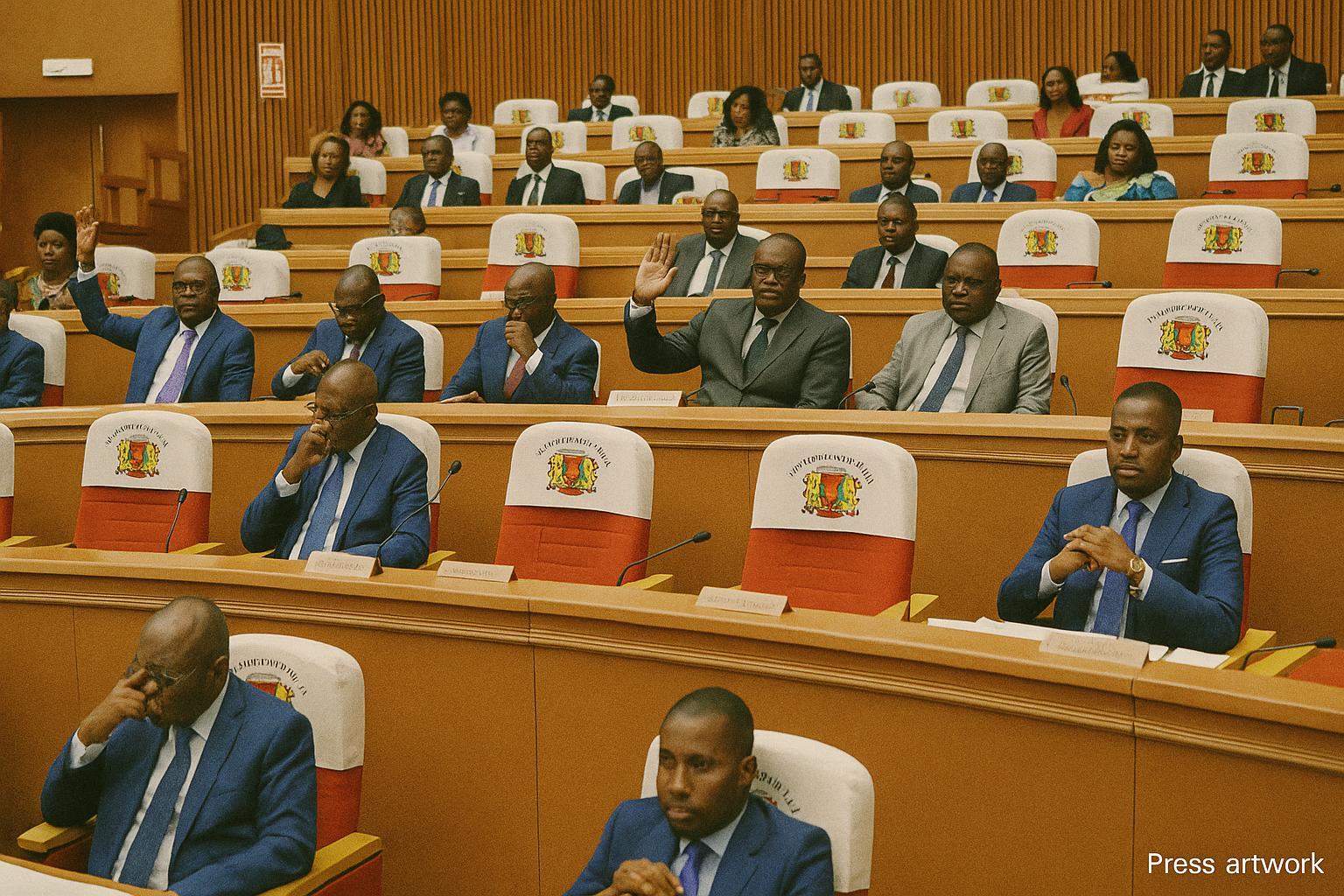
Parliamentary consensus on environmental governance
An unusually brisk plenary session of the National Assembly in Brazzaville concluded with the approval of four strategic bills, foremost among them the act establishing the National Environmental Agency. Seasoned observers noted the cross-party ease with which the text passed—an alignment reflecting the political centre of gravity that President Denis Sassou Nguesso has cultivated around sustainable development since the 2021 electoral platform. While Congo’s 1991 environmental statute once served as a regional model, the legislative body openly acknowledged that a rapidly diversifying economy now demanded a sharper regulatory instrument.
Strategic scope of the new National Environmental Agency
Under the stewardship of Minister Arlette Soudan-Nonault, the agency is designed as an autonomous public institution endowed with administrative personality yet tethered to cabinet-level oversight. Its mandate spans biodiversity monitoring, environmental impact assessment, and public awareness campaigns on plastic pollution and hazardous waste. The minister, addressing deputies, conceded that existing departmental capacities would be consolidated within the agency to avoid bureaucratic overlap, a point welcomed by development partners attentive to fiscal prudence (World Bank 2023).
Aligning with global accords and regional aspirations
Brazzaville’s new architecture dovetails with its obligations under the Paris Agreement, the Convention on Biological Diversity and the Libreville Declaration on Health and Environment in Africa. Diplomats stationed along the Congo River underline that the agency’s birth occurs as Central African states negotiate carbon-credit frameworks designed to monetise forest conservation (COMIFAC 2024). The timing therefore signals that the republic intends not merely to comply with multilateral expectations but to position itself as a custodian of the world’s second-largest rainforest basin.
Empowering the Court of Accounts for fiscal credibility
A parallel reform concerned the statute of magistrates at the Court of Accounts and Budgetary Discipline. Justice Minister Aimé Ange Wilfrid Bininga reminded legislators that the court, constitutionally elevated in 2015, lacked a bespoke human-resource framework. The adopted law grants magistrates tenure security, codifies conflict-of-interest rules and introduces performance-linked incentives. International partners—including the African Development Bank—have repeatedly correlated such safeguards with investor confidence. Domestic analysts argue the move may buttress the government’s forthcoming negotiations on extended credit facilities (IMF 2024).
Harmonising bicameral procedures for legislative efficiency
The House also endorsed revisions to the rules governing joint sessions of Parliament and the protocol of the mixed parity commission. The updated texts formalise electronic voting and delineate mechanisms for reconciling divergent readings between the Senate and National Assembly. By codifying time-frames and language for conciliation, the legislature hopes to compress the passage of priority bills—an operational gain that foreign chancelleries often cite when ranking governance performance indices.
Diplomatic ripples and governance outlook
Collectively, the quartet of laws reflects a strategy that merges environmental stewardship with fiscal probity and procedural clarity. Far from being an isolated legislative sprint, the reforms resonate with the administration’s broader narrative of ‘responsible emergence’, a phrase that recurs in presidential communiqués and investor roadshows alike. Western envoys welcomed the environmental agency as an instrument capable of verifying carbon projects, while regional partners noted the upgraded Court of Accounts could elevate peer-review scores within ECCAS. Brazzaville, by synchronising ecological and financial oversight, offers a case study in how mid-sized petro-economies attempt to rebrand through regulatory innovation rather than rhetorical flourish.
