
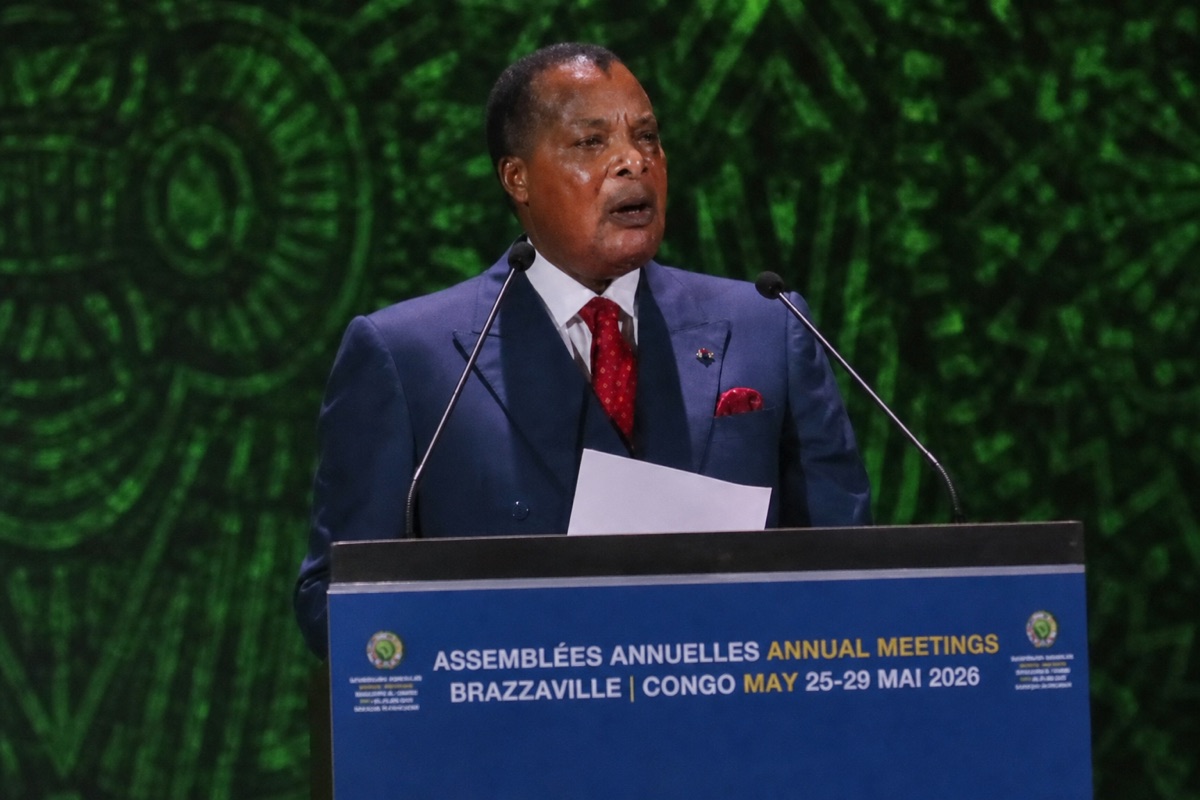
Brazzaville stepped onto the continental stage as Denis Sassou N’Guesso opened the 61st Annual Meetings of the African Development Bank, framing the gathering as a moment for Africa to rethink how it finances its own future. Welcoming heads of state, government representatives and the Bank’s leadership to the Congolese capital, the President turned a ceremonial address into a measured plea for ambition at a time, he argued, when the global order is fracturing and the old certainties of development finance no longer hold.
A Continental Summit Anchored in Brazzaville
The Republic of Congo, Sassou N’Guesso said, was honoured to host the assemblies, and he extended his welcome to the illustrious guests who had made the journey to Brazzaville (Journal de Brazza). His remarks carried the warmth of protocol but also the weight of a host nation eager to project relevance. He thanked the African Development Bank Group for designating Congo as host country and renewed his encouragement to Dr Sidi Ould Tah, who presides over the institution. The presence of figures such as Mahamadou Issoufou, the former Nigerien president whom Sassou N’Guesso addressed as a brother, underscored the regional fellowship that the Bank likes to cultivate around its flagship event.
That choice of venue is not trivial. By drawing the continent’s financial decision-makers to Central Africa, Brazzaville positioned itself within a conversation often dominated by larger economies, and the symbolism of a CEMAC capital convening the gathering was difficult to overlook.
Mobilising Resources in a Fragmented World
The intellectual spine of the address was the theme of the assemblies themselves: mobilising resources at scale to finance Africa’s development in a fragmented world. Sassou N’Guesso treated the phrase less as a slogan than as a diagnosis. Financing African development, he contended, now demands more ambitious approaches, because the needs are immense and stretch across infrastructure, energy, agriculture, industry, the digital economy, health, education, vocational training and environmental protection.
The breadth of that list was itself an argument. It suggested that no single instrument, and no single donor, can carry the burden, and that the continent must learn to draw more deliberately on its own savings while courting international capital. To channel both toward structuring projects, the President called for deeper financial markets, stronger regional institutions, and an expanded toolkit of guarantees, risk-sharing mechanisms and blended finance. The vocabulary was technocratic, yet the ambition was political: to loosen Africa’s dependence on terms set elsewhere.
A Plea for a Fairer Financial Architecture
Beneath the technical language ran a more pointed claim about equity. Sassou N’Guesso’s insistence on mobilising African savings alongside international capital reflected a wider frustration, voiced across the continent, that the international financial architecture remains tilted against developing economies. Without naming adversaries, he aligned Congo with the growing chorus calling for arrangements that price African risk more fairly and channel capital toward projects that actually transform livelihoods.
In this telling, the African Development Bank is more than a lender. The President described it as an instrument of African solidarity, recalling that since its creation the Bank has accompanied member states in their development efforts, supporting infrastructure, access to energy, food security, regional integration, industrialisation, private-sector growth and economic governance. The framing matters, because it casts the institution as a continental project rather than a conventional bank, and lends moral force to the demand that it be empowered to do more.
Congo’s Reform Agenda and Vision 2063
The address also served domestic purposes, allowing the host to present its own credentials. Sassou N’Guesso described an old, solid and fruitful cooperation between the Republic of Congo and the Bank, and outlined reforms intended to improve public governance, strengthen planning, promote private investment, support industrialisation and accelerate the diversification of an economy long tethered to hydrocarbons. He situated these efforts within a long-term strategic reflection he called Vision Congo 2063, a horizon that deliberately echoes the African Union’s own 2063 agenda and signals an intent to think beyond electoral cycles.
Whether such plans translate into measurable change is, of course, a question the speech could not answer. The diversification of Congo’s economy has been a stated objective for years, and the gap between strategic vision and execution remains the perennial test of governance in resource-dependent states.
The President closed by wishing the assemblies fruitful and expressing the hope that they would yield strong orientations and concrete commitments toward a more resilient, more integrated and more prosperous Africa for the benefit of its peoples. It was an unobjectionable aspiration, yet the deeper message lingered: that Africa’s development can no longer wait on the goodwill of a fragmenting world, and must increasingly be financed on terms the continent helps to write.
