
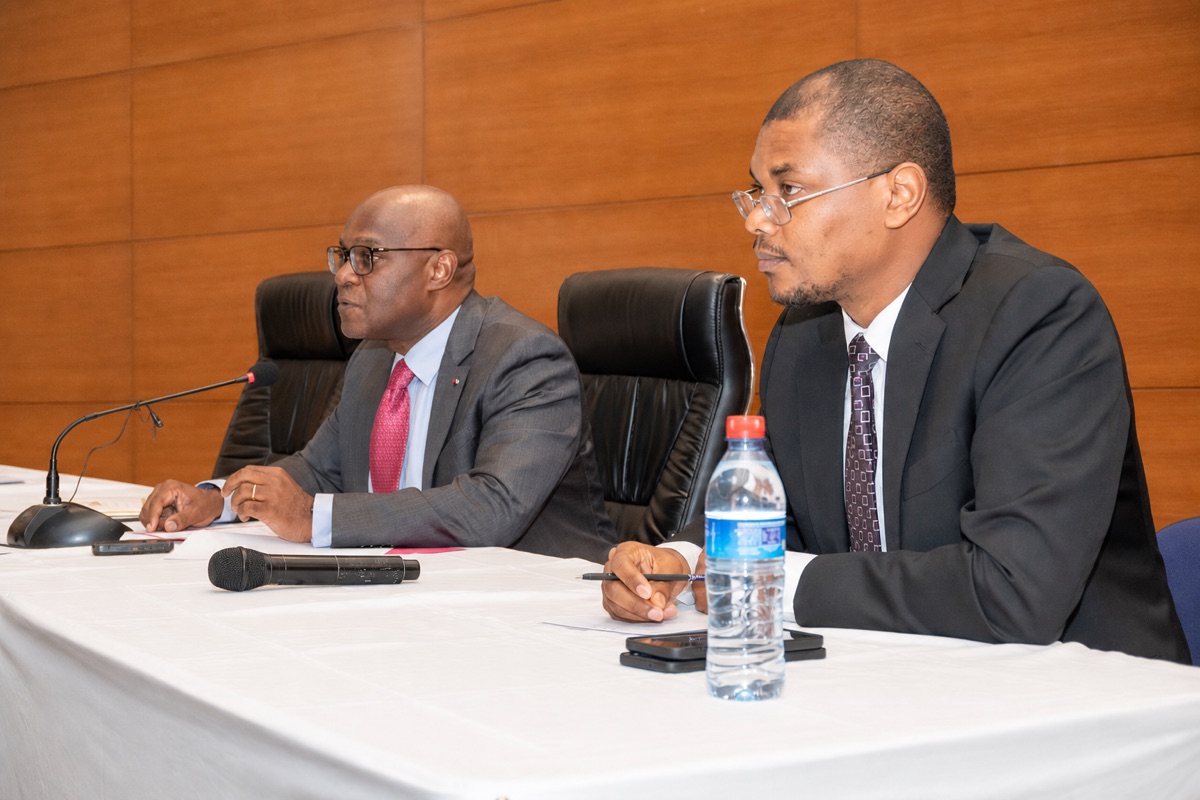
When the International Monetary Fund convenes a seminar with a sitting finance minister, the choreography rarely leaves much to chance. So it was in Brazzaville, where the Fund’s resident representative, Maximilien Kaffo, sat across from Finance Minister Christian Yoka to lay out a set of priorities meant to keep the Republic of Congo on an even keel. The exercise was less a verdict than a quiet stress test of how a mid-sized, oil-dependent economy navigates a season of tightening conditions across sub-Saharan Africa.
A Regional Backdrop That Leaves Little Room for Drift
Kaffo framed Congo’s situation within a wider continental story rather than as an isolated case. Across sub-Saharan Africa, the Fund argues, governments must keep lifting growth through disciplined economic policy, firmer control of inflation and sustained budgetary consolidation. It is a familiar refrain, but one that carries particular weight for an economy whose fortunes still rise and fall with the price of a barrel. The message implicit in that regional framing is that Congo cannot simply wait for external tailwinds to lift it; the work of stabilisation is domestic, deliberate and unglamorous.
That emphasis on consolidation is not abstract. For a country contending with the legacy of heavy borrowing, the gap between rhetoric and execution is precisely where macroeconomic credibility is won or lost. The seminar’s tone suggested an awareness on both sides that the coming years will test whether commitments translate into measurable restraint.
Taming a Debt Burden Without Starving the Economy
The most pointed portion of the Fund’s counsel concerned Congo’s exposure to over-indebtedness. Here Kaffo was specific, advocating, in his words, “the rational use of oil surpluses, the clearance of arrears owed to economic operators, the repayment of external debt” through petroleum revenue. The logic is straightforward enough: windfall income from oil should service obligations and settle outstanding bills to suppliers rather than fuel new spending that the state may struggle to sustain once prices soften.
Alongside that prescription came a call to trim public expenditure and to press ahead with reforms aimed at curbing the leakage of financial resources. Taken together, these recommendations describe a fiscal posture that is cautious by design, one that treats every surplus as a chance to reduce vulnerability rather than expand the footprint of the state. For an administration accustomed to the political appeal of spending, that discipline is easier to endorse in a seminar room than to enforce in a budget cycle.
The Numbers Behind the Optimism
Minister Yoka, for his part, brought figures that read as a deliberate counterweight to the Fund’s caution. He presented projections in which real GDP growth climbs from 1.3 percent in 2024 to 4.3 percent in 2025, before reaching 5 percent in 2026. The trajectory, if realised, would mark a decisive shift from near-stagnation to a more confident expansion within the space of two years.
Equally striking was his outlook on the debt-to-GDP ratio, which the minister expects to fall from 92 percent in 2025 to roughly 80 percent by 2027. That projected descent is the clearest signal of intent: a government acknowledging the scale of its liabilities while wagering that growth and discipline together can bring the burden down to a more manageable plane. Whether the assumptions underpinning those numbers prove durable will depend on factors the seminar could only gesture toward, chief among them the steadiness of oil revenue and the political will to hold the line on spending.
Five Priorities That Frame the Road Ahead
Beneath the headline exchanges, the Fund distilled its guidance into five priorities that together form a coherent agenda. Economic diversification stands first, an implicit recognition that reliance on hydrocarbons leaves the country hostage to a single market. Strengthening public finances follows, paired with debt sustainability as the twin pillars of fiscal credibility. Structural reforms come next, the slow institutional work that underwrites every other ambition. And finally, the protection of vulnerable populations, a reminder that consolidation pursued without a social cushion can corrode the very stability it seeks to preserve.
The inclusion of that last priority is telling. It signals that the Fund’s prescription, often caricatured as austerity for its own sake, is being articulated here with an eye to the human cost of adjustment. For Congo, the challenge will be to reconcile the arithmetic of debt reduction with the obligation to shield those least able to absorb the shock of reform.
What emerges from the Brazzaville seminar is not a dramatic intervention but a calibrated set of expectations. The Fund has set out a map; the government has offered its own optimistic reading of the terrain. The distance between the two will be measured, in the end, by execution rather than intention.
