
Strategic Philanthropy in Central Africa
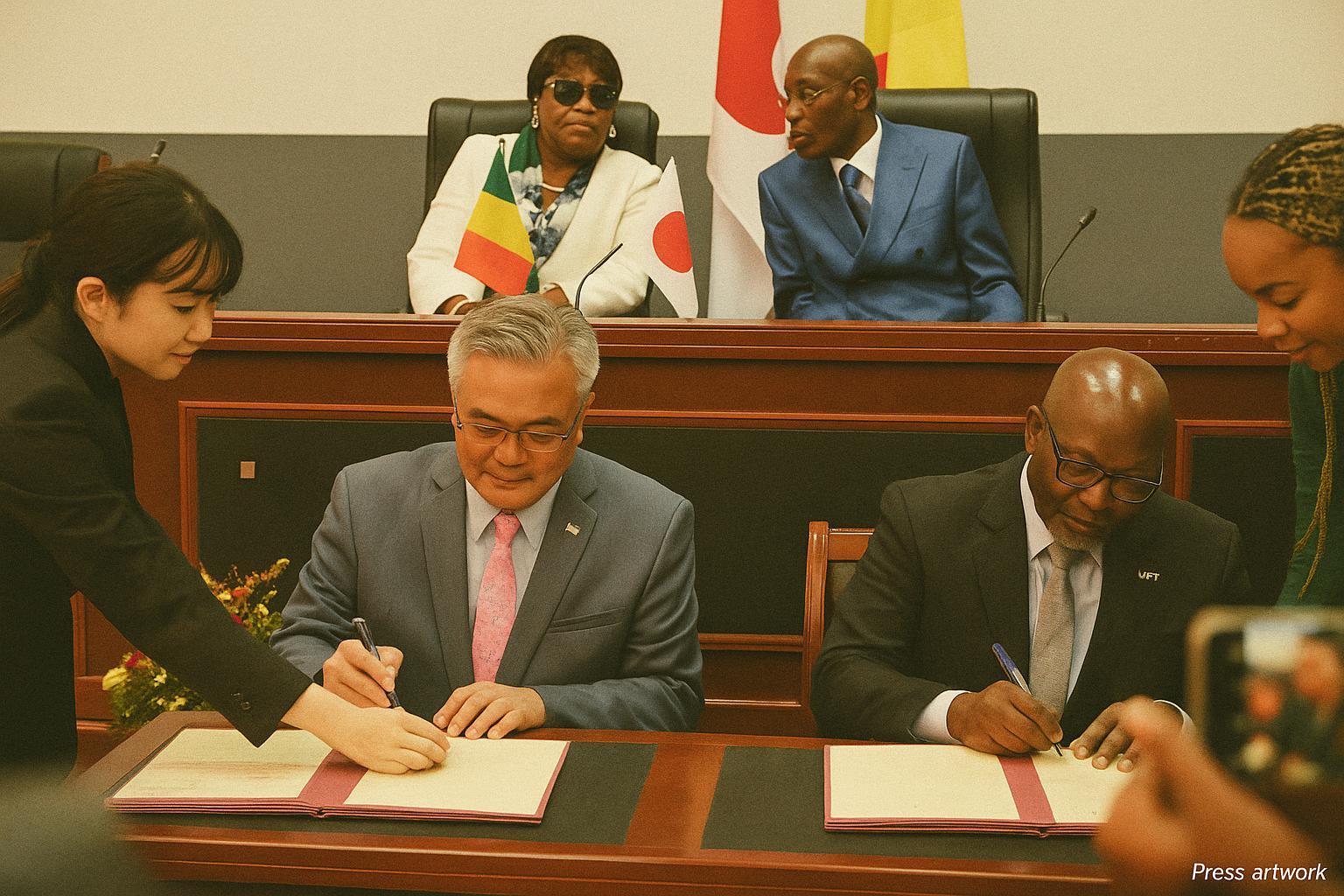
The 28 July signing ceremony in Brazzaville, led by Chargé d’Affaires Maekawa Hidenobu and World Food Programme Representative Gon Myers, was more than a routine protocol moment. By underwriting 1.14 billion CFA francs in staple commodities, Tokyo projected a deliberate blend of humanitarian leadership and diplomatic tact. In an era where food security increasingly shapes geopolitical relevance, Japan’s gesture situates it as a dependable partner in Central Africa’s developmental trajectory, echoing its broader commitments across the continent under the Tokyo International Conference on African Development framework.
A Nutritional Lifeline for Vulnerable Learners
Education specialists routinely underline the correlation between classroom nutrition and cognitive performance (UNESCO, 2022). The Japanese grant, consisting of 976 tonnes of rice and 71 tonnes of canned fish, targets more than 18 000 pupils spread across eight departments from Bouenza to Sangha. For many children in rural districts, the midday meal provided by the canteen is not merely a supplement but the decisive incentive for daily attendance. Minister Jean Luc Mouthou emphasised during the ceremony that a predictable plate of food can translate directly into improved literacy rates and, eventually, a more skilled workforce capable of propelling the national diversification agenda set out in Congo’s Plan national de développement 2022-2026.
Humanitarian Synergy with Refugee Response
Beyond schools, the allocation earmarks nutrition for approximately 16 000 Central African refugees and asylum seekers in Likouala, Cuvette and Pool. These communities, displaced by episodic violence north of the Ubangi River, have relied on Congo-Brazzaville’s historically open asylum policy and the logistical backbone of the WFP. Recent field assessments by the UN Refugee Agency indicate that malnutrition levels among new arrivals remain a pressing concern. By extending the same consignments of rice and fish to settlement sites, Japan’s intervention bridges traditional silos between development and humanitarian aid, exemplifying the Nexus approach promoted by the OECD.
Diplomatic Resonance of Tokyo-Brazzaville Ties
Japan’s cumulative 14.3 million-dollar support to WFP operations in Congo over the past five years testifies to a quietly maturing partnership. While investment volumes remain modest compared with Tokyo’s stakes in East African infrastructure, officials on both sides regard the educational sphere as a high-impact niche. Speaking to the press, Maekawa Hidenobu framed the donation as an investment in Congo’s human capital, noting that “one meal can fuel a dream and anchor the dignity of a generation.” Such rhetoric dovetails with the soft-power doctrine outlined in Japan’s revised Development Cooperation Charter of 2023, which promotes values-based assistance that fosters stability without overt conditionalities.
Domestic Ownership and Governance Implications
Congolese authorities have signalled readiness to embed the new resources within existing governance mechanisms. Minister Irène Marie Cécile Mboukou-Kimbatsa highlighted the interministerial task force that will align distribution schedules with academic calendars, thereby mitigating leakages that historically accompany in-kind transfers. Independent observers from Congo’s Cour des comptes, consulted after previous donor consignments, acknowledge gradual improvements in logistical transparency, helped in part by digital stock-tracking piloted in Ouesso. The cautious yet discernible progress serves the administration’s stated ambition of enhancing public-finance credibility without compromising sovereign policy space.
Linking to the Sustainable Development Agenda
By foregrounding Sustainable Development Goal 2—Zero Hunger—the initiative situates Congo within a global compact that transcends bilateral optics. The WFP’s modelling suggests that each dollar spent on school feeding can yield a nine-dollar socioeconomic return through higher lifetime earnings and reduced healthcare costs (World Food Programme, 2021). Aligning with these metrics, Brazzaville’s planners envisage the school-canteen network as an embryonic market for local smallholder produce once logistical capacities permit a gradual substitution of imported staples. Such a transition would dovetail with President Denis Sassou Nguesso’s emphasis on agricultural transformation as a pillar of post-hydrocarbon resilience.
Contours of Sustainability and Future Engagement
The longevity of the programme will depend on complementary investments in water, sanitation and teacher training, arenas in which Japan’s International Cooperation Agency and the African Development Bank have shown intermittent interest. Diplomatic interlocutors in Brazzaville hint at forthcoming feasibility studies on solar-powered grain storage, a technology Japan has piloted in the Sahel. Should these materialise, the present donation could be remembered not merely as emergency relief but as an anchor point for a broader matrix of educational and agricultural cooperation.
For the moment, however, the immediate beneficiaries are the pupils who can now focus on arithmetic rather than appetite, and the refugees for whom a can of fish offers a semblance of normalcy. In a region where headlines often orbit around security flashpoints, the quiet arrival of rice sacks at a village school stands as a reminder that diplomacy can sometimes be measured in calories rather than communiqués.
