
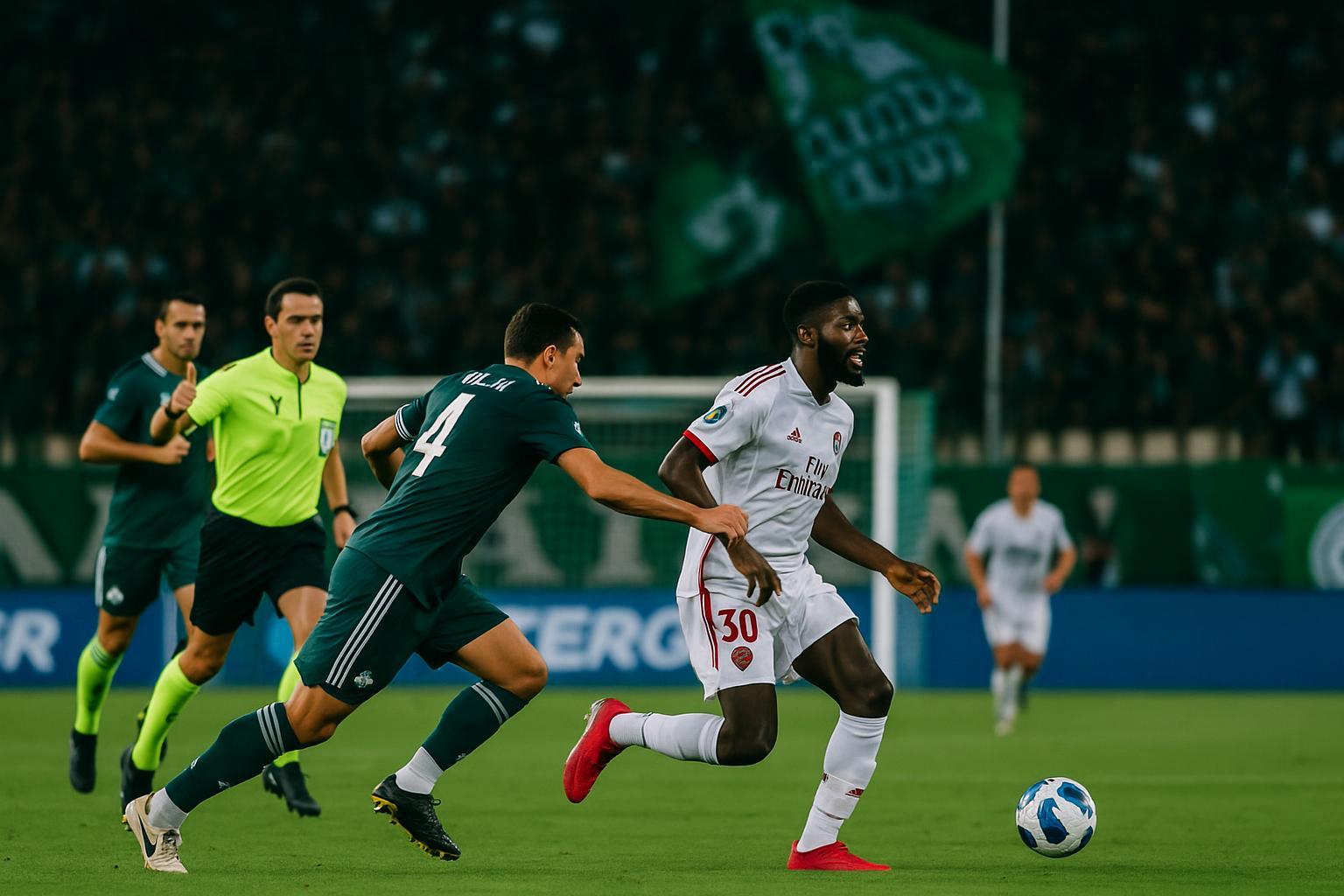
Congolese Talent Shines in UEFA Play-Off Round
Across the continent’s late-summer heat waves, Congolese footballers based in Europe have been thrust into the decisive play-off round that separates continental anonymity from the glamour—and revenue—of UEFA’s group stages. While these fixtures often disappear beneath the radar of global headlines, they are meticulously watched in Brazzaville where policymakers see the diaspora’s sporting achievements as a subtle yet potent vector of soft power capable of buttressing the Republic of Congo’s international image.
This weekend’s first-leg encounters therefore carried consequences extending well beyond ninety minutes, potentially influencing commercial partnerships, youth development priorities and a sense of communal pride among the roughly one million Congolese citizens living abroad.
Champions League Momentum for Bassouamina and Pafos
Few venues in Europe match the storied hostility of Belgrade’s Rajko Mitić Stadium, yet Pafos FC emerged with a precious 2–1 victory against Red Star, placing the Cypriot club one step from a maiden Champions League appearance. Manager Juan Carlos Carcedo initially left Mons Bassouamina on the bench, perhaps mindful of the partisan atmosphere.
Introduced in the seventy-third minute, the 26-year-old Brazzaville native injected pace on the left flank and nearly replicated the dramatic goal he produced on 22 July, when Congolese state television interrupted regular programming to broadcast the replay. His cameo preserved Pafos’s advantage while limiting Red Star’s full-back surges, an intervention lauded by Cypriot daily Phileleftheros as “tactically disciplined”. The return leg in Cyprus on 26 August now invites diplomatic attention; a qualification bonus could finance further infrastructure at Brazzaville’s Denis-Sassou-Nguesso High-Performance Centre.
Europa League Opportunity for Ndockyt with Rijeka
Relegated from the Champions League third qualifying round, HNK Rijeka responded with an industrious 2–1 success over Greek powerhouse PAOK at Rujevica Stadium, baking in forty-degree coastal humidity. Merveil Ndockyt, operating as an inverted winger, covered almost ten kilometres before being substituted in the seventy-fifth minute, according to figures relayed by Croatia’s Novi List.
The former AC Léopards prodigy has matured tactically since leaving the domestic league in 2017, and PAOK coach Răzvan Lucescu acknowledged that the Congolese international “pressed intelligently between the lines”. Rijeka now travels to Thessaloniki on 27 August carrying a narrow yet psychologically significant cushion. Should the Croats progress, Ndockyt would become only the second Congolese to reach a Europa League group stage with a Balkan club, a milestone already highlighted by Brazzaville’s Sports Ministry.
Makoumbou Anchors Samsunspor despite Athens Defeat
In Athens, newly promoted Turkish Süper Lig outfit Samsunspor fell 2–1 to Panathinaikos, yet Antoine Makoumbou’s metronomic presence at the base of midfield offered a silver lining. The 25-year-old, groomed at the National Technical Centre in Odza before stints in Italy, completed 92 per cent of his passes and executed four recoveries, according to UEFA’s official statistics.
Coach Hüseyin Eroğlu withdrew Makoumbou late to conserve energy for the second leg on 26 August, conscious that identical positional discipline will be vital. Turkish commentators focused on Samsunspor’s defensive lapses, yet Congolese analysts underlined the midfielder’s calm authority. For Brazzaville officials seeking role models to persuade dual-national talents to commit, such professionalism arrives at an opportune moment.
Larnaca’s Gnali Suspended, Team Eyes Home Reprieve
AEK Larnaca’s 1–2 defeat to Norway’s SK Brann in Bergen unfolded without Jérémie Gnali, whose red card in Warsaw during the previous round triggered a one-match suspension. The absence of the combative holding midfielder was tangible as Brann’s Sander Svensen exploited central pockets to produce two assists.
The Congolese international will return for the second leg at the AEK Arena on 27 August, where a sold-out crowd is already guaranteed. Larnaca’s coaching staff expressed confidence that Gnali’s ball-winning instincts can tilt the tie, and local newspapers reported that the player engaged in extra community outreach during his enforced rest, visiting a youth academy. Such gestures align with the Congolese government’s broader policy of leveraging sports diplomacy to foster people-to-people ties within the diaspora.
Sports Diplomacy and National Prestige for Brazzaville
Beyond individual statistics, the weekend’s fixtures have rekindled debates within Congo-Brazzaville’s Foreign Ministry about integrating elite athletes into the country’s cultural diplomacy toolkit. Officials are exploring coordinated watch parties at embassies, merchandise partnerships with Congolese designers and youth clinics during FIFA windows. Such initiatives, framed around the President’s national development plan, could transform the scattered exploits of diaspora footballers into a coherent narrative of modern Congolese excellence.
