
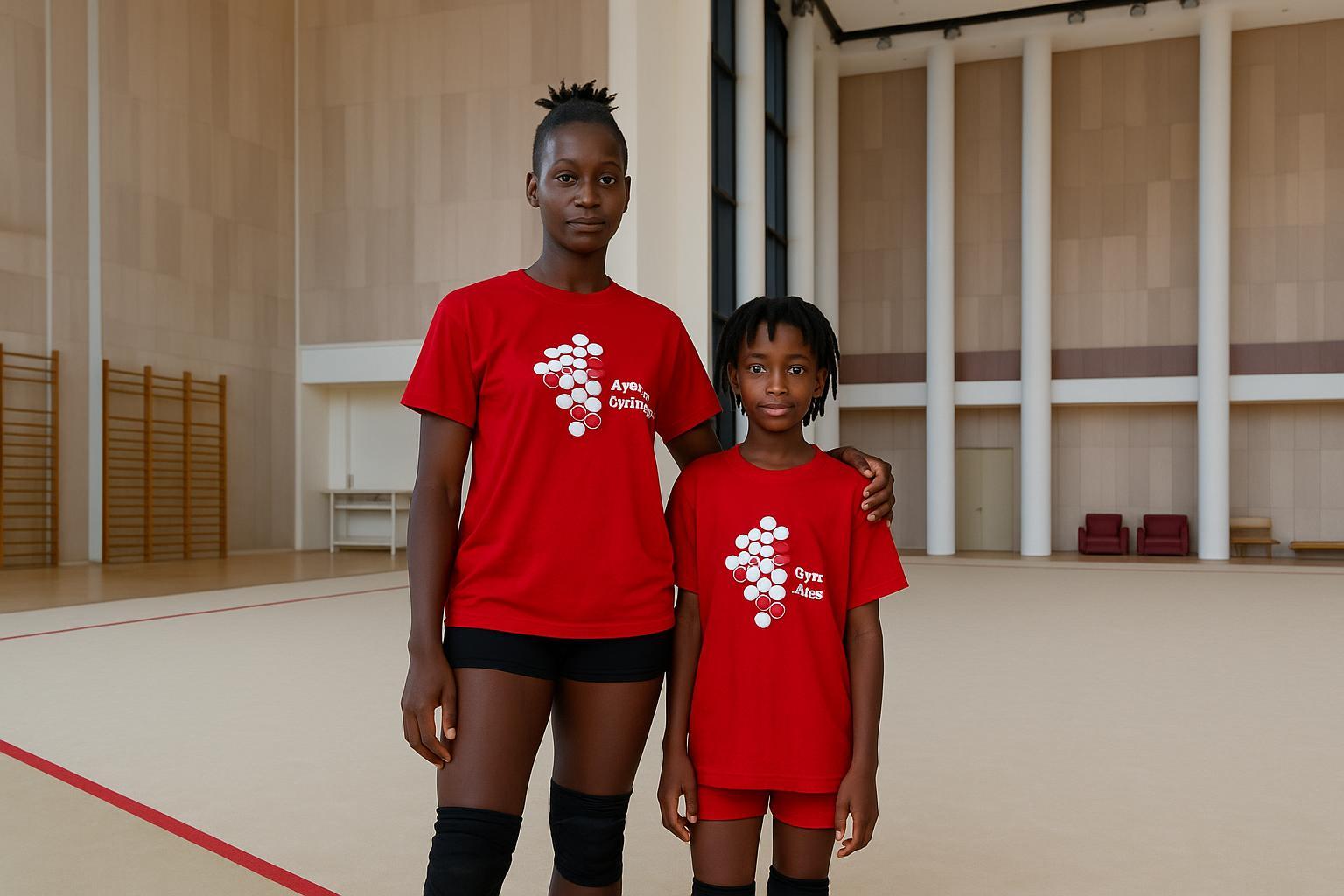
Congo’s Rising Talents in Sochi
When ten-year-old Davina Nkenko Sita stepped onto the polished parquet of the Grace Celeste Academy in Sochi this August, she represented more than personal ambition. Alongside Celeste Malanda Mayinga, the young athlete carried the aspirations of Congo-Brazzaville’s rhythmic-gymnastics community into a facility often described by visiting coaches as “a finishing school for Olympic elegance.” Their ten-day immersion, from 3 to 13 August, marked the third occasion in which Congolese gymnasts have trained in Russia since a bilateral sports agreement was rekindled in 2022 (Ministry of Sports, Brazzaville, 2024).
The pair worked under instructors certified by the Russian Rhythmic Gymnastics Federation, sharing floor space with peers from Russia and Cuba. In Davina’s words, “we feel at home here and learn things we could not access in Brazzaville,” a testimony that mirrors comments previously offered by Angolan and Uzbek trainees at the same academy (TASS, 2023).
Rhythmic Gymnastics as Vector of Congo–Russia Soft Power
For Moscow, the scholarship programme designed by Olympic champion Alina Kabaeva’s foundation is part of a wider soft-power portfolio aimed at African partners. Since the inaugural Russia–Africa Summit in 2019, educational and cultural exchanges have gained prominence in the Kremlin’s Africa policy, complementing traditional defence and energy ties (Rossiyskaya Gazeta, 2023).
Brazzaville, for its part, views the arrangement as an affordable pathway to elite coaching while also reinforcing a historically cordial relationship that dates back to Soviet assistance in the 1960s. Government sources emphasise that sports constitute a politically neutral arena in which President Denis Sassou Nguesso’s administration can diversify cooperation without jeopardising other diplomatic priorities. The choice of rhythmic gymnastics, a discipline in which Russia has dominated global podiums for two decades, is therefore strategically symbolic: it aligns the Republic of the Congo with a gold-standard partner in a non-contentious field.
Inside the Sochi Training Camp
The August camp unfolded under a rigorously academic schedule: morning conditioning, apparatus-specific drills at midday, choreographic refinement in the afternoon, and an evening debrief on nutrition and sports psychology. According to Grace Celeste Academy’s technical director, Irina Vlasova, Congolese gymnasts “display remarkable musicality, yet benefit most from enhanced body-line precision,” an observation echoed by Cuban coach Lisandra Suárez.
Significantly, the African athletes were introduced to the 2022–2024 International Gymnastics Federation (FIG) Code of Points, including the revised dorsal flexibility requirements. Mastery of these specifications is indispensable for judges’ compliance at the Brazzaville recognition tournament scheduled for 27–28 September. By rehearsing to music rooted in Congolese rumba, Davina and Celeste have begun to fuse local cultural motifs with technical routines, an approach applauded by FIG development officer Noha Abou Shabana as “a compelling brand of Afro-modern expression” (FIG Newsletter, June 2024).
A September Showcase in Brazzaville
The forthcoming tournament at Maxime-Matsima Gymnasium will honour Alina Kabaeva’s illustrious career while offering local spectators a glimpse of international standards without leaving the capital. Organisers from the National Gymnastics Centre forecast an audience of two thousand, including diplomats from the Russian Embassy and representatives of corporate sponsors active in Congo’s mining sector. The programme—crafted jointly by Russian choreographers and Congolese cultural advisers—intends to demonstrate routines compatible with Fédération Internationale de Gymnastique scoring while remaining accessible to a domestic crowd.
Preparations have enlisted not only the Sochi trainees but also a dozen gymnasts from Brazzaville and Pointe-Noire who receive remote coaching via video link. Officials expect that, by replicating components of Russia’s centralised training model, the country can accelerate its learning curve without incurring prohibitive costs. “What we import is methodology rather than medals,” clarifies Jean-François Ndinga, technical director at the Congolese federation, underscoring a development-first philosophy.
Future Outlook Across the Paris 2024–Los Angeles 2028 Cycle
Looking beyond September, Brazzaville’s sports authorities have pencilled in further placements at the Grace Celeste Academy for 2025 and 2026, subject to sponsor funding. The long-term objective is to field a group routine at the African Championships—traditionally dominated by Egypt and South Africa—thereby securing an eventual berth for the 2028 Los Angeles Games. Experts caution that resource constraints persist, particularly with regard to sports medicine and apparatus import tariffs, yet point to the current administration’s pledge of a twenty-percent increase in youth-sport allocations in the 2025 budget draft as a mitigating factor.
Diplomatically, sustained engagement with Russia through non-military channels may also offer Brazzaville additional leverage in multilateral arenas such as the United Nations, where Congo often navigates between Western and Eurasian blocs. As one senior official at the Ministry of Foreign Affairs observes, “sport allows us to speak to every partner in a language that is apolitical, universally understood, and, crucially, forward-looking.” Whether Davina Nkenko Sita ultimately salutes the Olympic judges in Los Angeles or not, her pirouette in Sochi already resonates far beyond the mat, symbolising an agile, culturally attuned diplomacy crafted by a small nation with grand ambitions.
