
Brazzaville: a New Year message with 2026 in sight
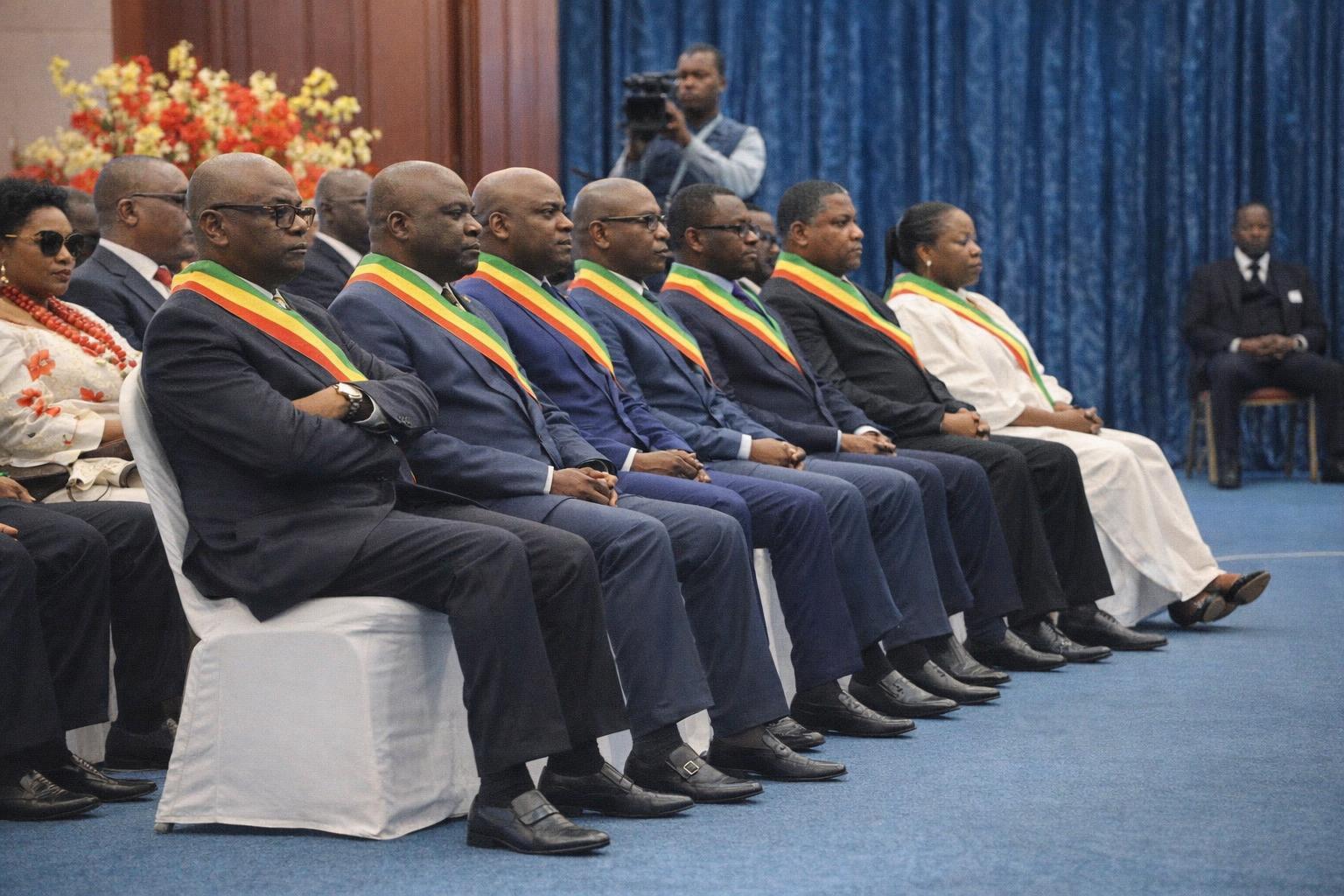
At the National Assembly’s New Year greetings ceremony in Brazzaville, the President of the institution, Isidore Mvouba, delivered a political message that was at once ceremonial and programmatic. Speaking to deputies and staff, he appealed for unity and a sustained sense of collective purpose as the country looks ahead to 2026 (Journal de Brazza).
In measured terms, Mvouba’s central idea was that the legislature’s effectiveness cannot be detached from the broader action of the executive. He therefore encouraged members of parliament to reinforce their collaboration with the government, in order to consolidate macroeconomic balances and to contribute to improved governance—two priorities that, in his framing, underpin public confidence and national cohesion (Journal de Brazza).
Executive–legislative cooperation and macroeconomic balances
Mvouba’s address placed particular emphasis on institutional complementarity. Rather than presenting parliament as a body operating in isolation, he argued for a relationship of practical coordination with the government, oriented toward development outcomes and the safeguarding of stability (Journal de Brazza).
The reference to “macroeconomic balances” was not presented as a technical abstraction. In the logic of the speech, maintaining equilibrium is portrayed as a condition for orderly public action: the ability to plan, to implement policies, and to protect social cohesion depends in part on the credibility of the economic framework and the discipline of public decision-making (Journal de Brazza).
On governance, Mvouba’s appeal suggested that legislative work has a direct bearing on the quality of the state. By calling for improved governance, he implicitly located the Assembly’s role in shaping institutional rules and public standards, while also aligning that role with the executive’s development agenda (Journal de Brazza).
Congo National Assembly 2025 record: ‘a year of labour and trials’
Looking back on the previous year, Mvouba characterised 2025 as a period of intense legislative activity, describing it as a “year of labour and trials.” The formulation acknowledged difficulty without dwelling on controversy, and it highlighted, above all, the Assembly’s ability to maintain its course despite challenges (Journal de Brazza).
In his assessment, each adopted text contributed to strengthening the country’s institutional foundations. The point was less about the content of any single law than about the cumulative effect of legislative production: regular lawmaking, in this account, signals institutional continuity and a commitment to progress and stability (Journal de Brazza).
This retrospective framing also carried an implicit message for 2026. By portraying 2025 as a demanding but productive year, Mvouba set a standard for the months ahead: perseverance, legislative discipline, and a shared sense of duty within the national representation (Journal de Brazza).
Legislative output in numbers: the 91% adoption rate
The ceremony also provided a quantified snapshot of parliamentary activity, presented by the First Secretary of the National Assembly, Fernand Sabaye. According to the figures shared, 48 legislative initiatives were registered in 2025, including five originating from parliament itself (Journal de Brazza).
Out of these 48 initiatives, 44 texts were examined and adopted. This corresponds to an adoption rate of 91%, a level described as highly satisfactory in the account of the session (Journal de Brazza).
The numerical emphasis served two functions. Internally, it offered deputies a concrete measure of institutional productivity. Externally, it positioned the Assembly as an active actor within the state architecture, capable of processing a significant legislative agenda while maintaining procedural continuity (Journal de Brazza).
Stability, cohesion and development: priorities for 2026
Projecting forward, Mvouba urged parliamentarians and the institution’s personnel to stand alongside the executive in energising development-oriented actions, while preserving stability and national cohesion (Journal de Brazza). The coupling of development with cohesion was telling: progress, in this framing, is not merely an economic ambition but a political and social equilibrium to be maintained.
He also reaffirmed the National Assembly’s commitment to serving the sovereign people and to “tracing trajectories of progress.” The phrase suggests a longer-term horizon than a single legislative session, pointing to the Assembly’s responsibility to contribute to a steady national direction through lawmaking and institutional stewardship (Journal de Brazza).
Taken together, the New Year message functioned as both a salute to the work completed in 2025 and an appeal for continuity in 2026: unity within the legislature, constructive coordination with government, and a focus on governance and macroeconomic balance as pillars of stability (Journal de Brazza).
