
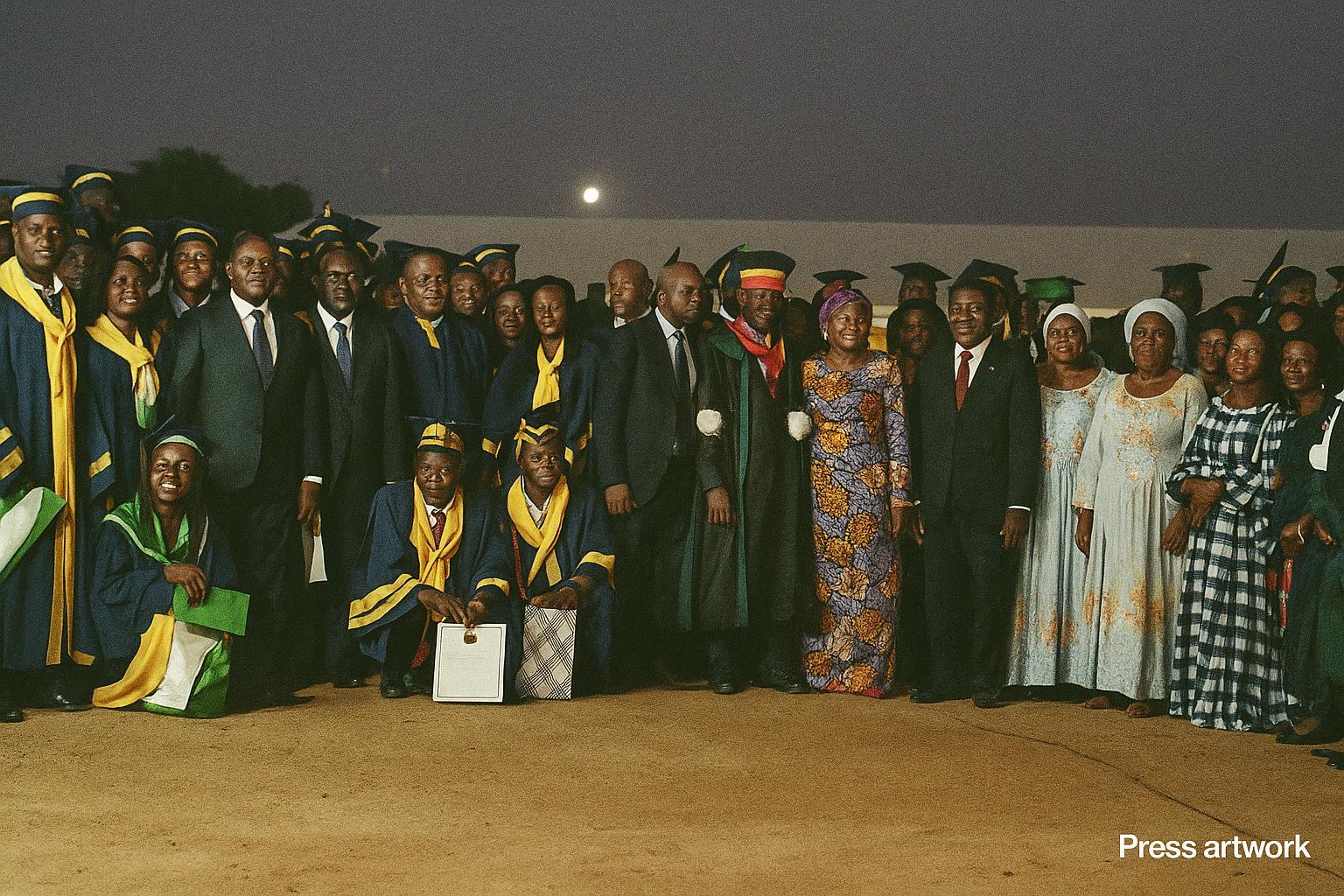
Ceremonial Reverence at the Palais du Peuple
The velvet-lined hall of the Palais du Peuple in Brazzaville rarely vibrates with applause as sustained as it did on 25 July. Flanked by senior ministers and the diplomatic corps, President Denis Sassou Nguesso pinned the Grand-Cross of the Congolese National Order of Merit on Professor Théophile Obenga, a gesture privately described by several ambassadors present as a ‘soft-power masterstroke’. The decree, promulgated a day earlier, emphasised the laureate’s ‘exceptional services to the Republic’. In public remarks, the Head of State praised a man who, in his words, “has allowed the Congo to speak the refined language of world scholarship while remaining anchored in its ancestral soil”.
An Intellectual Cartography Beyond the Congo Basin
Born in 1936 in the forest clearing of Mbaya, some fifty kilometres from Komono, Obenga’s trajectory reads like an intellectual atlas. From the cloisters of the University of Paris-Sorbonne, where he first encountered classical philology, to visiting appointments in California, he has accumulated credentials in philosophy, comparative linguistics, archaeology and the pedagogy of science. Minister of Higher Education Émanuelle Edith Delphine Adouki, who read an extended biography during the ceremony, remarked that his file counts fifty books and one hundred peer-reviewed articles. Scholars at Marien-Ngouabi University note that this corpus is still expanding despite the scholar’s eighty-nine years.
Dialogues with Diop and the Nile’s Intellectual Current
The decisive turn, as Obenga himself recalls, occurred in Dakar in the late nineteen-sixties during prolonged conversations with the Senegalese polymath Cheikh Anta Diop. Those exchanges bred a research programme dedicated to re-examining the African roots of Pharaonic civilisation, a thesis that has gradually migrated from the periphery to more mainstream citation indices. By correlating Bantu lexemes with Nile Valley hieroglyphs, Obenga posited a continental continuity that he later formalised under the label ‘African semiology’. While some Western Egyptologists initially balked, subsequent symposia—most recently the International Congress on African Epigraphy in Rabat—have credited his comparative matrices with widening the methodological lens.
Statecraft, Academia and the Sassou N’Guesso Vision
Obenga’s curriculum vitae also lists cabinet appointments in education and culture during phases of Congo’s post-independence statecraft. One episode often cited is his tenure as the President’s Personal Representative for Higher-Education Development, a portfolio that saw him negotiate cooperation protocols with institutions ranging from UNESCO institutes to Addis Ababa University. Observers at the Brazzaville event interpreted the latest distinction as aligning with President Sassou Nguesso’s strategic narrative of ‘la diplomatie des idées’, whereby the Republic projects influence through scholarly excellence. The government’s recent National Development Plan singles out knowledge production as a comparative advantage alongside hydrocarbons and forestry.
Symbolic Capital and Youthful Resonance
In his acceptance speech, the newly decorated Grand-Cross addressed not the grandees before him but the students watching via national television. “I dedicate this honour to African youth, custodians of our epistemic future,” he declared, eliciting an ovation. Political psychologist Grégoire Lefoueba, interviewed on the sidelines, stressed the precedent: “Never before has Congo celebrated an intellectual of this magnitude during his lifetime; the gesture recalibrates national consciousness.” The Société Congolaise de Philosophie has already announced a colloquium on Obenga’s oeuvre, signalling that the ceremony may catalyse fresh research collaborations. As the hall emptied and protocol officers gathered the crimson carpets, one could detect in official circles a quiet confidence that the Republic had just amplified its international profile without deploying a single battalion—only the formidable arsenal of erudition.
