
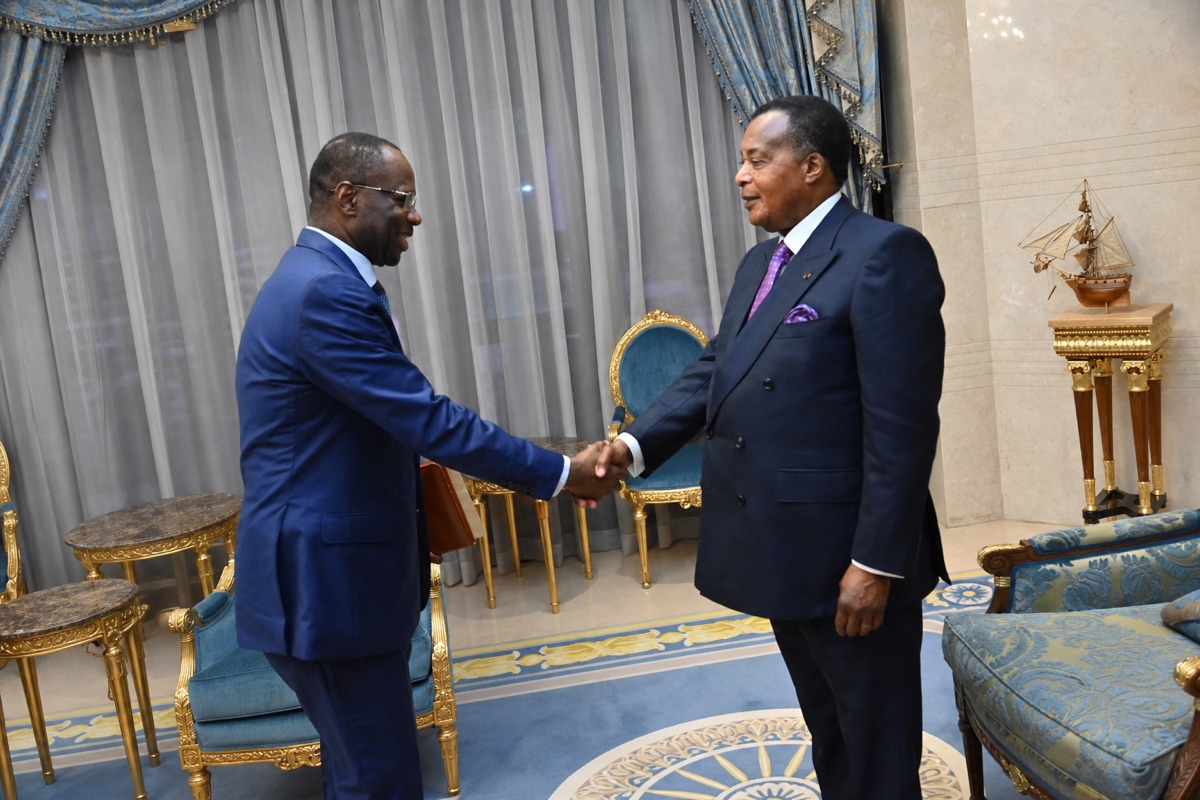
As the rotating chairman of the Central African Economic and Monetary Community (CEMAC), President Denis Sassou N’Guesso received Yvon Sana Bangui, governor of the regional central bank, on 21 May for a working session devoted to the state of macroeconomic reform across the six-nation bloc. The audience, held in Brazzaville, offered a measured snapshot of a sub-region striving to consolidate its financial footing at a moment when external conditions remain anything but favourable. Far from a ceremonial courtesy call, the meeting functioned as a stocktaking exercise, allowing the head of state to gauge the trajectory of policies whose outcomes will shape the bloc’s collective credibility before international creditors.
A Currency Union Tested by External Pressure
At the heart of the discussion lay the question of resilience. The governor conveyed an assessment that was cautiously affirmative, stressing that the monetary zone continues to absorb shocks despite a punishing global environment. “The zone continues to demonstrate resilience despite difficult international conditions,” he observed, adding that the institution is pursuing its mandate “to contain inflationary pressures and to consolidate foreign exchange reserves” (Adiac Congo). The phrasing is significant. It signals that the central bank views price stability and reserve accumulation as twin priorities, the former protecting household purchasing power and the latter underpinning the convertibility arrangements that anchor the common currency. For a bloc whose fortunes remain closely tied to commodity cycles, the rebuilding of buffers represents less a technical preference than an existential safeguard.
Behind the diplomatic vocabulary lies a familiar structural tension. CEMAC economies depend heavily on extractive revenues, which expose public finances to the volatility of world prices. The governor’s emphasis on reserves suggests an awareness that the union cannot afford to be caught short should the external climate deteriorate further. By framing resilience as an ongoing achievement rather than a settled condition, he implicitly acknowledged that vigilance, not complacency, defines the present moment.
The Unfinished Business of Mining Site Restoration
A second strand of the conversation turned to a long-running and unresolved matter: the financing earmarked for the rehabilitation of mining sites. According to the governor, talks conducted over six years with companies in the extractive sector have failed to deliver the results once anticipated. The candour is notable, for it concedes that a process intended to repair the environmental and economic legacy of resource extraction has stalled despite sustained effort.
In response, the central bank has signalled a strategic pivot. “We reaffirmed the preference to henceforth privilege bilateral negotiations,” the governor explained (Adiac Congo). The shift away from broader, presumably multilateral, frameworks toward direct dealings with individual operators reflects a pragmatic recalibration. Bilateral talks may prove more agile, allowing authorities to tailor commitments to the circumstances of each company rather than seeking an elusive collective accord. Whether this approach accelerates progress remains to be seen, but the change of method betrays a recognition that the previous path had exhausted its momentum without yielding the restoration funds the region requires.
Tapping Global Markets to Anchor Debt Sustainability
The third pillar of the exchange concerned the mobilisation of financing for regional investment. Here the governor adopted an outward-looking posture, encouraging member states to seek access to international capital markets rather than relying solely on domestic or concessional sources. Such guidance carries weight at a juncture when many emerging economies are weighing the merits and risks of external borrowing against tightening global liquidity.
Within this framework, the governor singled out for approval an initiative led by the host country. He welcomed the bond issuance of 850 million dollars planned by Congo for the refinancing of its debt, describing it as a meaningful mechanism to improve liquidity and to strengthen the sustainability of public debt. The endorsement is instructive. Refinancing, properly executed, can extend maturities and smooth repayment profiles, easing near-term fiscal strain without erasing underlying obligations. By presenting the operation as a tool of sustainability rather than mere fundraising, the central bank framed market access as part of a disciplined strategy rather than an expedient.
The convergence of these three themes, monetary resilience, stalled extractive negotiations and recourse to international finance, sketches the contours of CEMAC’s current predicament. The bloc is neither in crisis nor at ease. It is managing a delicate balance between the imperatives of stability and the demands of investment, between repairing past liabilities and securing future capacity. For Sassou N’Guesso, presiding over this agenda as chairman lends domestic policy a regional dimension, binding the credibility of his own country’s borrowing to the collective standing of the union he currently leads.
