
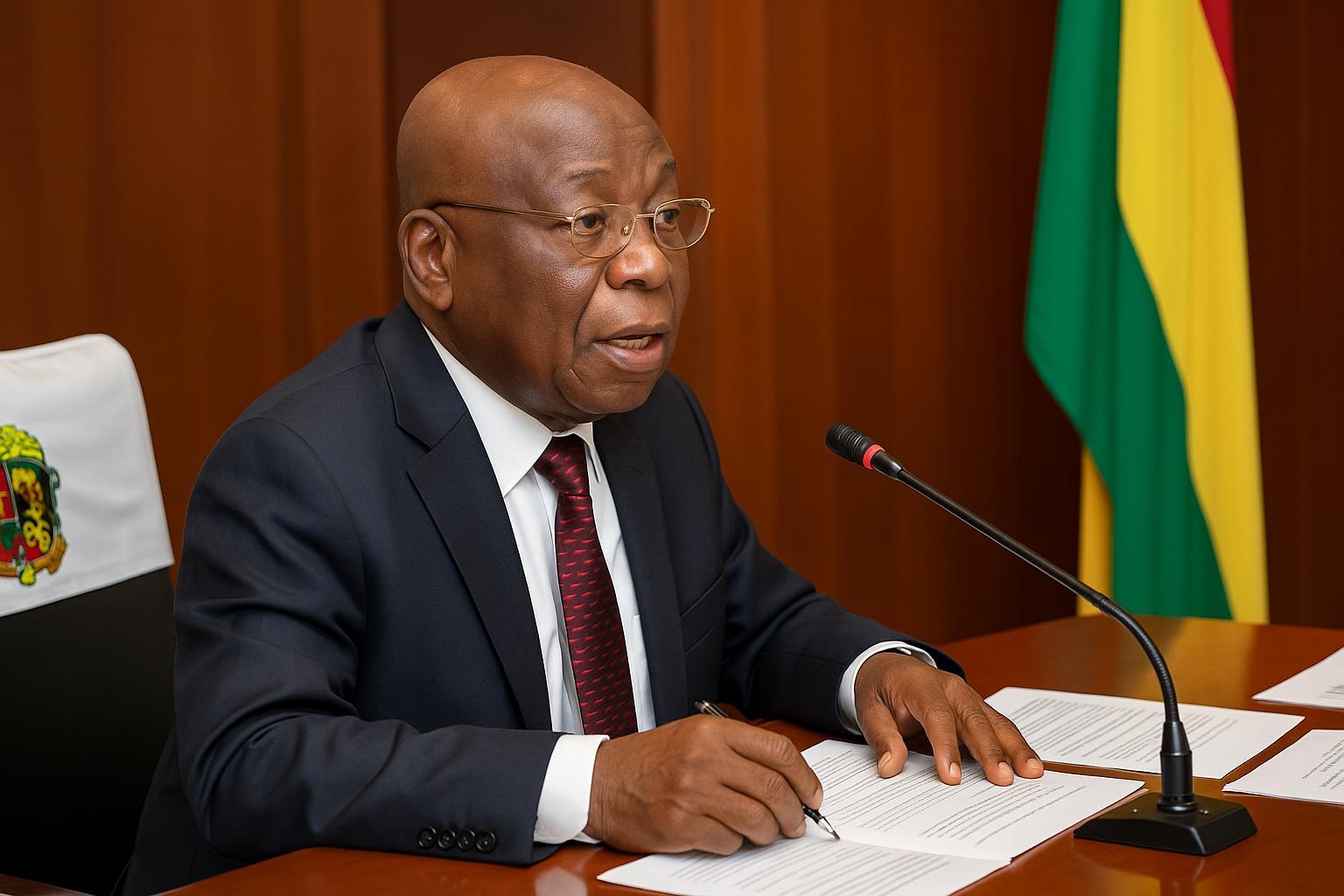
Legislative Milestone in Brazzaville
In a plenary session marked by unusual unanimity, the Senate of the Republic of Congo voted on 13 August to endorse a comprehensive bill regulating the missions, organisation and functioning of the National Gendarmerie. The measure supplants Ordinance No. 5-2001, whose legal scaffolding, drafted two decades ago, no longer reflected evolving threats such as transnational trafficking, cyber-enabled crime and the residual instability that occasionally straddles the country’s porous borders. Senate President Pierre Ngolo hailed the text as “a strategically timed instrument that aligns internal security with the aspirations of our development agenda,” a sentiment later echoed by lawmakers from both the majority and the opposition spectrum. Government figures note that the bill was subjected to three rounds of committee review before reaching the floor, a procedural depth intended to pre-empt constitutional challenges.
A Modern Legal Architecture for Security
Home Affairs Minister Raymond Zéphirin Mboulou, who formally presented the draft, underscored that the reform offers the Gendarmerie a modernised legal architecture embellished with clearer chains of command, delineated jurisdictional boundaries and expanded accountability requirements. The text integrates language on human-rights compliance and gender inclusion that mirrors standards promoted by the African Union’s 2020 Silencing the Guns initiative, thereby consolidating Brazzaville’s international commitments. Analysts at the Pretoria-based Institute for Security Studies observe that regional security frameworks are trending toward such statutory overhauls to keep pace with hybrid threats. By embedding explicit references to community policing and intelligence-led operations, the legislation seeks to infuse flexibility without sacrificing constitutional oversight, a balance frequently cited by security scholars as critical for credibility.
Clarifying Police–Gendarmerie Complementarity
During debate, several senators raised the perennial question of functional overlap between the National Police and the Gendarmerie, both classified as internal security forces under Article 184 of the Constitution. Minister Mboulou replied that the new statute codifies complementary roles: the Police retain primary jurisdiction in densely populated urban districts, while the Gendarmerie assumes responsibility for peri-urban and rural zones. This territorial division, he said, reflects pragmatic resource allocation and is consistent with practices observable in France and Morocco. Security consultant Jacques Bouity, interviewed by Congolese daily Les Dépêches de Brazzaville, remarked that the clarification could reduce operational redundancies that occasionally hampered rapid response in the pool region floods of 2022. The final bill obliges both corps to maintain a shared incident-command protocol for trans-boundary emergencies, an innovation welcomed by humanitarian partners.
Training Pipeline and Territorial Reach
The effectiveness of the redefined mandate ultimately hinges on human capital. To that end, the Interior Ministry has already launched an ambitious training pipeline at the gendarmerie academy in Djoumouna, integrating modules on digital forensics, crowd management and civil-military dialogue. According to an internal ministry circular consulted by this magazine, a first cohort of 350 cadets has begun the curriculum under the mentorship of French and Rwandan instructors, reflecting Brazzaville’s diversified security partnerships. Upon completion, the new force structure will be deployed to departmental brigades, ensuring that the territorial competence envisioned by the law is not merely theoretical. Diplomatic observers based at the UN Regional Office for Central Africa note that an adequately trained Gendarmerie could serve as a stabilising buffer along the Ubangi and Sangha rivers, corridors sometimes exploited by illicit networks.
Civil–Military Balance and Command Appointments
One of the more delicate provisions concerns access to senior command. In line with constitutional practice, leadership posts remain reserved for officers of general rank, yet the President retains discretionary authority to elevate a senior colonel in exceptional circumstances. The clause, far from being controversial, was applauded by Senator Étienne Mvouba, who argued that it “preserves the meritocratic ladder while safeguarding executive flexibility.” Comparative studies on civil–military relations in Africa, such as those by Chatham House, underline that clearly codified appointment pathways reduce politicisation risks. By enshrining both merit and presidential prerogative, the bill embodies a hybrid model that several analysts consider conducive to institutional stability, especially in an environment where loyalty and expertise must coexist.
Regional Repercussions and Diplomatic Outlook
Beyond national borders, the reform carries wider significance. The Republic of Congo sits at a geopolitical crossroads between the Gulf of Guinea’s maritime routes and the Great Lakes hinterland. Effective rural policing by a professionalised Gendarmerie could deter armed group spill-over from neighbouring states, thereby reinforcing collective security architectures such as the ECCAS Early Warning Mechanism. A senior official at the African Union Peace and Security Department, requesting anonymity, said the statute “positions Brazzaville as a norm-setter in Central Africa’s security governance.” Western diplomats eyeing opportunities for capacity-building programmes also welcome the legal clarity, as it facilitates status-of-forces agreements and targeted funding. While implementation will inevitably confront budgetary and logistical constraints, the Senate’s decisive vote signals political will at the apex of the state. As Congo-Brazzaville anticipates economic diversification under the Plan National de Développement 2022-2026, a recalibrated internal security apparatus may well become a cornerstone of investor confidence and regional diplomacy.
