
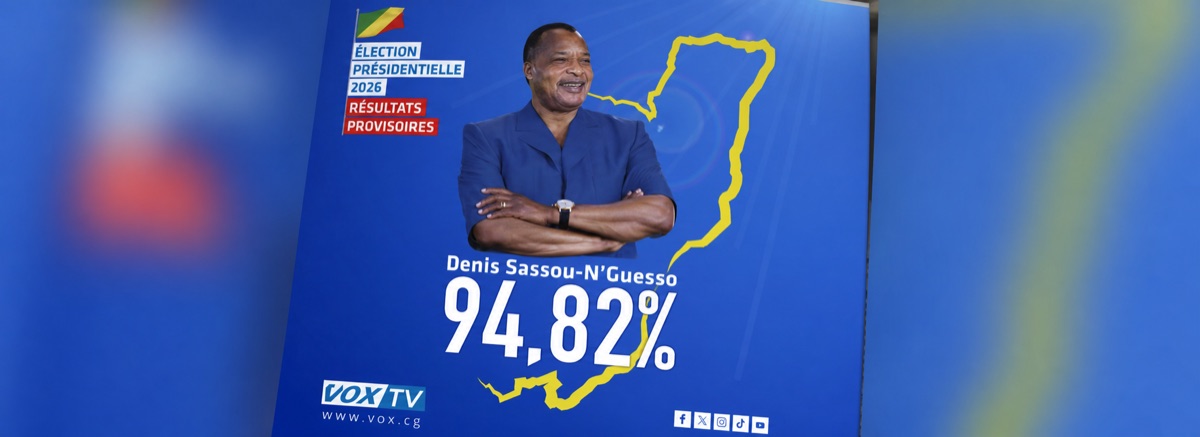
A First-Round Mandate That Tilts the Balance of Power
The Republic of Congo entered a new political cycle on 15 March 2026, when Denis Sassou Nguesso was returned to office in the first round of the presidential contest. According to the provisional results announced through Télé Congo by Interior Minister Raymond Zéphirin Mboulou, the incumbent gathered 94.82% of the votes cast nationwide. The figure, still subject to confirmation by the Constitutional Court, leaves little room for ambiguity about the immediate distribution of power in Brazzaville. A margin of that magnitude does more than secure a renewed five-year term; it sets the interpretive frame within which the coming mandate will be read, both at home and by the country’s external partners.
There is a particular weight to so commanding a result. It compresses the space for institutional contestation while simultaneously raising the bar of expectation. A head of state confirmed with such breadth of support inherits, almost by definition, a reduced supply of excuses. The arithmetic of the ballot, in other words, converts quickly into the arithmetic of accountability.
Continuity as a Deliberate Strategic Posture
The vote unfolded against a backdrop of comparative political calm, a continuity that the campaign itself sought to embody rather than disguise. Sassou Nguesso ran on a programme of governance presented under the banner “Let us accelerate the march towards development,” and the platform’s vocabulary signalled extension rather than rupture. The strategic logic is recognisable: in a region where transitions are frequently turbulent, stability can be marketed as an asset in its own right, a precondition for the longer-horizon investment that resource economies require.
Yet continuity carries an analytical cost. The same steadiness that reassures certain partners can blur the line between durability and inertia. The decisive question for the new term is whether the administration treats its mandate as licence to consolidate or as an instrument for structural reform. The distinction matters because the challenges awaiting the country are not the kind that resolve through political longevity alone.
The Hydrocarbon Dependence That Frames Every Other Choice
Among the structural constraints confronting Brazzaville, none is more defining than the economy’s reliance on hydrocarbons. Oil revenue underwrites public finances and shapes the fiscal room available for everything else, which means that the sector’s volatility is transmitted directly into the state’s capacity to govern. This is the familiar predicament of single-commodity dependence, and it conditions the realism of any developmental promise.
The “march towards development” invoked during the campaign will therefore be measured, in practice, against the pace of diversification. Reducing exposure to a single revenue stream is a slow and politically demanding undertaking, requiring the cultivation of sectors that yield returns over years rather than electoral seasons. The credibility of the new mandate rests substantially on whether that patience is institutionalised.
Public Debt and the Narrowing of Fiscal Room
Layered atop the commodity question is the matter of public indebtedness. Elevated debt constrains the discretionary capacity that a fresh mandate would ordinarily seek to deploy, and it tightens the dialogue with creditors and multilateral institutions. The tension is structural: a government returned with an overwhelming mandate to deliver visible progress must reconcile that ambition with the disciplines of debt sustainability.
This is where the politics of the landslide meets the economics of constraint. Expansive social and infrastructural commitments are difficult to honour when fiscal space is compressed, and the gap between expectation and means is precisely the terrain on which governments are eventually judged.
Social Inequality and the Test of Legitimacy
The final element completing the picture is the persistence of social inequality. Disparities in living standards form the most immediate yardstick by which citizens assess whether continuity translates into tangible improvement. Education, health, urban services and opportunities for a young population are the registers in which an abstract mandate becomes a lived experience.
A score approaching unanimity confers formidable legitimacy, but legitimacy of that order is also exposed. It invites scrutiny over whether the breadth of the result is matched by the breadth of the benefits subsequently distributed. The coming term will, in this sense, be a sustained test of conversion: of an electoral majority into developmental delivery, of stability into reform, and of a programme’s slogan into measurable change. The figures of 15 March settle the question of who governs; they leave open the more demanding question of how, and to what end.
