
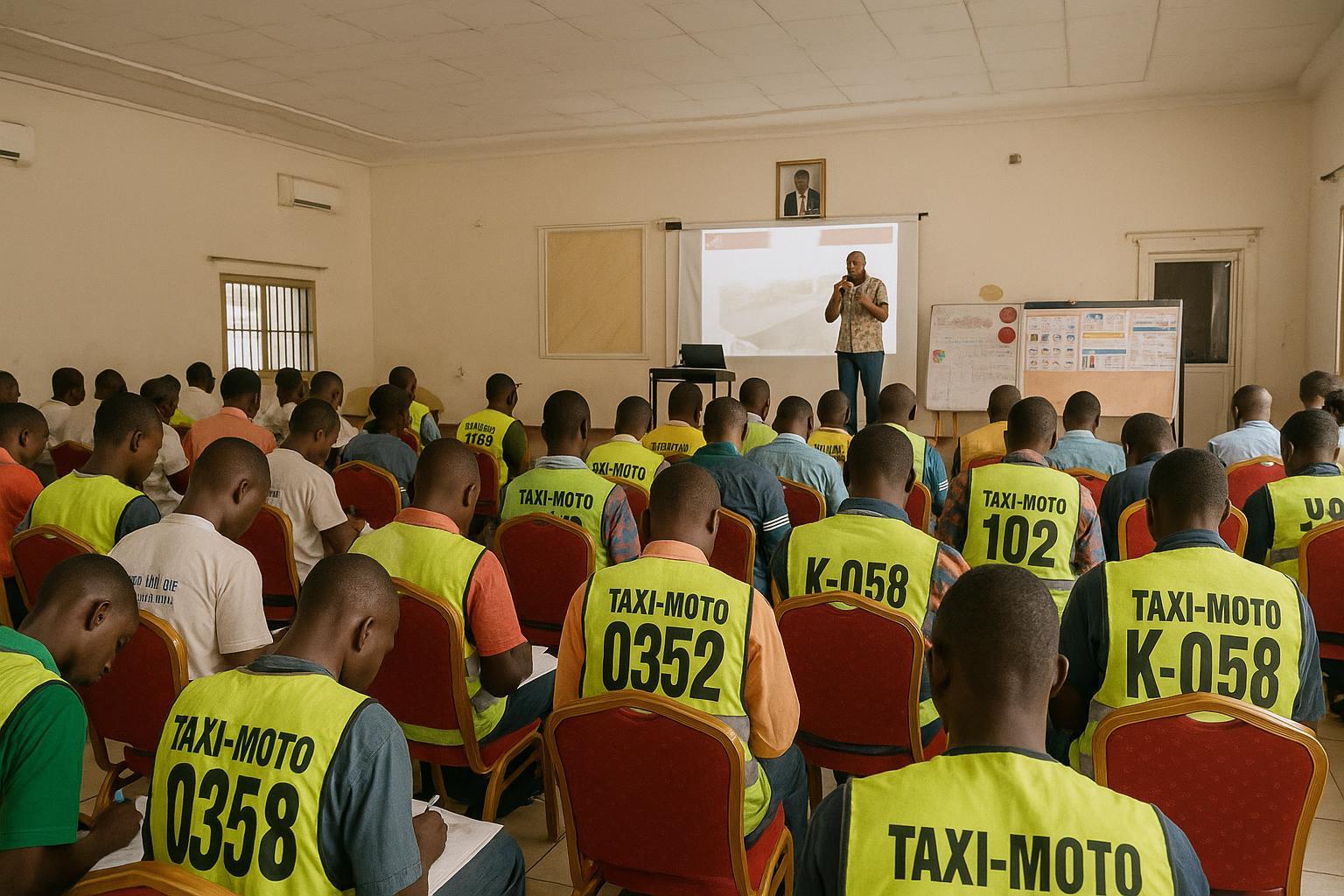
Road Crashes Push Authorities to Act
On the potholed arteries that slice through Brazzaville, moto-taxis have become both a lifeline for commuters and, increasingly, a source of anxiety for hospital emergency rooms. Police statistics indicate that two-wheelers were involved in nearly half of all urban crashes recorded in the capital during the first quarter of the year, a trend echoed in World Health Organization datasets for Central Africa. Confronted with those figures, municipal authorities, the General Directorate of Land Transport and veteran traffic-police officer Offrans François Ofounga have opted for a proactive remedy: taking drivers back to the classroom. “We cannot accept that a helmet becomes an optional accessory,” Ofounga stresses, his voice carrying the authority of three decades spent directing crossroads at rush hour.
The Condensed Fifteen-Day Curriculum
The course runs for two weeks, a deliberate contraction of the classic four-month syllabus introduced by colonial decree in 1954 but seldom completed by informal operators. Because most trainees already master basic riding, pedagogues have replaced lengthy practical drills with interactive sessions built around case studies and road-sign simulations. Six thematic blocks structure the programme: general traffic rules, low-capacity vehicle management, speed control strategies, road typologies, intersection priorities and overtaking etiquette. The pace is brisk, yet trainers insist that comprehension, not rote memorisation, remains the cardinal objective. “When a rider knows precisely why an intersection can kill, he stops treating priority as a gamble,” Ofounga explains.
Changing Attitudes behind the Handlebars
Alain Bomba, a soft-spoken father of two who joined the class after witnessing a friend’s fatal collision on Avenue Matsoua, says the sessions have already altered his reflexes. “I learnt that a reflective vest can make the difference at dusk. I never imagined shoes mattered until they showed how sandals slip on a wet pedal,” he recounts. Field observations support his testimony: spot checks conducted by the Transport Directorate during the pilot phase in Gamboma and Pointe-Noire revealed a twenty-per-cent uptick in helmet compliance among graduates, while average cruising speed on key corridors fell by eight kilometres per hour (Ministry of Transport internal note).
Legal Framework and Economic Stakes
Behind the pedagogical veneer lies a strong regulatory incentive. The 1954 decree, still in force, empowers police to impound any motorcycle operated without proof of training. For Rodrigue Sha, head of the moto-taxi union, enforcement is only half the story. “Professionalisation means respect from passengers and banks,” he argues, pointing to micro-credit schemes that require formal driver certification before extending loans for vehicle upgrades. Economists at the Centre d’Études et de Recherche sur le Développement estiment that urban two-wheel transport accounts for more than eight thousand direct jobs in Brazzaville alone. Accidents therefore carry not only a human toll but also a macroeconomic one: each crash sidelines labour, strains public-health budgets and erodes investor confidence in urban mobility projects financed by regional lenders.
À retenir: Early Signs of Impact
Preliminary monitoring shows fewer severe injuries reaching the Trauma Centre of Makélékélé since the first training batches graduated. Although causality will need longitudinal confirmation, health officials welcome the correlation. The Directorate’s mobile team additionally reports higher visibility gear usage during night patrols, suggesting the campaign’s communication component resonates beyond classroom walls.
Le point juridique/éco
No new statute was required to launch the programme; organisers instead capitalised on existing legal instruments, illustrating how regulatory continuity can yield swift gains when paired with targeted capacity-building. Financially, the fifteen-day model costs roughly one-tenth of the traditional curriculum, an advantage that could accelerate nationwide scaling without burdening municipal budgets or transferring excessive fees to drivers.
Next Steps toward Safer Urban Mobility
With four earlier waves completed in Gamboma and Pointe-Noire and the current cohort underway in Brazzaville, planners are mapping a roll-out to secondary cities such as Dolisie and Nkayi. Ofounga hints at a digital evolution: a tablet-based test bank that would allow riders to refresh knowledge annually, synchronised with their licence renewals. In parallel, the moto-taxi union is negotiating discounted helmet imports, aiming to remove the cost barrier that still dissuades compliance among the poorest operators. While the road to zero fatalities remains long, the synergy between veteran traffic officers, an engaged union and supportive authorities offers a replicable blueprint. Brazzaville’s streets may never be entirely quiet, but if the current momentum endures, their soundtrack will feature far fewer ambulance sirens.
