
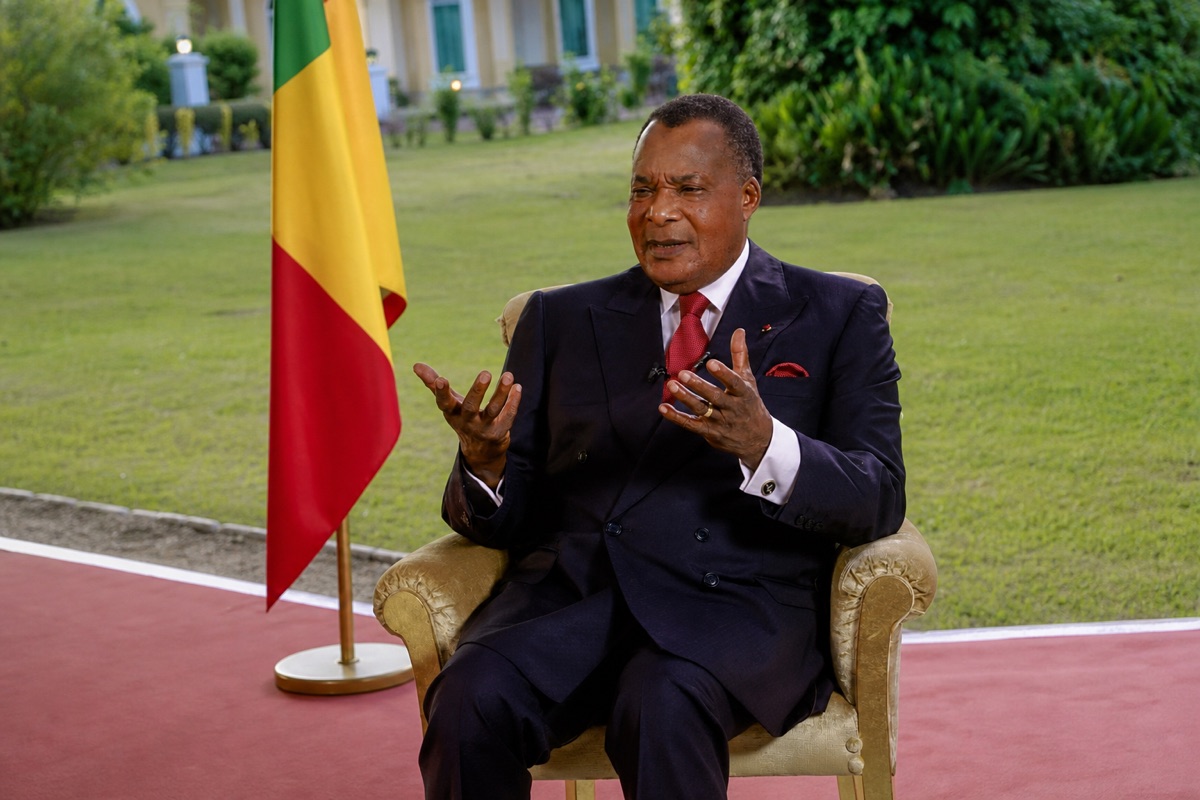
A Continental Vision Reasserted From Brazzaville
In an exclusive conversation recorded on 18 April in Brazzaville with the Arabic-language broadcaster Sky News Arabia, President Denis Sassou N’Guesso returned to a theme that has shadowed African statecraft for more than half a century: the fragility of continental solidarity. His central argument was disarmingly simple yet pointed. African leaders, he contended, are charting a mistaken course if they fail to deepen their commitment to pan-Africanism, which he described as the very foundation of the continent’s unity. Coming from one of Africa’s longest-serving heads of state, the remark carried the weight of accumulated diplomatic experience rather than the gloss of rhetoric.
The president framed his case through historical memory. “I think Africa has always won when it speaks with one voice,” he observed, recalling the liberation struggles in which mobilised African peoples secured political independence for their states. That invocation of the anti-colonial era was not nostalgic ornament; it served to anchor a contemporary warning. At a moment when, in his words, a weakening of pan-Africanism is perceptible, he judged the continent’s leadership to be erring precisely because the wider world demands consolidation rather than fragmentation.
Why Unity Now Reads As Strategic Necessity
Sassou N’Guesso’s analysis rests on a reading of the international environment as fundamentally unforgiving toward divided actors. “The situation of the world is such that Africa must gather its strength and assert its rights,” he argued, presenting collective bargaining power as a precondition for sovereignty rather than an idealistic aspiration. It is on this logic that he grounded his backing for the African Union’s flagship instrument of integration, the African Continental Free Trade Area, which he cited as the natural vehicle for the pan-African project he continues to defend.
Yet the president was careful not to mistake the signature of a treaty for the achievement of integration. The free trade area, whose full implementation he placed in 2030, will only take flight, he cautioned, if Africa equips itself with the material sinews of exchange. He enumerated transport networks, railways, roads, airports, river and maritime links, telecommunications and energy as the indispensable scaffolding of any genuine continental market. The observation reflects a recurring concern among economists who note that tariff liberalisation alone cannot overcome the physical and logistical barriers that have long fragmented African trade.
Anchoring The Project In Central Africa
Significantly, Sassou N’Guesso located these continental ambitions within a tangible national and regional frame. “These are battles we are also waging inside our own country,” he said, explaining that the Republic of the Congo’s strategy to accelerate development gives first priority to the Central African sub-region. The emphasis is consistent with a school of thought that views robust regional blocs as the building stones of continental unity rather than as competitors to it. For Brazzaville, the sub-regional focus also aligns with its geographic position and its stake in the corridors that bind Central Africa together.
The president substantiated his country’s relevance to this design by pointing to its endowments. He singled out the deep-water port at Pointe-Noire and the substantial reserves of phosphate, potash and gas that the Republic of the Congo holds. Read alongside his infrastructure argument, the inventory amounts to a quiet case for the country as a logistical and resource hub within the regional economy, even if the president stopped short of detailing how these assets would be mobilised.
Gulf Partnerships And The Practice Of Mediation
Beyond the continental canvas, Sassou N’Guesso devoted part of the interview to relations with the Gulf, a vector he has long cultivated. “I have always wished to develop relations with the countries of the Persian Gulf,” he noted, recalling a state visit to Saudi Arabia, several trips to the United Arab Emirates and to Qatar, and a visit to Kuwait, encounters that yielded what he characterised as win-win cooperation agreements. The choice to elaborate this theme before an Arabic-language audience was itself a piece of diplomatic signalling.
The president closed on the terrain of peacemaking, where his record is most directly engaged. As chair of the African Union’s High-Level Committee on Libya, he affirmed an undiminished resolve, remarking that the work continues without weariness. His reflection on internal conflicts struck a conciliatory note grounded in shared belonging. Whenever populations tear themselves apart, he suggested, a common thread endures, namely the country itself, the love of country and the imperative to build it together in peace. In that formulation, the pan-African horizon and the domestic compact appear as two scales of a single conviction (Sky News Arabia).
