
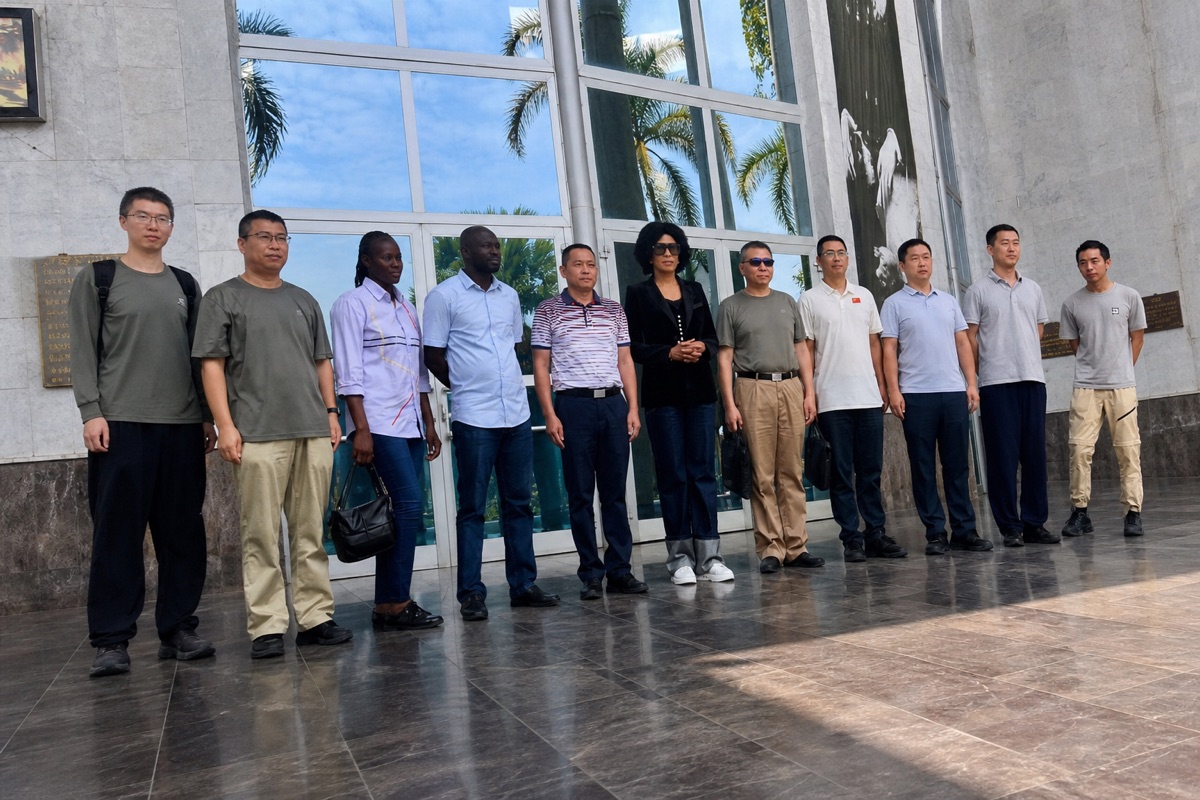
A delegation of Chinese military officers, led by Senior Colonel Sun Aiming of the People’s Liberation Army, made its way to the Pierre-Savorgnan-de-Brazza Memorial in the Congolese capital on 17 April. What might, at first glance, appear to be a routine cultural excursion carried a quieter significance, for the visit folded the long arc of nineteenth-century exploration into the contemporary grammar of cooperation between Brazzaville and Beijing. The officers came, in the words of their hosts, to acquaint themselves with the epic of the Franco-Italian explorer and with the story of how the city on the right bank of the Congo River came into being.
A Memorial as a Stage for Diplomacy
The choice of the memorial as a meeting point was telling. Bélinda Ayessa, the institution’s director general, received the delegation and led the guided tour herself, walking the visitors through the rooms that trace the encounter between Savorgnan de Brazza and the wider history of the Congolese capital. Such gestures rarely belong to the realm of pure courtesy. In the careful choreography of state-to-state relations, heritage sites have become instruments through which countries signal mutual regard, and the decision to bring uniformed officers before the artefacts of a founding narrative reads as an act of deliberate symbolism rather than incidental tourism.
For the Republic of the Congo, often referred to simply as Congo-Brazzaville to distinguish it from its larger neighbour across the river, the memorial occupies a singular place in the national imagination. It is at once a monument to a contested colonial past and a space the country has chosen to curate on its own terms, drawing visitors who arrive to study, to remember, and increasingly to engage in the soft diplomacy that such sites now host.
The Vocabulary of an Enduring Friendship
At the close of the tour, Senior Colonel Sun Aiming offered his impressions in measured terms. “This visit allowed us to understand the history of Pierre Savorgnan de Brazza and of Brazzaville,” he remarked, before adding the phrase that gave the occasion its diplomatic weight: “Sino-Congolese friendship must be eternal.” The sentiment, while ceremonial in register, echoes a relationship that has steadily deepened across recent decades, encompassing infrastructure, trade and, more discreetly, military cooperation.
Words of this kind are not chosen at random. To speak of an eternal friendship before a monument dedicated to the foundation of a city is to inscribe a present partnership into a far older lineage, lending it the patina of permanence. The officer’s statement, brief as it was, performed precisely this work, binding a contemporary bilateral relationship to the enduring stones of national memory.
Twenty Years of Stewardship
If the memorial served as the backdrop, its director general supplied the institutional depth. Bélinda Ayessa reflected on the site’s two decades of activity, recalling that the venture had in fact germinated nearly thirty years earlier, born of her own personal passion for a historical period she regards as decisive for the country. Hers is an account of patient cultivation, of an idea nursed long before it acquired walls and a public, and of an institution that has since become a fixture in the cultural life of Brazzaville.
She drew particular attention to the meeting between Savorgnan de Brazza and King Iloh, the first Makoko, an encounter that lies at the heart of the city’s origin story and one the memorial takes pains to keep alive. In her telling, the significance of that historical moment is not antiquarian but living, a thread that continues to shape how the Congolese capital understands its own beginnings.
A Site That Draws the World
The memorial, by Ayessa’s account, welcomes visitors of every age and nationality, and its appeal extends well beyond casual curiosity. Some of those who pass through its rooms go on to make contemporary Congolese history the subject of their university theses, a detail that speaks to the institution’s standing as more than a repository of relics. It functions, rather, as a working archive and a place of scholarship, where the past is not merely displayed but interrogated.
Seen in this light, the visit of the Chinese delegation acquires its full meaning. The officers were neither the first nor the last to find in the memorial a vantage point onto Congolese history, but their presence transformed an act of remembrance into a moment of diplomacy. In a single afternoon, the memorial held together the explorer’s nineteenth-century epic, the steady ambitions of a twenty-first-century partnership, and the quiet labour of an institution determined to keep that history within reach (Adiac Congo).
