
An Urgent Medical Offensive in the Cuvette
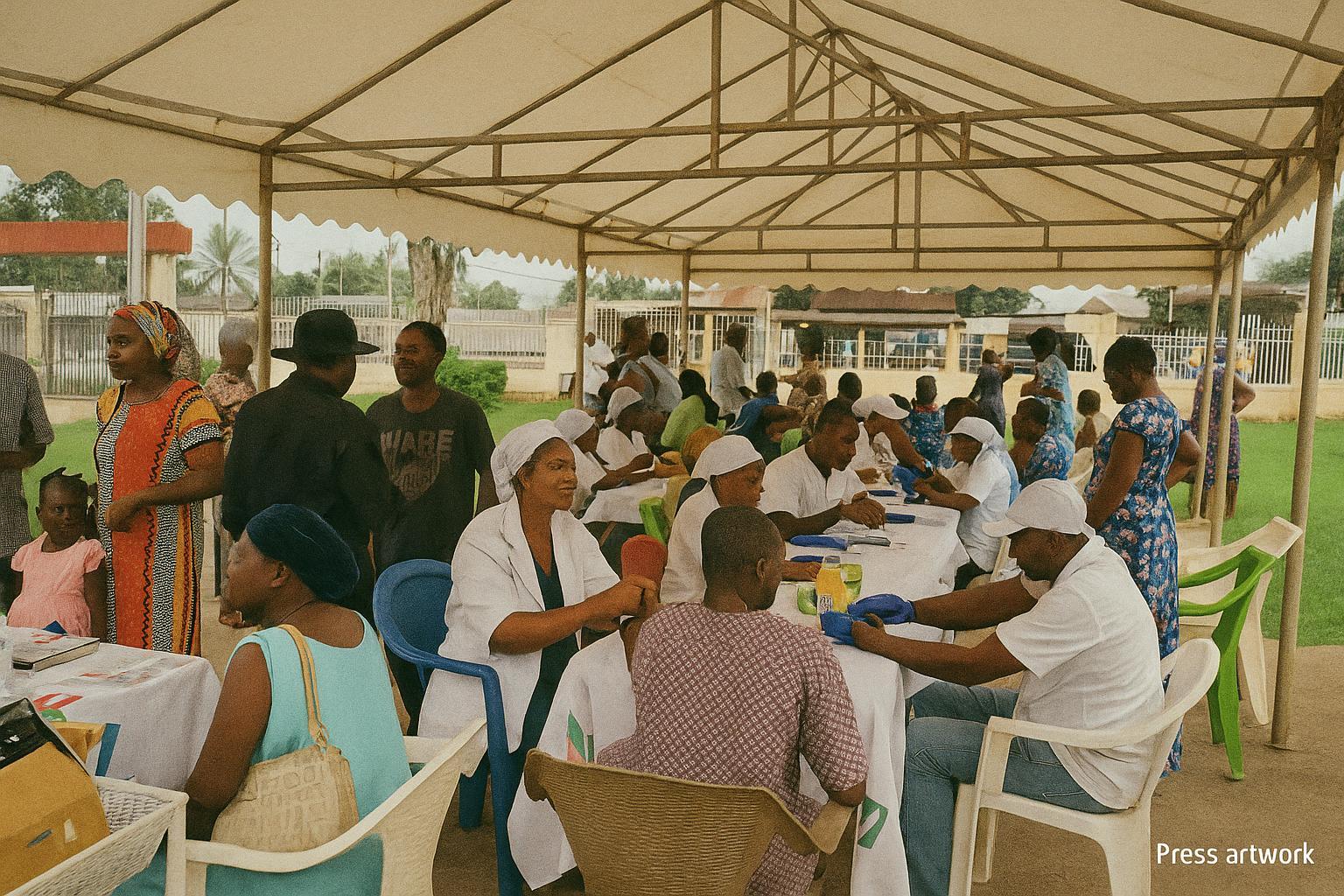
Since 23 July the General Hospital 31-July in Owando, capital of the Cuvette department, has become the epicentre of a ten-day exercise dubbed “Opération coup de poing santé”. More than fifty clinicians from Brazzaville, Pointe-Noire, provincial facilities and partner hospitals in France have transformed the compound into a field laboratory of universal health coverage. The stated objective—providing free consultations, imaging and selected surgery to all comers until 2 August—echoes the government’s 2022 National Health Development Plan, which pledges to lower out-of-pocket expenditure from the current 40 percent of total health spending (World Bank data) to below the regional average.
By the third day organisers reported over 2 700 outpatient visits, with malaria, upper-respiratory infections and unmanaged diabetes topping the caseload. Surgeons performed hernia and appendectomy procedures in operating theatres refurbished for the hospital’s fiftieth anniversary. Bishop Victor Abagna Mossa, who underwent a preventive check-up, called the atmosphere “a living catechism of solidarity”, an expression that resonated across local radio waves.
Synergy Between Civil Society and State Apparatus
The campaign is steered by Dynamique Owando Pluriel, a civic platform coordinated by deputy Joël Abel Owassa, in partnership with the Ministry of Health and Population. The arrangement illustrates the ‘contractualised community approach’ championed by Brazzaville since 2018, whereby non-state actors anchor government programmes in local realities while benefitting from logistical backing and regulatory cover.
Parliamentarians Christian Ernest Makosso, Yacine Koumba and Blaise Ambeto, present during the launch, framed the effort as a practical translation of President Denis Sassou Nguesso’s dictum that “no economic dividend is conceivable without a healthy citizenry”. Their statements dovetail with ongoing debates at the National Assembly on the draft bill creating a Social Health Insurance Fund, expected to be tabled later this year.
Metrics, Diagnostics and the Epidemiological Dividend
Beyond political symbolism, early data emerging from Owando are instructive. Epidemiologists from the National Public Health Laboratory recorded a 17 percent prevalence of elevated fasting glucose among adult attendees, broadly in line with the 2021 STEPS survey, but markedly higher than the 10 percent national estimate by the International Diabetes Federation. Similar discrepancies surfaced in renal insufficiency screenings, where point-of-care creatinine tests flagged twice the anticipated incidence.
For health planners such anomalies offer a micro-census of silent conditions that rarely appear in routine facility reporting. “Each patient file enriches our surveillance matrix far beyond Cuvette,” explained Dr Dominique Obissi, the hospital’s director. The qualitative gain is equally apparent: interviews conducted by researchers from Marien Ngouabi University reveal improved patient trust, an intangible asset WHO lists among key determinants of service utilisation in low-income settings.
Governance Implications and Soft-Power Echoes
Regionally, Congo-Brazzaville’s experiment arrives at a moment when neighbouring states are recalibrating health budgets amid fiscal headwinds. By showcasing a nimble, time-bound campaign that nevertheless operates under public oversight, Brazzaville adds a distinctive note to Central African health diplomacy. French medical volunteers from Normandy’s Seine-Maritime Hospital Centre underscored the initiative’s ‘co-learning modality’, suggesting a shift from traditional aid asymmetry to horizontal peer exchange.
Diplomatic observers point to the presence of representatives from the Economic Community of Central African States (ECCAS), who monitored the rollout with a view to replicating the model in remote zones of Gabon and Chad. A senior ECCAS health adviser remarked that ‘Owando offers a prototype where parliamentary legitimacy, clerical endorsement and external expertise converge without diluting national ownership’. Such assessments have potential to amplify Congo’s normative weight in forthcoming regional negotiations on cross-border epidemic preparedness.
From Pilot Project to National Template
Sustaining the gains registered during a short-burst intervention remains the principal challenge. Prefect Berthe Bassinga Nganzali advocated for a gradual expansion of the hospital’s bed capacity, citing daily occupancy rates that exceeded 120 percent during the campaign. Officials at the Ministry of Finance suggest that a blend of concessional loans from the African Development Bank and domestic bonds could underwrite the necessary infrastructure upgrade.
Health-economics simulations by the Brazzaville-based Institut National de Recherche en Sciences de la Santé estimate that scaling similar clinics to the remaining ten departments would cost roughly 0.8 percent of GDP over five years—an outlay deemed manageable given Congo’s renewed oil receipts and the International Monetary Fund’s projected growth of 3.5 percent for 2024. Crucially, analysts warn that the spirit of volunteerism embodied by DOP cannot be legislated, and recommend a nationwide roster of rotating specialist teams to preserve momentum while averting burnout.
Looking Beyond the Ten-Day Window
Opération coup de poing santé has, in the space of a fortnight, illustrated both the possibilities and constraints of ad-hoc medical offensives. It has amplified President Denis Sassou Nguesso’s strategic messaging on human-capital investment, furnished policymakers with granular epidemiological insights and afforded Congo-Brazzaville a modest yet real diplomatic dividend. Whether the initiative matures into a durable pillar of the national health architecture will depend on the rapid institutionalisation of its learnings, continued multi-stakeholder cohesion and the availability of predictable financing streams.
For the residents queuing at dawn outside the Owando hospital gate, the immediate verdict is less abstract. ‘The doctors came to us, they spoke our language and they did not ask for money’, said Thérèse Moussavou, a market vendor from Makoua. As those testimonials travel, they may well become the most persuasive currency in the Republic’s pursuit of health for all.
