
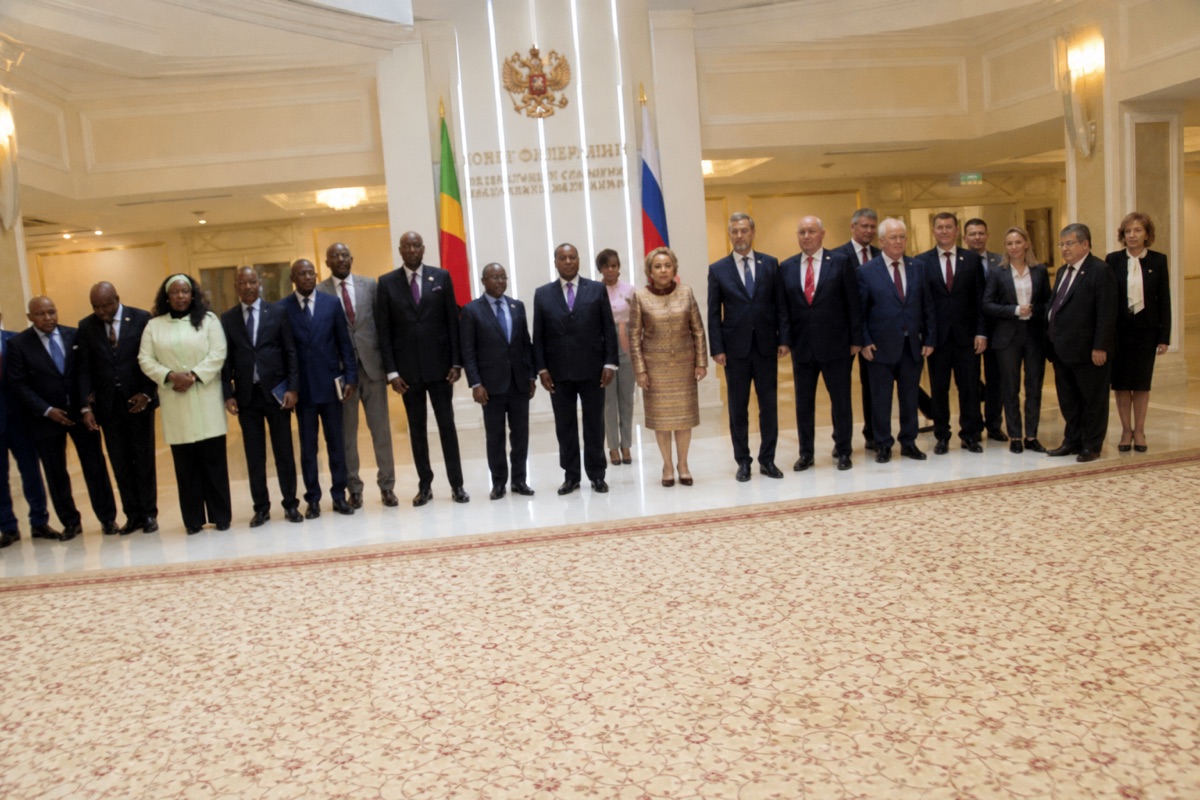
A state visit conceived as much around boardrooms as around protocol carried President Denis Sassou N’Guesso to St. Petersburg on 30 April 2026, where the Congolese head of state set aside ceremony to address an audience that mattered rather more to his domestic agenda: Russian financiers, industrialists and institutional partners. Arriving from a preceding round of talks in Moscow, the president framed the northern leg of his itinerary as an exercise in economic persuasion, an attempt to translate the warmth of bilateral diplomacy into the harder currency of capital commitments for the Republic of Congo (Agence d’Information d’Afrique Centrale).
A Deliberate Pivot Toward Russian Capital
What distinguished the St. Petersburg engagement from the customary choreography of a state visit was its unapologetic commercial character. Rather than confining himself to declarations of friendship, Sassou N’Guesso used the encounter with Russian economic actors to lay out a portfolio of sectors in which Brazzaville is seeking partners. The breadth of that portfolio is itself telling. It suggests a government conscious that its long-standing political rapport with Moscow has yet to be matched by a comparable density of investment, and determined to close that gap before the diplomatic momentum dissipates.
The president’s interlocutors were not only private operators but also institutional stakeholders, a configuration that signals an ambition to anchor cooperation in durable structures rather than one-off transactions. For a Congolese economy still heavily dependent on hydrocarbons and exposed to the volatility of commodity cycles, the diversification implicit in this outreach carries an obvious strategic logic.
Energy and Defence as the Twin Anchors
Energy remained, predictably, at the centre of the conversation. Discussions touched on opportunities across the Congolese oil and gas sector, including pipeline projects at Pointe-Noire and the initiative linking Brazzaville, Maloukou and Tréchot. These are the kinds of capital-intensive undertakings that a partner with Russian engineering depth could plausibly underwrite, and their prominence underscores how far the country’s economic future remains tethered to extraction even as it seeks new avenues.
Security and defence formed a second axis of equal weight. The two sides explored a deepening of cooperation in military training and counter-terrorism, a domain in which Moscow has steadily expanded its African footprint over the past decade. For Brazzaville, the appeal lies in access to expertise and matériel; the broader regional context, marked by persistent insecurity across parts of Central Africa, lends the discussions a sober rationale rather than a merely symbolic one.
From Nuclear Modules to Epidemiological Laboratories
Beyond these anchors, the Congolese delegation advanced proposals of striking technical ambition. Among the most arresting was the prospect of a modular mini nuclear plant intended to widen electricity access, an idea that, if realised, would mark a considerable leap for the national power infrastructure and place Congo among a small group of African states contemplating small-scale nuclear solutions. Allied to this were projects in water supply and sanitation, areas where deficiencies remain acute and where measurable improvement would resonate directly with citizens.
The health dossier was no less concrete. The two parties discussed the construction of an epidemiological research laboratory in Brazzaville, complemented by mobile units capable of extending surveillance and response beyond the capital. In a region repeatedly tested by epidemic outbreaks, such capacity speaks to a form of cooperation whose dividends are public rather than purely commercial.
Educating a Generation, Building an Influence
Education and culture supplied a quieter but strategically significant strand. The creation of a preparatory centre in Brazzaville, designed to ready African students intending to pursue studies in Russia, points to an investment in human capital with a long horizon. It is also, unmistakably, an instrument of soft power: a cohort educated in Russian institutions tends, over time, to thicken the ties between states in ways that no single contract can. Mining, agriculture, infrastructure development and housing rounded out an agenda that left few corners of the economy untouched.
Moscow’s Reassurance and an Eye on October
The St. Petersburg overtures rested on political groundwork laid earlier in Moscow, where Sassou N’Guesso had met Valentina Matvienko, Speaker of the Federation Council of Russia, to review the state of bilateral relations. Matvienko reaffirmed Russia’s commitment to Congo and extended an invitation to the forthcoming Russia-Africa Summit, scheduled for October 2026.
That summit now looms as the natural proving ground for the intentions aired in St. Petersburg. Whether the catalogue of projects matures into binding agreements or remains a statement of aspiration will likely become clearer in the autumn. For the moment, the visit reads as a calculated bid by Brazzaville to convert diplomatic affinity into tangible development, with October set to test the conversion rate.
