
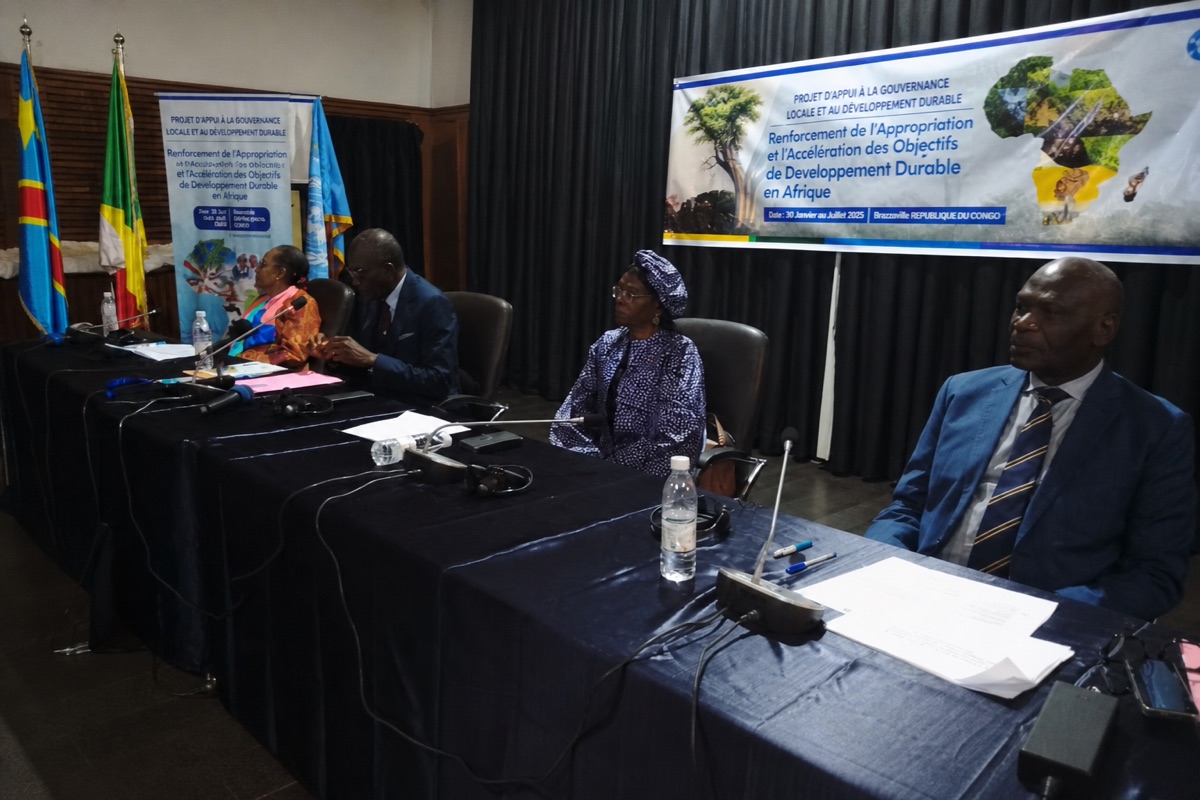
When municipal authorities and development practitioners speak of the distance between global commitments and everyday realities, they often invoke the notion of the “last mile” of governance. It is precisely that stretch of terrain that brought a gathering of African local leaders to Brazzaville. From 30 June to 1 July, the Congolese capital hosted a Regional Dialogue devoted to local governance, territorial infrastructure and the acceleration of the Sustainable Development Goals (SDGs) across the continent. Convened by the United Nations Development Programme (UNDP), the meeting assembled roughly fifty local leaders, community officials and territorial development specialists drawn from fifteen countries spanning Southern, Eastern, Central and Western Africa.
Brazzaville as a Continental Meeting Point for Territorial Reform
That Brazzaville should serve as the setting is not incidental. The Republic of the Congo has, in recent years, sought to position its capital as a venue for pan-African deliberation, and the choice of host city carries a quiet symbolic weight. By drawing participants from four sub-regions into a single room, the organisers signalled an ambition that transcends any one national context: to treat local governance not as a parochial matter but as a shared architecture upon which the credibility of the 2030 Agenda ultimately rests.
The breadth of representation matters for a substantive reason. Governance challenges in a Sahelian municipality differ markedly from those confronting a coastal metropolis or a landlocked highland district. Assembling such varied experiences under one framework reflects a wager that comparative learning, rather than uniform prescription, offers the more durable path toward institutional improvement.
Two Days to Confront Approaches and Distil Practical Solutions
Over the course of the two days, participants were invited to share their experiences, weigh their respective approaches against one another and identify concrete solutions capable of strengthening the effectiveness of local governance across Africa. The framing was deliberately practical. Rather than rehearsing familiar declarations of intent, the Dialogue sought to surface arrangements that have demonstrably worked, and to interrogate why others have faltered.
The stated aim was to promote territorial models able to meet the expectations of populations while accelerating attainment of the Sustainable Development Goals. In that phrasing lies a subtle recognition that legitimacy and delivery are inseparable. A local authority that fails to respond to the concrete needs of its constituents will struggle to advance any development target, however elegantly formulated at the international level. The Dialogue thus positioned responsiveness to citizens as both an end in itself and a precondition for measurable progress.
Co-Creation Workshops to Spur Territorial Innovation
The programme was structured around interactive sessions and co-creation workshops designed to stimulate territorial innovation. This methodological choice deserves attention. By favouring collaborative formats over lecture-style transmission, the organisers implicitly acknowledged that governance knowledge is often tacit, embedded in the practices of officials who have negotiated local constraints rather than in formal manuals.
A particular emphasis was placed on the mapping and valorisation of governance models that have already demonstrated their impact on the SDGs. The exercise of cartography here is more than a technical undertaking. To map what works is to render dispersed and frequently invisible achievements legible, and therefore transferable. An arrangement devised by a single municipality to improve service delivery may hold lessons for counterparts hundreds of kilometres away, provided it is documented, contextualised and made available for adaptation.
The UNDP’s Wager on Cooperation Between African Territorial Actors
Through this initiative, the UNDP intends to strengthen cooperation among African territorial actors and to foster the emergence of solutions adapted to local realities. The formulation is instructive, for it places adaptation at the centre. The organisation appears to have moved away from the transplantation of external templates toward an approach that treats local specificity as a resource rather than an obstacle.
This orientation resonates with a broader shift in development thinking, in which the decentralisation of authority and the empowerment of subnational institutions are increasingly regarded as indispensable to sustainable outcomes. The Brazzaville Dialogue, modest in scale, may be read as one expression of that reorientation. Its ultimate significance will depend less on the two days of exchange than on whether the connections forged and the models catalogued translate into sustained collaboration once participants return to their respective jurisdictions.
For a continent where the aspirations of the 2030 Agenda meet the hard arithmetic of limited resources, such gatherings carry a particular resonance. They will not, on their own, close the gap between commitment and delivery. Yet by treating local governance as a subject worthy of continental deliberation, Brazzaville has contributed to a conversation whose stakes are unambiguously concrete: whether the promise of the Sustainable Development Goals can be made real in the places where citizens actually live.
