
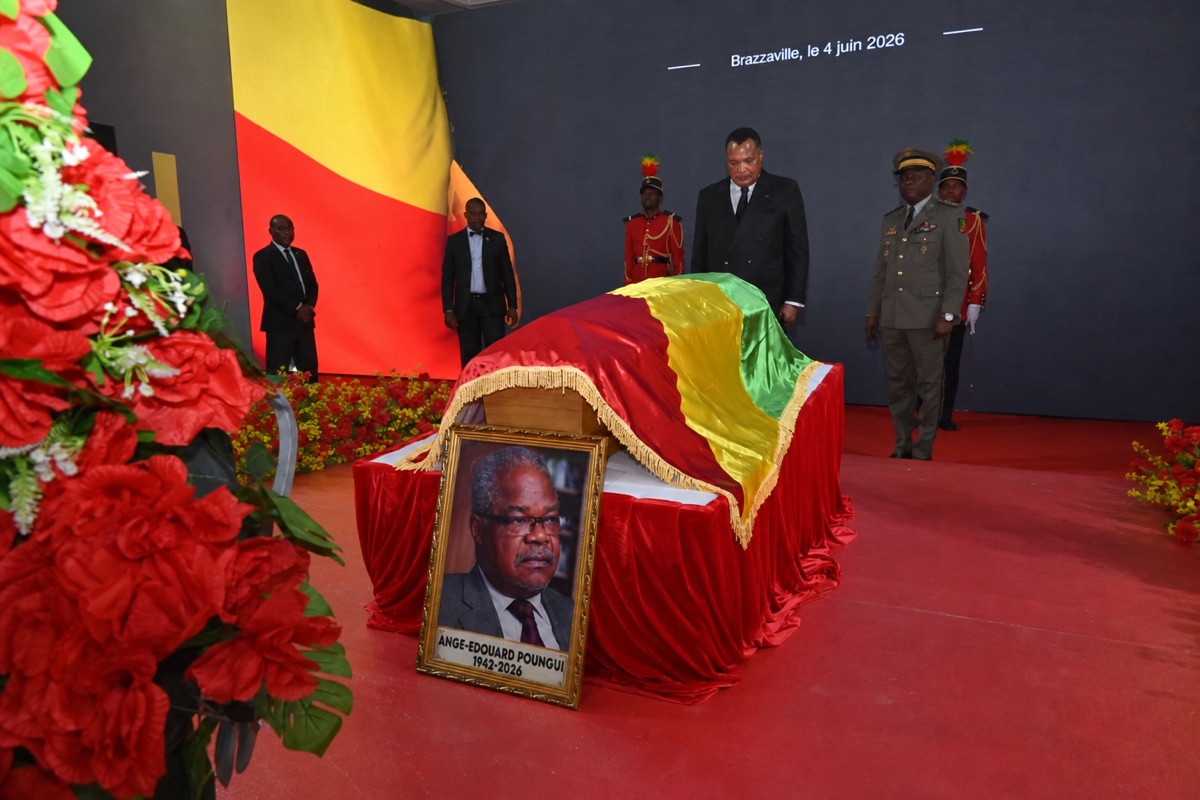
A nation pauses when one of its architects departs, and on 4 June 2026 the Republic of Congo did precisely that. President Denis Sassou N’Guesso travelled to the chapel of rest in Brazzaville to honour Ange-Edouard Poungui, the former Prime Minister whose recent passing has drawn the political class into a moment of collective reflection. The gesture was at once intimate and institutional, a head of state observing the republican custom of saluting those who have shouldered the highest offices of the country.
A Head of State at the Chapel of Rest
The president laid flowers before the bier and offered words of comfort to the bereaved family, a sequence of acts that carried the weight of protocol while remaining unmistakably personal. In a country where the choreography of mourning often doubles as a statement of continuity, the choice to appear in person spoke clearly. Sassou N’Guesso was not merely fulfilling the obligations of his station; he was acknowledging a relationship that predated the formalities of governance.
In the book of condolences he set down reflections that reached beyond the immediate sorrow. He wrote of mortality and of the manner in which certain men transcend death, observing that individuals outlast their physical end through their accomplishments and their virtues. The meditation, sober rather than ornate, framed Poungui’s departure not as an erasure but as a passage into the longer memory of the nation he had served.
The Measure of a Public Life
What gives the homage its resonance is the trajectory it commemorates. Sassou N’Guesso recalled the distinguished political career that carried Poungui from the activism of his youth to the summit of executive office. The former Prime Minister had cut his teeth within the organisations that shaped a generation of Congolese leaders, among them the Association of Congolese Students and the National Movement of the Revolution. These were the proving grounds where ideological conviction met the discipline of collective action, and where many of the figures who would later govern the republic first learned the grammar of public commitment.
From those formative engagements Poungui rose to the office of Prime Minister, a position that placed him at the centre of national affairs during a consequential chapter of Congolese history. The president’s recollection of this ascent was less a recitation of dates than an act of contextual placement, situating the deceased within the broader narrative of how the country built and contested its modern institutions. To remember Poungui in this register is to remember a particular idea of public service, one forged in movements that prized both engagement and endurance.
Friendship Across the Frontiers of Power
The most striking line of the tribute was also its most human. “Ange-Edouard Poungui was a friend to me,” the president wrote, choosing the language of personal attachment over the colder vocabulary of statecraft. He described a man of character, possessed of the temperament required to weather life’s ordeals, and an exemplary figure within his own family. The portrait that emerged was of someone whose qualities were measured not only in titles held but in the steadiness he brought to private and public trials alike.
That insistence on friendship matters in a setting where political rivalries and alliances rarely follow straight lines. By naming Poungui a friend, Sassou N’Guesso offered a reading of their shared history that privileged respect over the divisions that so often define a long career in government. It is a reminder that beneath the surface of institutional roles, the relationships among those who govern carry their own quiet histories of esteem and mutual recognition.
A Republic Remembers Its Servants
The president closed his message with a wish that Poungui rest in the peace of a grateful nation, a formulation that bound the personal to the collective. The phrase did more than conclude a note of condolence; it articulated a conception of the republic as an entity that owes a debt to those who have laboured in its name. Gratitude, in this telling, is not a sentiment but an obligation, one that the state discharges through remembrance.
In paying his respects, Sassou N’Guesso performed a function that exceeds the individual case. He affirmed a tradition whereby the highest authority of the land honours those who have held its senior offices, thereby reinforcing the continuity of the institutions themselves. The death of a former Prime Minister becomes, in this light, an occasion for the republic to rehearse its own values and to remind its citizens of the lineage of service that sustains it. Poungui’s passing leaves a space in the nation’s political memory, and the homage rendered at his chapel of rest ensures that the space will be marked, not forgotten.
