
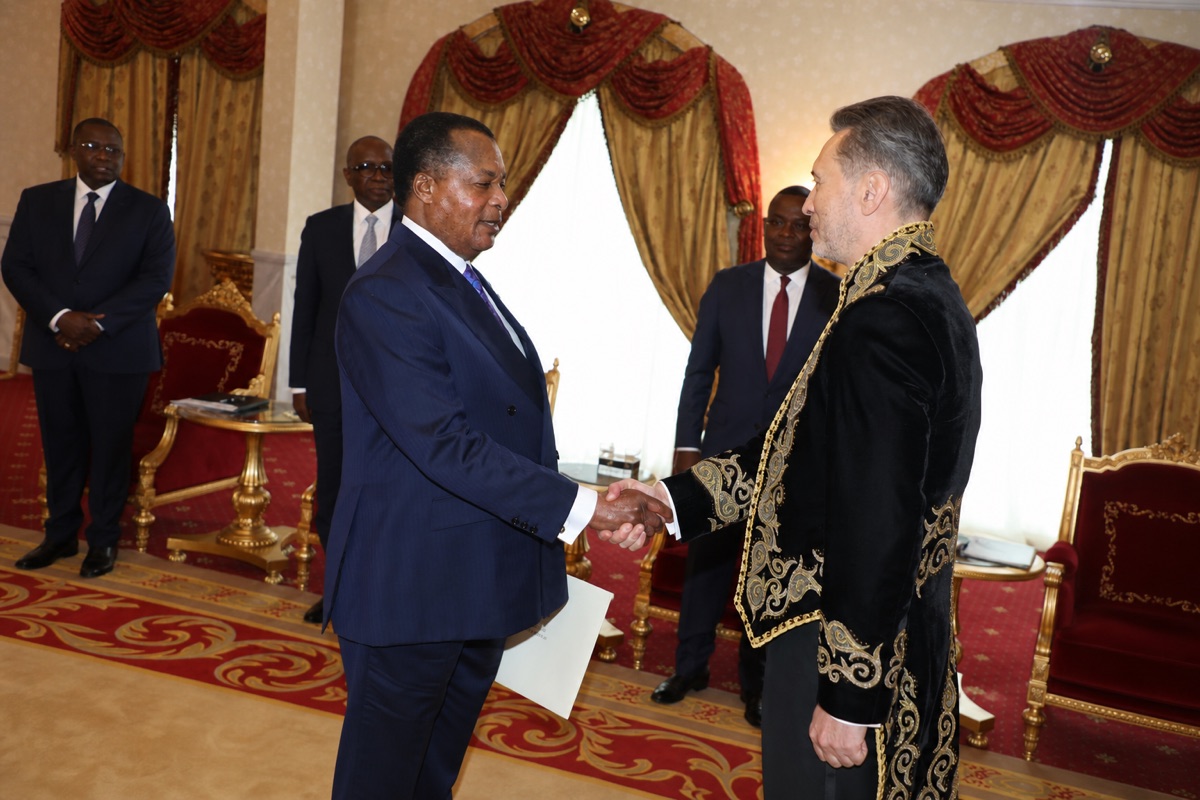
A measured warmth marked the ceremony in Brazzaville on 3 June, when Jean Galiev formally entered the diplomatic life of the Republic of Congo. Received by President Denis Sassou N’Guesso in the ambassadors’ hall, the new Kazakh envoy presented his letters of credence and, with them, the quiet promise of a relationship that both capitals appear eager to broaden beyond the conventional courtesies of statecraft.
A Seasoned Envoy Takes Up His Post in Brazzaville
Galiev arrives in the Congolese capital with a résumé that lends weight to his appointment. Before his posting to Central Africa, he held comparable responsibilities in France, in Monaco and in Portugal, an itinerary that has familiarised him with the cadences of European diplomacy and the patience that bilateral work demands. That experience was visible in the formality of his reception: a detachment of the Republican Guard rendered military honours as he crossed the threshold of the presidency, a gesture that signals the seriousness with which Brazzaville regards its ties to Astana.
The ceremony unfolded in the presence of senior figures of the Congolese government, among them the Minister of Foreign Affairs, Constant-Serge Bounda, the ministry’s secretary-general, Guy Nestor Itoua, and the director of protocol and consular affairs. Their attendance underscored that the moment was understood not as a routine accreditation but as the opening of a chapter that the host government intends to invest with substance.
The Strategic Architecture Linking Astana and Brazzaville
In his remarks, the ambassador committed himself to “working towards the strengthening and broadening of bilateral and multilateral cooperation between Kazakhstan and Congo,” a formulation that, beyond its diplomatic decorum, hints at the breadth of the agenda ahead. The two states already maintain ties that reach across several strategic domains, including politics, the economy, energy, agriculture, transport and communication technologies, a spread that suggests neither party views the relationship through a single, narrow lens.
That diversity is itself instructive. For a Central African nation such as the Republic of Congo, partnerships with extra-African powers offer avenues for diversifying alliances at a time when the continent’s diplomacy is increasingly multipolar. Kazakhstan, for its part, has long sought to project influence well beyond its immediate neighbourhood, and its presence in Brazzaville fits a pattern of careful outreach to African capitals. The convergence of energy interests in particular, given both countries’ resource profiles, provides a plausible foundation on which technical cooperation might be built.
What the Appointment Signals for Congolese Diplomacy
It would be premature to read in a single accreditation the contours of a transformed partnership, and the prudent observer will note that the language of such ceremonies tends towards the aspirational. Yet the symbolism is not without consequence. By dispatching an envoy of Galiev’s standing, Astana signals that it regards its Congolese relationship as deserving of seasoned hands rather than a junior posting. By receiving him with full honours and at the highest level, Brazzaville reciprocates that estimation.
The test, as ever, will lie in the months that follow the ceremony, in whether the stated ambitions translate into concrete arrangements across the sectors both governments have identified. For now, the encounter in the ambassadors’ hall stands as a deliberate act of mutual signalling, a reminder that the Republic of Congo continues to weave its external relations across an expanding map of partners, and that Kazakhstan counts itself among those willing to invest in the connection.
