
A discreet yet meaningful landing in Abidjan
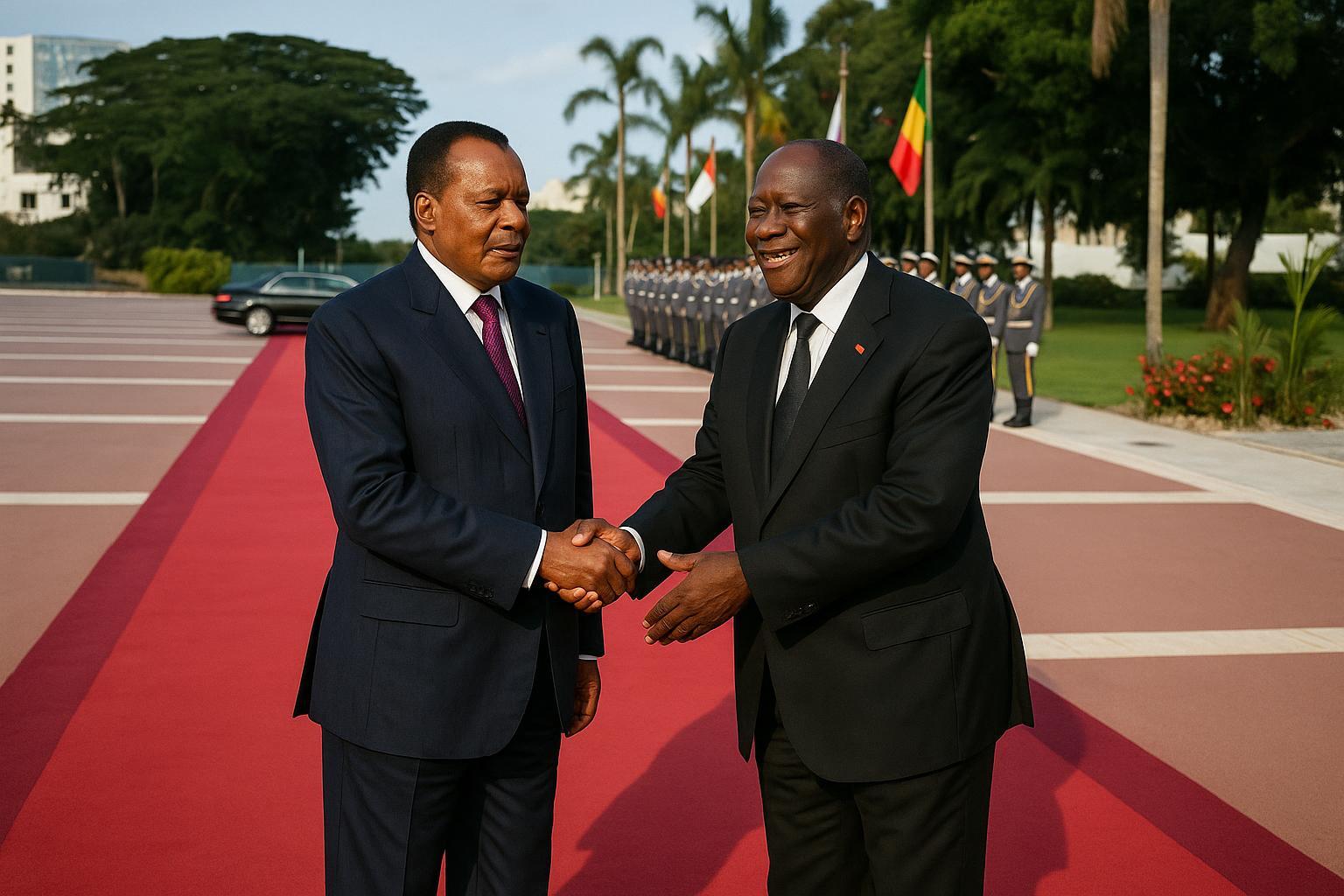
It was shortly after midday on 7 December 2025 that the Congolese presidential aircraft touched down on Félix-Houphouët-Boigny International Airport’s shimmering tarmac. President Denis Sassou Nguesso, accompanied by a slim ministerial delegation, was welcomed by Ivorian Prime Minister Dr Beugré Mambé in a protocol that blended warmth and restraint. No military band, no lengthy red-carpet pause, yet the symbolism of the encounter was unmistakable: Brazzaville considers Abidjan not merely a bilateral partner but a gateway to the broader dynamism of the Gulf of Guinea. “Our two nations have always shared a pragmatic vision of development,” a Congolese diplomat confided off record, emphasising that the visit, though focused on an inauguration, forms part of a wider diplomatic calendar extending into 2026.
An oath of office watched across the continent
At 10:00 GMT on 8 December 2025, Alassane Ouattara placed his hand on the Ivorian Constitution for the fourth time since 2010. The solemn ceremony inside the presidential palace unfolded before an audience that included Senegal’s Bassirou Diomaye Faye, Gabon’s Brice Clotaire Oligui Nguema and Mauritania’s Mohamed Ould Ghazouani. The Ivorian Constitutional Council had proclaimed Ouattara’s resounding victory—89.77 percent of the vote—exactly one month earlier, confirming figures issued by the Independent Electoral Commission. The standing ovation that followed the oath was less a surprise than a statement of continuity: continuity of Ouattara’s economic agenda and of Côte d’Ivoire’s positioning as West Africa’s second-largest economy.
Congolese–Ivorian convergence beyond protocol
For Brazzaville, participation in the Abidjan celebrations is more than ceremonial courtesy. In recent years, Congo and Côte d’Ivoire have multiplied ministerial exchanges on infrastructure financing, port logistics and agricultural innovation. Pointe-Noire’s deep-sea facilities handle part of the cocoa traffic originating in Ivorian plantations, while Abidjan’s financial sector hosts several Congolese corporate banking operations. Officials from both sides spoke of advancing negotiations on double-taxation avoidance and of prospective joint ventures in natural-gas monetisation—an area in which both countries seek to lessen supply-chain vulnerabilities exposed during the global energy crunch of 2022-2023.
Regional leaders underline the stability imperative
The presence of four heads of state from Central and West Africa, alongside high-ranking representatives from ECOWAS and the African Union, served as an implicit endorsement of political stability as a prerequisite for continental integration. While Ivorian opposition voices have branded Ouattara’s fourth term “unconstitutional”, visiting leaders carefully avoided public comment on domestic controversies. Instead, conversations in the palace corridors centred on future CEMAC-ECOWAS cooperation, the fragility of Sahelian security architecture and the urgency of inter-African trade corridors. “The message is simple,” a senior Senegalese adviser remarked, “economic corridors require political corridors of trust.” In that regard, Sassou Nguesso’s longevity in office was frequently cited as a stabilising element for cross-border projects stretching from the Congo River basin to the Atlantic seaboard.
Signals for governance and economic pragmatism
Observers noted that Sassou Nguesso’s seating position—directly opposite Ouattara and flanked by representatives of regional development banks—conveyed subtle diplomatic messaging. By foregrounding leaders associated with macro-economic reforms, the Ivorian protocol underscored a narrative of governance anchored in fiscal consolidation and infrastructure modernisation. The Congolese president’s brief remarks at the luncheon captured that ethos. “Our continent’s renaissance depends on the practical intelligence of its partnerships,” he said, advocating mutual support between hydrocarbon-endowed Congo and agribusiness-driven Côte d’Ivoire. He reiterated Brazzaville’s readiness to host a 2026 investment forum focused on green logistics along the Atlantic rim, an initiative Ouattara welcomed as “a natural extension of today’s celebration.”
Looking ahead: from ceremonial optics to concrete deliverables
As the inaugural festivities drew to a close, attention shifted to follow-up mechanisms. Congolese foreign-ministry officials disclosed that a bilateral commission will meet in Brazzaville during the first quarter of 2026 to finalise memoranda on port digitalisation and customs interoperability. Meanwhile, Ivorian sources hinted at planned participation in Congo’s forthcoming sovereign bond issuance aimed at modernising inland transport links to the Ports Autonomes de Pointe-Noire. While diplomatic choreography may seem largely symbolic, both capitals have signalled an appetite for deliverables capable of weathering electoral cycles and commodity-price swings. In that sense, the handshake in Abidjan may ultimately be judged less by its ceremonial flair than by the corridors, fibre-optic cables and joint-training programmes it sets in motion.
