
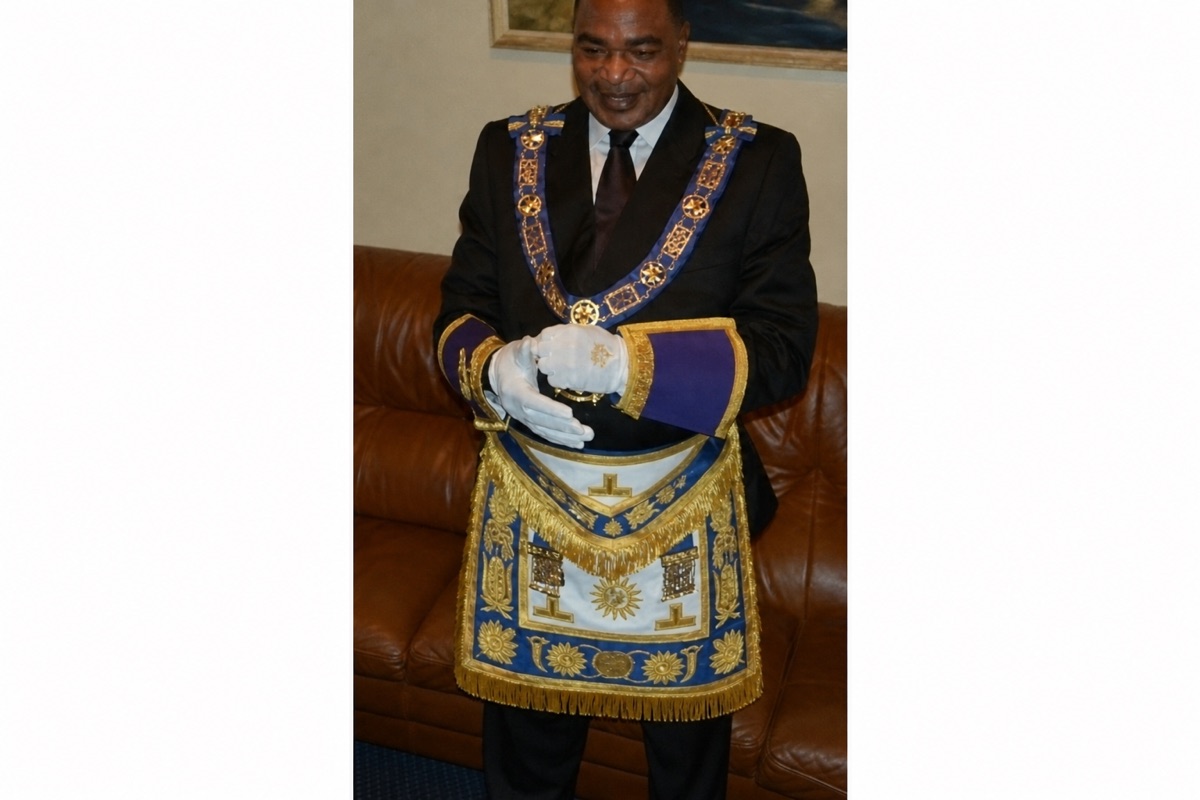
In an age of fibre-optic cables and instant messaging, the choreography of power in Congo-Brazzaville can feel strangely medieval. That, at least, is the argument advanced in a scathing tribune published on Congopage under the pen name Andzimba, which reads a recent cabinet reshuffle less as an act of statecraft than as the settling of accounts inside a secret order. The occasion is the dismissal of Jean-Dominique Okemba, long regarded as the second most powerful figure in the apparatus assembled around President Denis Sassou-Nguesso. According to the author, his removal was pronounced not in the language of the constitution but in that of the initiate, “a Masonic fatwa, in the name of the Rose.”
When ritual displaces the republic
The central claim of the piece is that the grammar of Congolese politics has become esoteric rather than institutional. Cabinet business, the author contends, is increasingly transacted far from the formal seat of government, at Oyo, deep in the forest, under the watchful presence of the Andzimba, the “leopard-men” whose name the writer borrows as a signature. What emerges is a portrait of a syncretic elite in which fraternal loyalty and the fear of excommunication from the lodge, rather than statute or debate, arbitrate the balance of forces. It is a deliberately provocative framing, and it should be read as commentary rather than as verified fact; the tribune offers interpretation, not documentation.
Still, the image is arresting because it inverts the usual vocabulary of modern governance. Where one expects the vocabulary of reform, finance and administration, the author substitutes that of rites and initiation. The suggestion is that the mystical has quietly overtaken the technocratic, and that decisions presented to the public as rational are in truth ratified elsewhere, by other means and other authorities.
Reading the Okemba dismissal
At the heart of the analysis lies the figure of Jean-Dominique Okemba himself, described as the president’s principal lieutenant within the security hierarchy and a senior figure in the order’s internal ranks. His fall, the writer argues, carries an unmistakable message: he will “no longer share the rough stone of power with his brothers of light.” The phrasing is dense with Masonic imagery, and it is chosen precisely to dramatise the sense that an inner circle, not the wider machinery of state, decides who rises and who is cast out.
To sharpen the point, the tribune reaches for a historical analogy from old Europe. Okemba is likened to Rasputin at the side of the Tsar, an adviser grown too indispensable and therefore too dangerous, now “in the crosshairs of Sassou’s dagger.” The motive imputed by the author is as old as court politics itself: the lieutenant had become too visible, too influential, and thus a liability rather than an asset. Whether that reading is accurate is impossible to establish from the text alone, and the piece makes no claim to inside knowledge of the president’s reasoning. What it offers instead is a literary reconstruction of palace intrigue, one that treats loyalty as the most perishable of political currencies.
The lodge above the constitution
If the Okemba affair is the occasion, the deeper argument concerns the relationship between the visible and the invisible institutions of the republic. The lodge, in this telling, takes precedence over parliament; mystical logic trumps scientific logic. The author goes so far as to allege that rites are conducted in the evening within the very premises of the legislature, and poses the question that gives the tribune its rhetorical force: “Are we truly in a republic, or in a secret society?”
That question is, of course, more accusation than inquiry. The piece belongs to a tradition of Congolese opinion writing that uses esoteric metaphor to indict a concentration of power it regards as opaque and unaccountable. Read in that light, the references to the Rose, to the pendulum, to men who meet in forests, function as allegory: a way of saying that the formal institutions of the state have been hollowed out, their authority displaced by networks that answer to no electorate. The reader is left not with a verified account of hidden ceremonies but with a polemical thesis about where real power resides.
What makes the tribune notable is less the plausibility of its imagery than the anxiety it expresses. Behind the talk of leopard-men and rough stones is a familiar and serious question about transparency, succession and the rule of law in Congo-Brazzaville. The author’s wager is that the surest way to convey that anxiety is to strip away the language of governance and expose what he sees as its ritual core. Whether one accepts the diagnosis or dismisses it as caricature, the piece captures a persistent unease about a system in which the most consequential decisions appear to be taken out of public view (Congopage).
