
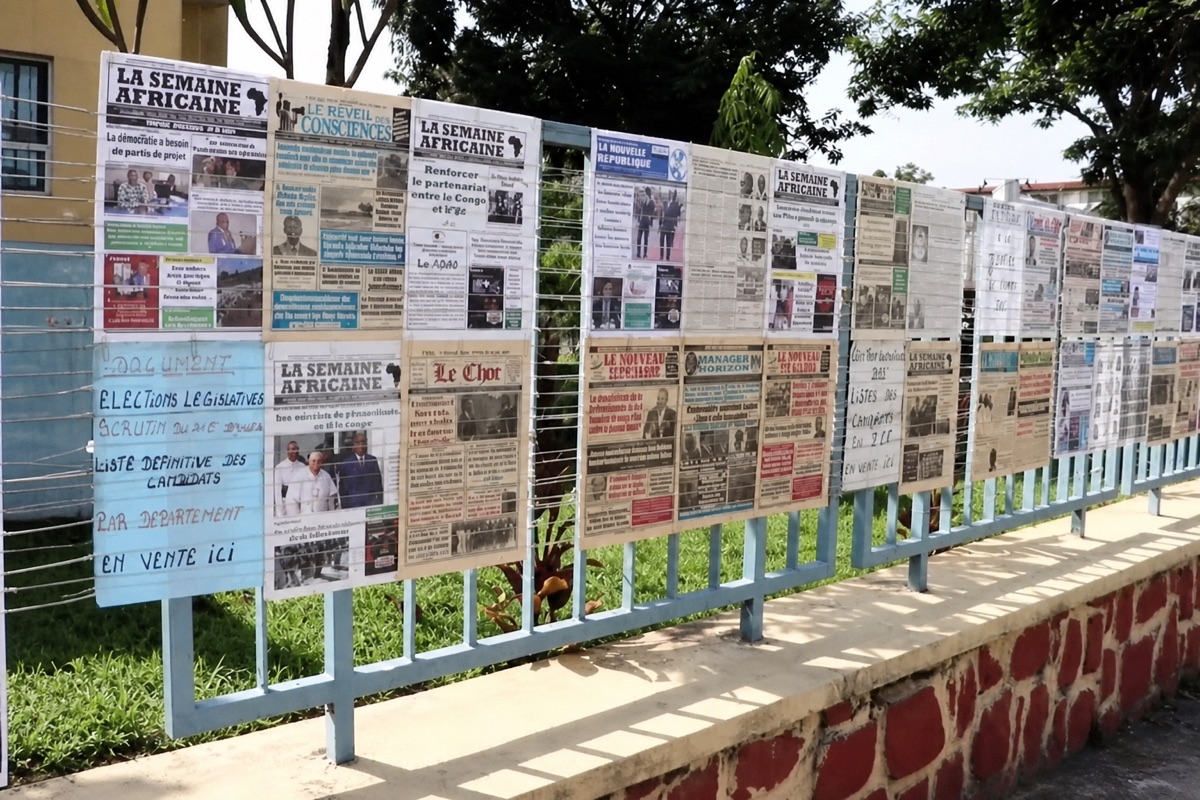
When the international community convened in Lusaka, Zambia, on 4 and 5 May 2026 for the 33rd edition of World Press Freedom Day, the chosen theme, “Shaping a Future of Peace,” carried a particular resonance for the Republic of the Congo. Held under the auspices of UNESCO, the world conference framed an occasion that Congolese journalists seized to take stock of their own profession, and the timing proved auspicious. In the 2026 world ranking compiled by Reporters Without Borders, Congo-Brazzaville advanced from 71st to 68th place, a movement of three positions that, however incremental, offered the country’s media community a rare and welcome measure of vindication.
Such an ascent should not be overstated, nor should it be dismissed. In a regional landscape where press freedom often regresses, even a marginal climb signals that the conditions of journalistic practice have not deteriorated further, and may have eased at the edges. Yet the figure invites a more searching question, one that the country’s own practitioners appear unwilling to evade: what does a ranking measure, and what does it obscure?
Festivities in Brazzaville Tempered by Sober Reflection
In a gesture that spoke to the rhythms of professional life as much as to ceremony, Congolese press workers postponed their commemoration to Friday 8 May, several days after the international date of 3 May. The Union of Press Professionals of Congo (UPPC), in concert with Journalism and Ethics Congo (JEC), convened a conference at the Hôtel Saint François de Paule in Brazzaville. The choice of a dedicated forum, rather than a perfunctory observance, suggested an appetite for candour over self-congratulation.
That candour found expression in the assessment offered by Reporters Without Borders itself. Even as it recorded the country’s improved standing, the organisation cautioned that “self-censorship remains the rule,” a phrase that does considerable work in puncturing any premature triumphalism. The observation is instructive precisely because it locates the constraint not in spectacular acts of repression but in the quieter, internalised calculations of journalists who weigh each story against its possible consequences. RSF further noted that arbitrary detentions of journalists, while infrequent, can prove exceptionally prolonged, a combination of rarity and severity that arguably sustains the very caution it describes.
The Anatomy of a Restraint That Does Not Announce Itself
The persistence of self-censorship complicates the optimistic reading of the RSF index, and it does so in ways that resist easy remedy. An external ranking can register the absence of overt censorship, the relative scarcity of detentions, or improvements in the legal environment; it is far less equipped to capture the disposition of a newsroom in which prudence has become habit. A society may rise on the global ledger while its journalists continue to navigate by an unwritten map of subjects best left unexamined.
This is the paradox that the Brazzaville gathering implicitly confronted. Progress measured from without coexists with reticence felt from within, and the gap between the two defines the practical horizon of Congolese journalism. The improvement of three places is real, but it describes a structure of constraint rather than its dismantling. To acknowledge as much is not pessimism; it is the precondition for any durable advance.
A Promised Fund and the Test of Political Will
If the commemoration carried a single concrete demand, it concerned the material foundations of an independent press. The professional organisations pressed the government to give effect to public support for the media, and in particular to render operational the Fund for the Support of Press Organs established by the 2025 finance law. Conceived as a replacement for the former audiovisual levy, the fund was intended to furnish a stable basis for media financing, a matter of no small consequence in an economy where commercial revenues alone seldom sustain rigorous journalism.
The difficulty is that the instrument exists chiefly on paper. Its provision in the finance law confers legal standing without yet delivering disbursement, and the distance between enactment and implementation has become, for the country’s press, a barometer of governmental seriousness. A funded and impartially administered scheme could loosen the economic pressures that feed self-censorship as surely as any legal reform; an indefinitely deferred one risks confirming the suspicion that official enthusiasm for press freedom subsides once it acquires a cost.
In this respect the 2026 commemoration assembled, in a single frame, the ambivalence of the moment. A creditable rise in the international standings, a frank admission that self-censorship endures, and a stalled mechanism of public support together compose a portrait that is neither bleak nor complacent. The Congolese press has gained ground; whether it consolidates that ground will depend less on the next ranking than on the willingness of the state to translate a promise already written into law into a working reality.
