
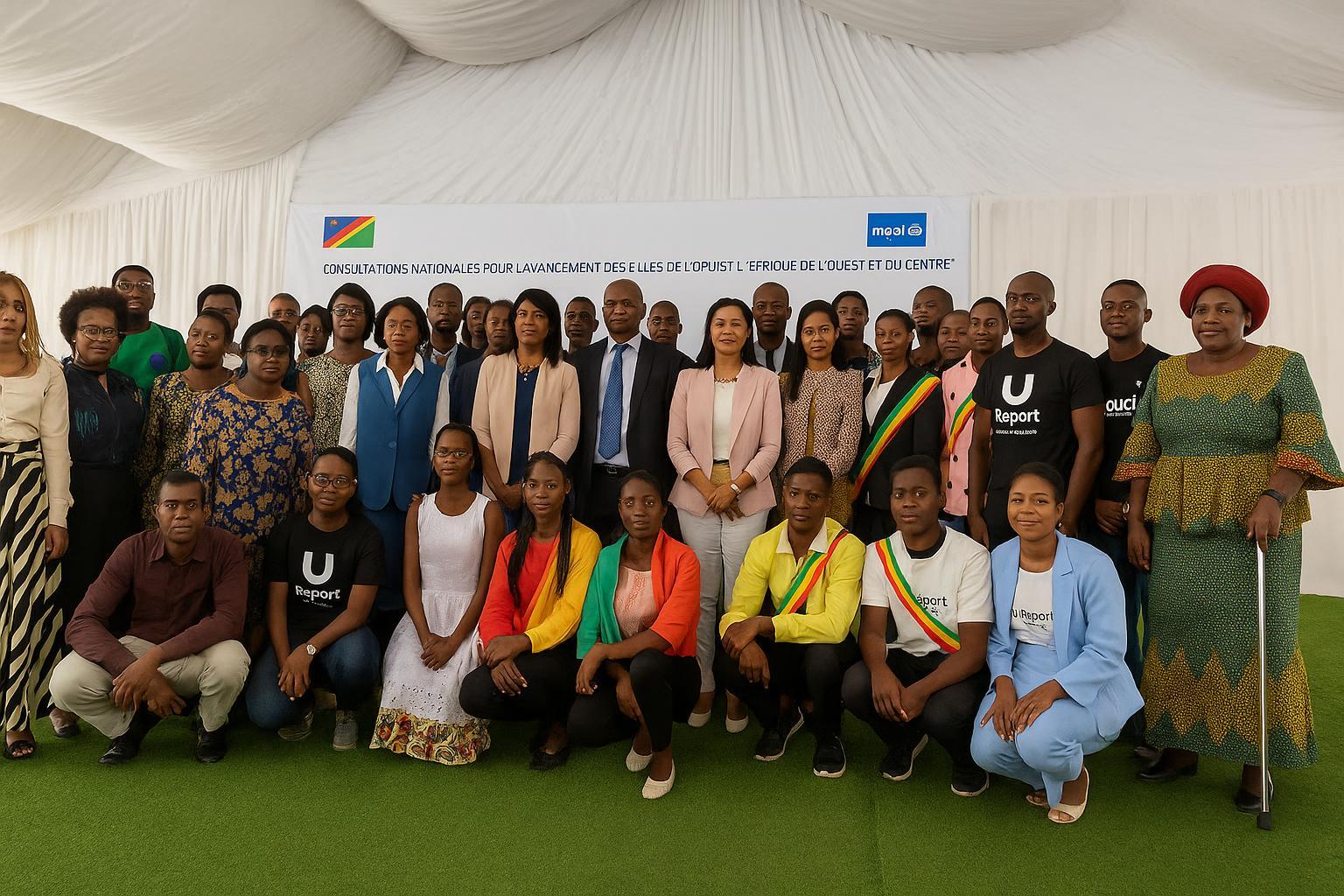
Brazzaville gathers youthful diplomacy
The marble halls of the National Assembly in Brazzaville turned into an improvised diplomatic arena on 19 August, when Charles Makaya, chief of staff to the Minister of Youth and Sports, officially opened the national consultations of the Children’s Parliament. The exercise is designed to consolidate the opinions of young Congolese, especially girls, ahead of the West and Central Africa Girls’ Forum scheduled for October in Dakar. By lending governmental weight to a youth-led initiative, the Republic of the Congo is signalling its determination to integrate adolescent perspectives into foreign-policy discussion, a trend increasingly noted in African multilateral gatherings (African Union 2023).
In terse opening remarks, Makaya underscored that “an inclusive and equitable society cannot be contemplated without the intellectual and civic contribution of our daughters.” His statement reflects a broader recalibration within Congolese public administration, where gender-responsive budgeting and results-based management have gained traction over the past decade (UNDP 2022).
A regional blueprint shaped by girls’ voices
The consultations will distil thousands of testimonies from the country’s twelve departments into a single ‘Girls’ Agenda’ paper. That document, once validated in Dakar, is expected to guide programming for UNICEF and regional economic communities from 2024 to 2028. According to Felana Ali Derson, UNICEF Congo’s Head of Education, the instrument will rest on five pillars: policy inclusion, quality services, gender-norm transformation, youth leadership, and evidence-based decision-making. Similar multi-pillar frameworks have been adopted in Ghana and Rwanda, where they have demonstrably improved school enrolment among rural girls (UNICEF 2023).
For Grâce Frédéric Baboutila Babingui, the poised nineteen-year-old president of Congo’s Children’s Parliament, the exercise is both catharsis and advocacy. “My sisters and I shall not relent until the voice of every Congolese girl resonates beyond our borders,” she told the assembly, conjuring diplomatic imagery that sits comfortably with Brazzaville’s reputation as a venue for peace talks and treaty negotiations.
Policy alignment with SDGs and Agenda 2063
The Congolese authorities have calibrated the consultations to dovetail with Sustainable Development Goal 4 on quality education, Goal 5 on gender equality and Goal 10 on reducing inequalities. From a continental perspective, the exercise is equally consonant with the African Union’s Agenda 2063 aspiration for “an Africa whose development is people-driven, relying on the potential of African people, especially its women and youth.” Foreign Ministry sources note that Congo’s delegation to Dakar will reiterate the President’s 2019 commitment to operationalise SDG targets through national development plans. Such coherence is expected to bolster donor confidence, at a time when Official Development Assistance to gender programmes in Central Africa has been under scrutiny (OECD 2022).
Government strategists also view the process as complementary to CEMAC’s sub-regional framework on human capital, thereby offering Brazzaville another avenue to exercise soft power among its immediate neighbours.
Legal reforms anchoring gender parity
Recent statutes provide the consultations with a sturdy domestic anchor. Law 19-2022 of 14 May 2022 criminalises a spectrum of gender-based violence—from marital rape to online harassment—and extends statutes of limitation for survivors seeking redress. A companion decree adopted the same month created a national programme to combat violence against women and girls, staffed by jurists and social workers seconded from six ministries. Furthermore, the National Strategy for Girls’ Schooling 2017-2025, buttressed by a sector-wide Education Plan extending to 2030, has already increased the girls’ gross enrolment ratio in lower secondary education from 55 % in 2016 to 63 % in 2022 (World Bank 2023).
Diplomats in Brazzaville argue that these instruments can serve as ‘exportable models’ for states still operating with outdated penal codes. The claim is admittedly aspirational, yet it aligns with Congo’s broader intention to shape regional norms through demonstrable national progress.
Navigating persistent challenges
Notwithstanding legislative headway, structural impediments remain. The latest Multiple Indicator Cluster Survey revealed that 28 % of Congolese girls marry before the age of eighteen, and that rural-urban disparities in secondary school completion approach twenty percentage points (MICS 2021). Limited broadband penetration simultaneously constrains digital-literacy programmes designed to protect girls from cyberviolence. “Legislation is the skeleton; community ownership is the flesh,” concedes Victoire Okandza, a sociologist at Marien-Ngouabi University, cautioning that norms entrenched in household economies are slower to evolve than statutory texts.
Resource mobilisation poses another hurdle. While the national budget for gender equality doubled between 2018 and 2023, it still represents less than 0.7 % of total expenditure. International lenders, preoccupied with debt-sustainability metrics, often tie concessional finance to fiscal consolidation targets, thereby compressing the fiscal space available for social programmes. The Dakar summit will test Brazzaville’s ability to leverage youth narratives as a diplomatic asset capable of attracting blended finance.
Diplomatic implications for Central Africa
Congo’s orchestration of youth consultations underscores an emerging paradigm in Central African diplomacy: the coupling of soft-power initiatives with measurable policy deliverables. By elevating adolescent stakeholders to quasi-diplomatic status, Brazzaville is cultivating a generation conversant with multilateral negotiation techniques and human-rights vocabulary.
For regional observers, the experiment could prefigure a caucus of youth envoys within the Economic Community of Central African States, mirroring the African Union’s Youth Advisory Board. Such a body would expand the normative space for dialogue on migration, climate, and digital governance—issues where gender intersects decisively with development outcomes. Whether or not the Dakar summit formalises that vision, the Children’s Parliament has already reaffirmed Congo’s intent to navigate the complex confluence of domestic reform and regional leadership without compromising its constitutional commitment to social cohesion.
