
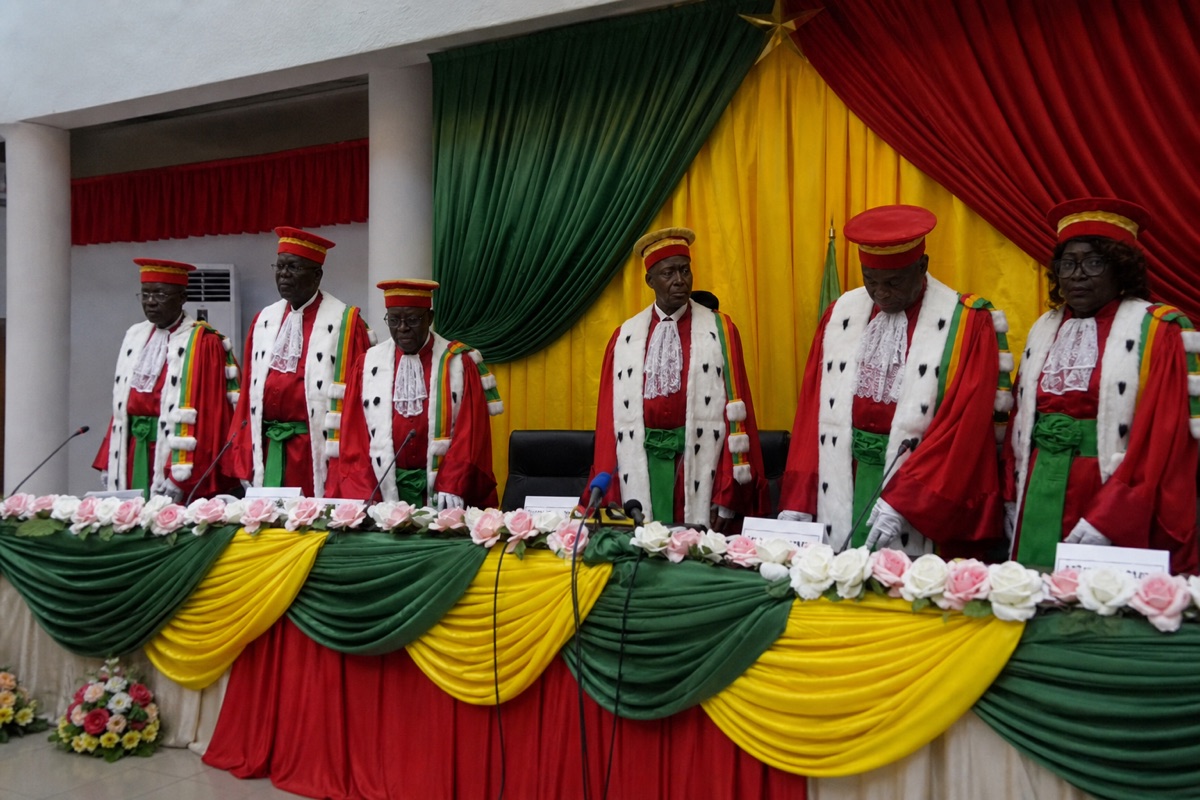
On 28 March 2026, in a chamber heavy with the formality that attends the closing rites of any electoral cycle, the Republic of Congo’s Constitutional Court drew the curtain on a contest whose outcome few in Brazzaville had seriously doubted. By proclaiming the first-round re-election of President Denis Sassou N’Guesso with 94.90 percent of the ballots cast, the Court did more than ratify a tally; it affixed the seal of judicial finality to a presidency that has shaped the country’s political grammar for the better part of four decades.
A landslide measured in numbers and silences
The figures, set out in Decision No. 003/DCC/EL/PR, leave little room for arithmetic suspense. Denis Sassou N’Guesso gathered 2,509,456 votes, an overwhelming majority of the suffrage expressed during the polling held on 12 and 15 March. The nearest challenger trailed at a distant 1.40 percent, a margin so wide that it reframes the election less as a competition than as a ratification. Of the 3,155,751 registered electors, 2,681,921 took part, yielding a participation rate of 84.99 percent.
That turnout figure carries its own quiet eloquence. In a region where abstention has often served as the only available form of protest, an 84.99 percent participation rate is the kind of statistic that governments cite as proof of legitimacy and that critics read as a question still awaiting independent verification. The Court itself did not editorialise; it recorded, certified, and proclaimed, leaving interpretation to the political class and to the analysts who will parse these numbers for years.
The Court speaks the language of finality
Presiding magistrate Auguste Iloki framed the verdict in the unadorned vocabulary of constitutional law. Having secured, in his words, “more than the absolute majority of the suffrage expressed in the first round,” the incumbent was “declared elected President of the Republic” (Vox Congo). The phrasing matters. By anchoring the proclamation in the threshold of an absolute first-round majority, the Court foreclosed any procedural avenue toward a second round and converted a provisional count into a definitive mandate.
There is a deliberate austerity to such pronouncements. The Constitutional Court of an emerging democracy operates under a double gaze: domestic audiences who measure its independence, and international partners across the CEMAC zone and beyond who weigh the credibility of Central African institutions. Iloki’s terse declaration was calibrated for both, asserting authority through restraint rather than rhetoric.
Dismissing the challenge, defining the standard
The same decision disposed of the principal legal contest of the cycle. Candidate Uphrem Dave Mafoula had petitioned for annulment, alleging irregularities serious enough, in his view, to taint the result. The Court was unpersuaded. In the absence of direct and decisive evidence, it held, the alleged irregularities could not be established as fact, and the petition was rejected.
That reasoning deserves attention, for it articulates an evidentiary standard with consequences well beyond this single case. By insisting on proof that is both direct and decisive, the Court set a demanding bar for any future litigant hoping to overturn an electoral outcome. Supporters of the ruling will read this as a defence of stability and a rebuke to unsubstantiated grievance. Sceptics may counter that such a threshold is difficult to clear precisely because the mechanisms for gathering decisive proof remain unevenly distributed between incumbents and challengers.
The decision was notified to the parties and published in the Journal officiel, the procedural gestures that transform a courtroom ruling into a matter of public record. With that publication, the legal cycle closed.
Continuity and the questions it leaves open
What the proclamation settles in law it does not necessarily settle in politics. A mandate confirmed at 94.90 percent grants formidable institutional latitude, yet the very scale of the figure invites scrutiny about the texture of pluralism in the Republic of Congo. The country faces the familiar arithmetic of a hydrocarbon-dependent economy navigating its obligations within the CEMAC framework, alongside the persistent demands of governance, public finance, and the expectations of a youthful population.
For Denis Sassou N’Guesso, the ruling extends a tenure already woven deeply into the nation’s modern history. For the Constitutional Court, the episode is an assertion of its role as the final arbiter of electoral disputes, a role whose authority depends on perceptions of impartiality that no single decision can fully secure. And for the wider electorate, the proclamation marks not an ending but a threshold, the point at which the language of campaigns gives way to the harder language of delivery.
The numbers are now definitive. Whether they translate into the renewed confidence they ostensibly represent will be measured not in courtrooms but in the years of governance that follow.
